


Hardware commercialization in the hospitality and delivery sectors is a race for emotional trust. When a design team finalizes a CAD model for a new hotel concierge bot or a last-mile delivery rover, the physical shell must communicate a "Retail-Ready" soul to secure market adoption. For innovators in 2026, the primary adversary is the "Prototype Uncanny Valley"—the dangerous gap where a robot looks like a science project rather than a finished product. Navigating the requirements for high-end aesthetics and agile scaling requires the strategic deployment of service robots manufacturing expertise. Jucheng Precision operates as a high-fidelity manufacturing sanctuary in the Shenzhen precision manufacturing hub, providing the technical depth to transform complex electronic assemblies into friendly, durable, and showroom-perfect physical assets. Within the broader framework of Robotics Automation Manufacturing, we bridge the gap between "digital render" and "physical brand authority," ensuring your autonomous fleet scales with absolute cosmetic and structural certainty.
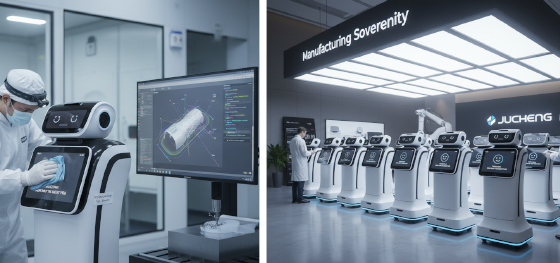
Establishing a premium brand identity demands the rejection of crude "hobbyist" fabrication methods. Amateurs often rely on heavily sanded 3D prints for investor demos, unaware that the porous surface and visible layer lines signal a lack of manufacturing maturity. Jucheng Precision eliminates this "Visual Doubt" by providing an integrated ecosystem of polyurethane vacuum casting and low-volume molding. Whether you are developing a 200-unit pilot run for a restaurant chain or a high-gloss interactive kiosk, our facility provides the material science and finishing rigor required for 2026 market entry. We don't just "mold plastic"; we engineer a specialized "Haptic Handshake" between your technology and its human users. This guide deconstructs the necessity of high-fidelity prototyping, the economics of rapid aluminum tooling, and why JUCHENG’s "Showroom Protocol" is the mandatory foundation for anyone developing service robots for global deployment.
Prototyping the Interaction: High-Fidelity Vacuum Casting for Investor Demos
Scaling with Economic Agility: Low Volume Injection Molding and Rapid Tooling
Cosmetic Sovereignty: High-Gloss Finishes, UV Coatings, and IMD
JUCHENG Protocol: Turning Digital Files into Showroom-Ready Products
Frequently Asked Questions: Service Robot Hardware
Prototyping the Interaction: High-Fidelity Vacuum Casting for Investor Demos
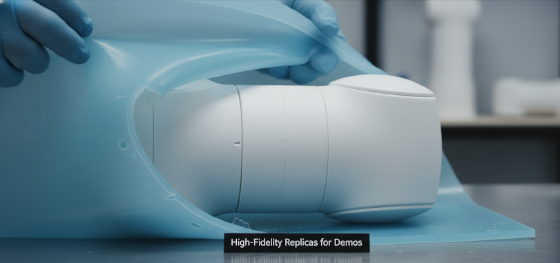
Tactile authority dictates the success of a project's funding round. For service robots, the exterior housings must possess the exact weight, color depth, and surface energy of an injection-molded product. Jucheng Precision utilizes advanced vacuum casting to produce batches of 10 to 50 units that are indistinguishable from production intent. By utilizing high-resolution CNC master patterns, our silicone molds capture every micron of VDI 3400 texture or SPI A-1 polish. We utilize in-mold pigmentation to match your specific Pantone or RAL branding, ensuring the color is integral to the part and won't chip during rough handling at trade shows. This technology allows your human-factors team to conduct valid UX audits, ensuring that buttons feel crisp and enclosures don't creak, long before you commit to the financial ransom of a mass-production steel mold. We turn "mockups" into "marketing assets," documented for high-stakes validation.
Scaling with Economic Agility: Low Volume Injection Molding and Rapid Tooling
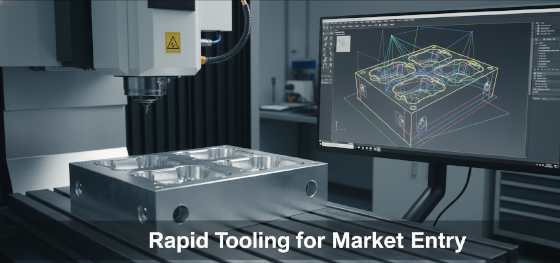
Economic velocity remains the primary driver of successful hardware scaling. The "Valley of Death" for service robots typically occurs between 200 and 2,000 units—too many for manual casting, but too few for $100,000 hardened steel molds. Jucheng Precision eliminates this "CapEx Barrier" by utilizing rapid aluminum tooling. Using high-strength 7075-T6 aluminum, we can cut a functional tool in just two weeks. This "Bridge Tooling" strategy allows you to launch your fleet profitably by slashing upfront tooling costs by 60% compared to traditional steel. Because aluminum has superior thermal conductivity, we achieve faster cooling cycles, which directly lowers your per-part price. We provide the manufacturing insurance needed to ensure your startup remains capital-efficient while delivering the real ABS or PC/ABS material properties your hardware demands for field survival.
Cosmetic Sovereignty: High-Gloss Finishes, UV Coatings, and IMD
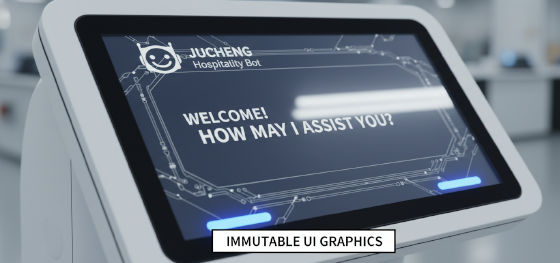
Visual depth determines the "Premium DNA" of hospitality robotics. Enclosures for service robots are large canvases where every dust particle or flow line is a microscopic failure. Jucheng Precision operates oversized Class 100,000 cleanroom paint booths, applying automotive-grade 2K coatings that provide extreme scratch resistance and chemical defense against hospital-grade disinfectants. For robots with integrated touchscreens or backlit control panels, we utilize In-Mold Decoration (IMD) to encapsulate high-definition graphics behind a clear resin layer. This ensures your icons and logos will never peel or fade through years of human contact. We turn "industrial plastic" into "Showroom Art," providing the visual authority needed to outpace slower, more "boxy" competitors who ignore the power of professional surface engineering.
JUCHENG Protocol: Turning Digital Files into Showroom-Ready Products
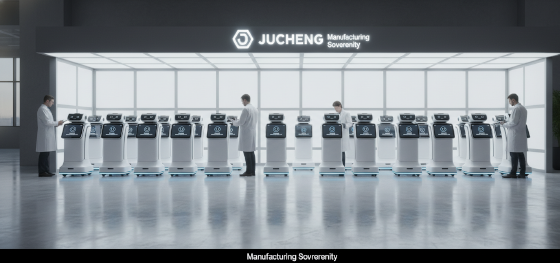
Manufacturing excellence at Jucheng Precision is built on the foundation of the "Single-Source" mandate. We eliminate the friction of supply chain fragmentation by housing 150+ CNC machines, specialized RIM units, and automated finishing lines under one ISO 13485 and IATF 16949 certified roof. We don't just "take orders"; we act as your manufacturing navigator. Our engineers perform comprehensive DFM audits on your service robots CAD files, suggesting wall-thickness optimizations to prevent sink marks and gate locations that minimize cosmetic weld-lines. Stop gambling your brand’s reputation on fragmented vendors who treat aesthetics as an afterthought. Leverage our decade of Low Volume Injection Molding mastery to validate rapidly, launch confidently, and scale profitably. Contact our technical team today for a free DFM review and see how we can turn your digital service intent into a retail-ready, physical reality.
Frequently Asked Questions: Service Robot Hardware
Question: What is the best material for high-gloss "Piano Black" service robot bezels?
Answer: We recommend specialized high-flow Polycarbonate (PC) or a PC/ABS blend. At Jucheng Precision, we use SPI A-1 diamond polished S136 stainless steel molds to achieve mirror finishes without the need for secondary paint.
Question: Can JUCHENG help with small batches of 200 service robots?
Answer: Absolutely. Our "Bridge Tooling" strategy is specifically designed for quantities between 100 and 2,000 units, providing injection-molded quality with 60% lower tooling investment.
Question: How do you ensure the large plastic panels of a service robot don't warp?
Answer: We utilize Reaction Injection Molding (RIM) for oversized panels. RIM uses low-pressure liquid chemistry, resulting in parts with virtually zero internal residual stress, which ensures they remain flat and stable across massive spans.
Question: Do you offer IMD (In-Mold Decoration) for touch screen panels?
Answer: Yes. We can encapsulate printed graphics and functional layers directly into your robot's UI panel during the molding cycle for a permanent, scratch-proof finish.

