


Molecular transformation within a steel cavity is an act of violent physical precision. For hardware engineers navigating the Injection molding process, the transition from a handful of raw polymer pellets to a high-fidelity diagnostic housing or an automotive bracket is often viewed as a "black box." In reality, this journey is a rhythmic, multi-stage thermodynamic event that requires micro-second synchronization between hydraulic force and thermal energy. Failing to understand the nuances of Plastic injection molding step by step is a strategic error that leads to inconsistent dimensions, weak structural spines, and catastrophic cosmetic defects. Jucheng Precision operates as a high-fidelity manufacturing sanctuary, providing the technical depth and all-electric machine precision needed to ensure your design scaling remains 100% predictable. We don't just "shoot parts"; we engineer a repeatable molecular event that ensures part number one is a perfect digital twin of part number ten thousand.
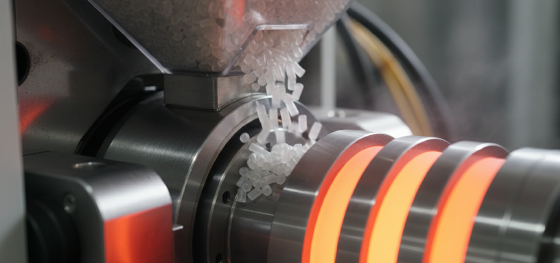
Establishing a high-yield production run requires moving beyond generic machine settings and entering the domain of "Scientific Control." Amateurs focus on the "Injection Button," while JUCHENG process engineers focus on the viscosity of the melt and the stability of the packing pressure. Every stage of the cycle—from the initial clamp lock-up to the final mechanical ejection—serves as a critical guardrail for your part’s integrity. Our facility, housing over 150 CNC machines and elite injection bays, is optimized for the agile middle-ground of manufacturing, where Low Volume Injection Molding demands prototype speed with mass-production rigor. This guide deconstructs the manufacturing cycle into five forensic stages, providing the data needed to secure your project's market entry.
Mechanical Fortress: The Physics of Clamping and Tonnage
Molecular Transition: Managing Melt Front Velocity
Density Sovereignty: The Science of Packing and Dwelling
Thermodynamic Exit: Optimizing the Cooling Bottleneck
Mechanical Release: Ensuring Damage-Free Part Ejection
Mechanical Fortress: The Physics of Clamping and Tonnage
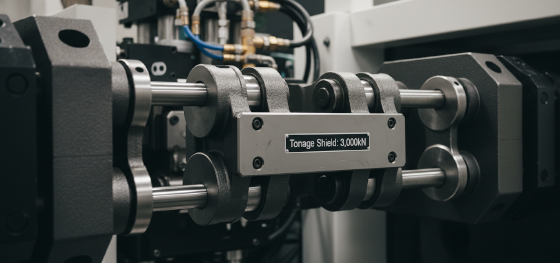
Manufacturing sovereignty begins with the refusal to allow the mold to "breathe." The first stage of Plastic injection molding step by step is the clamping phase, where the two halves of the steel tool are pressed together with enough force to resist the explosive pressure of the incoming plastic melt. This "Tonnage Shield" is calculated based on the projected surface area of your part. If a machine with insufficient clamping force is used, the 15,000 psi of plastic pressure will physically push the mold open by microns, resulting in Injection molding flash—ugly excess plastic that ruins tolerances and requires manual trimming. Jucheng Precision utilizes high-tonnage all-electric presses that provide sub-millimeter toggle control. We calculate the exact clamp force required for your specific Injection molding materials, ensuring the parting line remains hermetically sealed throughout the cycle. By managing the "Lock-up Physics," we eliminate the secondary labor costs of trimming and ensure your parts arrive retail-ready.
Molecular Transition: Managing Melt Front Velocity
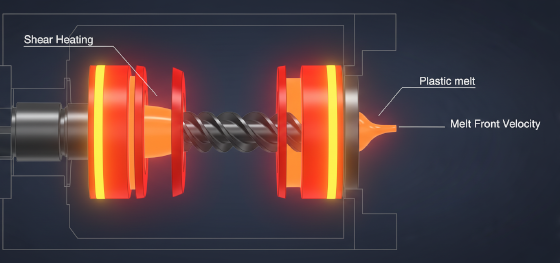
Fluid dynamics dictate the structural success of your enclosure's thin walls and ribs. Once the mold is locked, the reciprocating screw moves forward, acting as a high-pressure plunger to drive the molten polymer into the cavity. This is the "Injection Phase," and its success is measured by "Melt Front Velocity." At Jucheng Precision, we don't just "push" the material; we profile the speed. We slow the flow as it passes through the restrictive gate to prevent "Shear Burning," then accelerate to fill the main volume before the plastic "freezes off." This stage is where the "Molecular Grain" of your part is decided. If the velocity is too low, you encounter short shot injection molding failures where the part is incomplete. If too high, the polymer chains are physically torn, reducing the impact strength of your prototype injection molding batch. We utilize real-time sensor feedback to maintain a stable velocity, ensuring every rib and mounting boss achieves 100% density.
Density Sovereignty: The Science of Packing and Dwelling
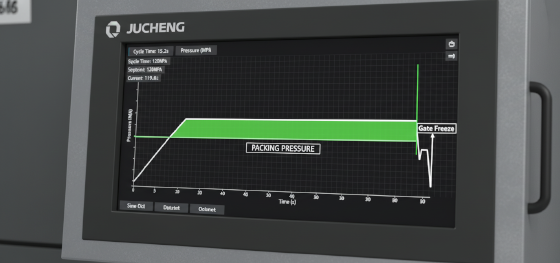
Consistency in a Plastic injection molding step by step run is actually won after the cavity is 95% full. This is the "Dwelling" or "Packing" phase, the most frequently misunderstood step in the cycle. Because plastic shrinks as it cools, the machine must continue to "pack" extra material into the mold to compensate for this volumetric loss. If the packing pressure is removed too early—before the gate has physically solidified—the pressurized plastic inside the cavity will flow *backwards* out of the mold, resulting in Injection molding warpage and massive sink marks. Jucheng Precision process engineers conduct "Gate Freeze Studies" for every new tool. We plot the part weight against hold-time to identify the exact second the "Molecular Door" closes. This data-driven approach ensures your parts possess the correct mass and flexural modulus, armoring your hardware against the dimensional drift that plagues amateur manufacturing operations.
Thermodynamic Exit: Optimizing the Cooling Bottleneck
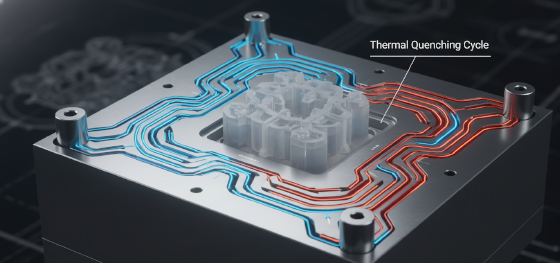
Operational profitability is governed by the speed of heat extraction. In nearly every injection cycle, "Cooling" represents seventy percent of the total duration. Because plastic is a thermal insulator, it stubbornly retains heat in thick sections. If you eject a part too early, it is still "rubbery" and will collapse under its own weight. If you wait too long, your part price skyrockets due to wasted machine time. Jucheng Precision toolmakers design "Thermodynamic Highways" within the mold steel—precision-drilled water lines that wrap around the part's geometry. For complex 3D shapes, we often utilize conformal cooling injection molding technology, using 3D-printed metal inserts to pull heat out of "hot spots" that traditional drilling can't reach. By synchronizing the cooling rate across the entire part, we neutralize internal residual stresses, ensuring your housings emerge flat, stable, and ready for high-precision assembly.
Mechanical Release: Ensuring Damage-Free Part Ejection
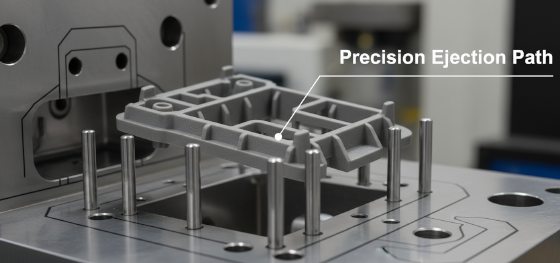
Geometric survival reaches its most vulnerable moment during the final stage: Ejection. The mold opens, and the "B-Side" ejection system—a network of polished steel pins—pushes the part out of the cavity. If the Injection molding design lacks proper draft angles or if the ejection force is unevenly distributed, the part will suffer from "Stress Whitening" or physical puncture. Jucheng Precision avoids this "Ejection Violence" by utilizing advanced DFM audits during the CAD phase. We ensure your part features a minimum of 1 to 2 degrees of taper on all sidewalls, allowing the component to "break free" of the steel the instant the pins move. We don't just "kick the part out"; we manage the mechanical release to protect your SPI finishes and VDI textures. This surgical care is what allows JUCHENG to deliver 50-unit short run injection molding batches with the same aesthetic authority as a million-part high-end consumer launch. Stop gambling with "trial and error" vendors. Leverage our decade of process mastery to ensure every step of your hardware's birth is documented for success. Contact our technical team today for a free DFM review.

