


Environmental volatility remains the ultimate judge of autonomous agricultural hardware. In the hyper-abusive landscape of modern farming, the transition from a laboratory demo to a 24/7 weeding or harvesting bot represents a violent leap in mechanical requirements. For hardware engineers in 2026, the primary adversary is not the AI vision algorithm—it is the corrosive reality of nitrogen fertilizers, the abrasive assault of mud, and the extreme UV radiation of the open field. If your protective covers shatter upon a rock strike or your chassis begins to rust after the first rain, your ROI evaporates. Navigating this requirement for "Indestructible" hardware requires the strategic deployment of precision agriculture robotics manufacturing. Jucheng Precision operates as a high-fidelity manufacturing sanctuary in the Shenzhen precision manufacturing hub, providing the technical depth to deliver oversized enclosures, rugged chassis, and sealed joints that possess the mechanical spine needed for the farm environment. Within the broader framework of Robotics Automation Manufacturing, we bridge the gap between "prototype mobility" and "agricultural sovereignty," ensuring your fleet scales with absolute material and dimensional certainty.
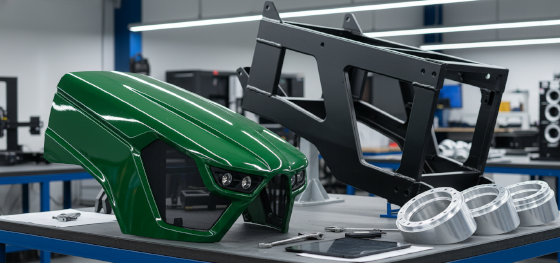
Establishing a resilient agricultural supply chain in 2026 demands the rejection of "general purpose" fabrication methods. Amateurs often treat a farming bot like an indoor delivery robot, unaware that the high-mass kinetic impacts common in harvesting require specialized polymers like DCPD. Jucheng Precision eliminates these "Field Failures" by providing an integrated multi-process ecosystem of large-format RIM, heavy-duty sheet metal, and precision CNC. Whether you are developing a specialized grape-harvesting arm or a high-capacity autonomous sprayer, our facility provides the material science and metrological rigor required for market entry. We turn "vulnerable logic" into "armored assets," delivering hardware that survives where standard polymers fail. This guide deconstructs the necessity of DCPD enclosures, the physics of weatherproof coatings, and why JUCHENG’s "Farm Protocol" is the mandatory foundation for anyone developing precision agriculture robotics projects for global deployment.
content:
Molecular Armor: Utilizing RIM and DCPD for Field Durability
Structural Foundations: Weatherproofing Chassis with Powder Coatings
Mechanical Isolation: CNC Machining for Dust and Mud Defense
Agile Scaling: Low-Volume Production for Niche Farming Bots
JUCHENG Protocol: Integrated Manufacturing for the Farm Environment
Frequently Asked Questions: Agriculture Robotics Hardware
Molecular Armor: Utilizing RIM and DCPD for Field Durability
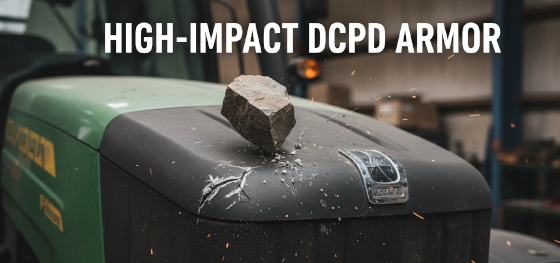
Mechanical survival on the farm is dictated by the energy absorption of the exterior shell. In precision agriculture robotics, oversized enclosures must protect expensive internal LiDAR and GPS units from tree branches and flying debris. Jucheng Precision utilizes Reaction Injection Molding (RIM) with Polydicyclopentadiene (DCPD) to create hoods and guards up to 2.5 meters in length. DCPD is the undisputed king of impact resistance, surviving sledgehammer blows and sub-zero temperatures that would shatter standard fiberglass or ABS. Because it possesses a low-viscosity liquid genesis, DCPD fills complex 3D molds at low pressure, allowing JUCHENG to utilize cost-effective aluminum tooling. This reduces your initial tooling CapEx by nearly 80% compared to high-pressure steel molds. We turn "brittle shells" into "impact-ready armor," ensuring your bot’s internal logic remains undisturbed by the violence of the field.
Structural Foundations: Weatherproofing Chassis with Powder Coatings
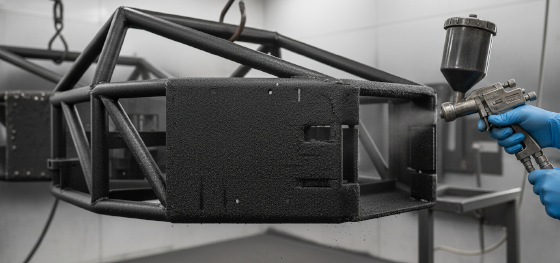
Structural integrity remains a hostage to chemical corrosion in the agricultural sector. The load-bearing chassis of a farming robot is constantly exposed to moisture and caustic fertilizers that eat through standard industrial paints in weeks. Jucheng Precision utilizes heavy-duty sheet metal fabrication—including laser-cut steel and CNC bending—to create skeletal frames with high torsional rigidity. To armor these frames, we implement a multi-stage finishing protocol. We utilize zinc-rich primers followed by outdoor-rated, UV-stable powder coatings that provide a 1,000-hour salt-spray resistance. This "Environmental Shield" ensures that your bot’s chassis remains structurally sovereign through years of rain and mud. We don't just "weld metal"; we engineer a corrosion-proof foundation that protects your long-term investment from the chemical hostility of modern farming.
Mechanical Isolation: CNC Machining for Dust and Mud Defense

Precision is a byproduct of isolation. The joints and motor housings of precision agriculture robotics must operate in a permanent state of "Atmospheric Defense." Microscopic dust particles and liquid mud are the primary predators of robotic actuators and gearboxes. Jucheng Precision utilizes 5-axis CNC machining to carve housing interfaces with +/- 0.01mm tolerances. We specialize in the creation of complex O-ring grooves and hermetic seals that keep internal electronics perfectly dry even when the robot is power-washed. By utilizing 316L stainless steel or hard-anodized 7075 aluminum for these critical movement centers, we ensure that your robot’s "muscles" remain free of abrasive contaminants. We turn "exposed joints" into "sealed mechanical vaults," ensuring your autonomous machines maintain their industrial repeatability across every acre of land.
Agile Scaling: Low-Volume Production for Niche Farming Bots
Manufacturing velocity dictates the survival of disruptive Ag-tech startups. Most precision agriculture robotics programs require batches of 200 to 1,000 units for regional pilot programs. Traditional high-volume factories ignore these niche quantities, forcing innovators into expensive "one-off" prototype cycles. Jucheng Precision eliminates this "Scaling Trap" by providing specialized Low Volume Injection Molding and bridge tooling. We can deliver your first 500 production-grade enclosures in just three weeks using rapid RIM tooling. This speed allows you to gather real-world field data and iterate your design before the next growing season begins. We turn "seasonal bottlenecks" into "agile market entries," ensuring your brand is the first to fulfill customer orders. We provide the manufacturing insurance needed to scale responsibly without the financial burden of massive over-production.
JUCHENG Protocol: Integrated Manufacturing for the Farm Environment

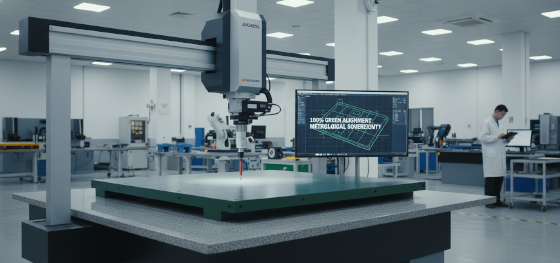
Engineering excellence at Jucheng Precision is built on the foundation of single-source accountability. We don't believe you should manage one vendor for your DCPD machine hoods and another for your precision-welded chassis. JUCHENG houses over 150 CNC machines and elite RIM bays under one ISO 9001 certified roof. We provide full material lot traceability and CMM inspection reports for every precision agriculture robotics batch, providing the "Paper Trail of Quality" required for industrial-tier contracts. Stop gambling your robot's field-life on uncertified vendors who don't understand the chemistry of corrosion. Leverage our decade of high-impact replication mastery to validate rapidly and scale profitably. Contact our technical team today for a free DFM review and see how we can turn your digital ag-tech intent into a structurally sovereign, weather-proof physical reality that is documented for success.
Frequently Asked Questions: Agriculture Robotics Hardware
Question: Why is DCPD better than standard plastic for agricultural hoods?
Answer: DCPD offers extreme impact resistance that actually increases in cold temperatures, and it is entirely immune to the corrosive salts and fertilizers that cause standard polymers to become brittle and crack.
Question: Can JUCHENG handle the manufacturing of large-format robotic chassis?
Answer: Yes. Our facility features oversized laser cutting and robotic welding bays specifically optimized for precision agriculture robotics frames up to 2.5 meters in length.
Question: Do you offer weatherproofing for electronic components inside the robot?
Answer: We provide pcb insert molding and low-pressure encapsulation services to hermetically seal delicate sensors and circuit boards, ensuring IP68+ protection against rain and spray.
Question: What is the lead time for a pilot run of 500 agricultural robots?
Answer: Utilizing our rapid RIM tooling and in-house CNC capabilities, we can deliver a full hardware set (enclosures + chassis + mounts) in as fast as 14 to 21 business days.

