


Staring at a $100,000 quote for a hardened steel mold can bring any prototype robot project to a grinding halt in [2026]. When your design features oversized panels or complex internal structures, the physics of traditional melt-flow become a financial liability. Many engineering teams default to high-pressure injection molding simply because they aren't aware of the alternatives. However, a deep dive into Reaction injection molding vs conventional molding reveals that for mid-scale production and giant enclosures, the reaction injection molding process is often the "hidden winner" for saving budget and accelerating field trials.
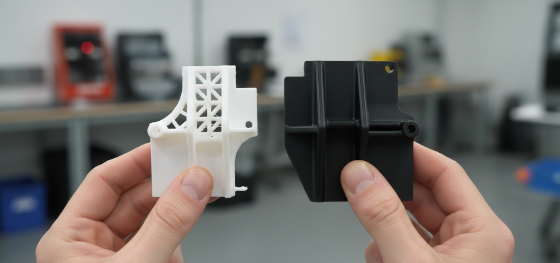
Conventional molding relies on heat and pressure to force molten pellets into a cavity, which creates massive internal stress in the final part. In contrast, Polyurethane Molding Services utilize liquid chemistry to "grow" a part inside the tool. This low-pressure approach is the secret to manufacturing 2-meter-long medical housings that are perfectly flat and ready for automotive-grade painting. Jucheng Precision addresses these manufacturing dilemmas by providing Custom Plastic Molding strategies that prioritize part quality over traditional process rigidness.
Operating within the Shenzhen precision manufacturing hub, JUCHENG acts as the technical bridge for global OEMs deciding between these two paths. We transform raw concepts into functional, production-ready hardware while helping you avoid the "Tooling Debt" that kills startups. This guide is a down-to-earth comparison of the physics, the costs, and the design freedom found in Reaction injection molding vs conventional molding to ensure your next fleet of autonomous machines is built on a smart financial foundation.
The Physics: Low-Viscosity Liquids vs. High-Heat Melts
Technical Data: Tooling Cost and Lead Time Showdown
Design Freedom: Why Variable Wall Thickness Wins in RIM
Energy Check: Cold Curing vs. High-Heat Melting
JUCHENG Hub: Helping You Choose the Right Path in Shenzhen
FAQ: Real Answers for Sourcing Managers and Engineers
The Physics: Low-Viscosity Liquids vs. High-Heat Melts

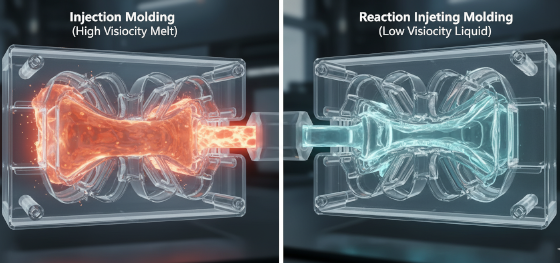
The biggest difference in Reaction injection molding vs conventional molding is how the material enters the mold. Traditional molding uses a "melt and push" strategy. Plastic pellets are heated to 250°C+ and forced through a nozzle at pressures up to 20,000 psi. This creates a "fountain flow" that can trap air and create internal stress. RIM, however, uses two room-temperature liquids that mix and react. These liquids have the viscosity of water, allowing them to flow into complex, tiny ribs and deep pockets with virtually zero resistance. This is why RIM parts can be so much larger than traditional molded parts without needing a machine the size of a building.
Is the material strength the same?
Actually, RIM parts often have better impact resistance because the chemical cross-linking happens throughout the entire part simultaneously, creating an isotropic structure with no weak weld lines.
Internal stress management is another physical win for RIM. When molten plastic cools in a traditional mold, it shrinks unevenly, causing the part to "pull" and warp. Because RIM happens at low temperatures and low pressures, the material is relaxed as it cures. This ensures that the 1.5-meter door panel for your medical cart stays perfectly straight, which is almost impossible to achieve in high-pressure molding without massive, expensive cooling systems. JUCHENG utilizes this "Relaxed Physics" to deliver parts that assemble perfectly the first time, every time.
Material purity is the final physical advantage. High-pressure molding can occasionally degrade the polymer chains if the heat or shear is too high. RIM is a gentle chemical process. By precisely controlling the temperature of the liquid streams in our Shenzhen hub, JUCHENG ensures the molecular weight of the polyurethane is perfectly optimized. This results in enclosures that don't just look like ABS or PP but actually outperform them in extreme field conditions, whether they are being hit by rocks on a farm or wiped with bleach in a hospital.
Technical Data: Tooling Cost and Lead Time Showdown
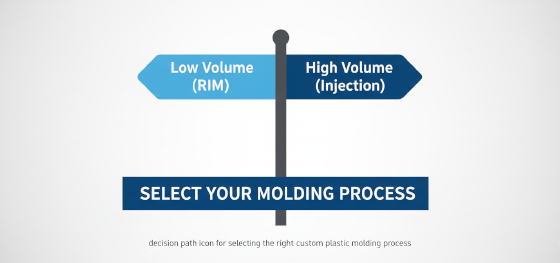
For most hardware developers, the choice between Reaction injection molding vs conventional molding comes down to the bottom line. If you only need 500 units a year, spending $50,000 on a steel tool is a "budget killer." Jucheng Precision provides transparent DFM reviews to help you find the financial break-even point. The following table compares the essential economic variables for a 1-meter robotic enclosure across these two different paths.
| Economic Variable | RIM (Polyurethane) | Conventional Injection | Decision Logic |
|---|---|---|---|
| Initial Tooling Cost | $2,500 - $8,000 | $30,000 - $120,000+ | RIM is 80% cheaper for R&D |
| Tooling Lead Time | 2 - 3 Weeks | 8 - 12 Weeks | RIM is 3x faster to market |
| Unit Piece Price | Higher ($$$) | Lower ($) | High volume favors injection |
| Break-even Point | 100 - 3,000 units | 5,000+ units | The "Bridge to Production" zone |
The "Aluminum Advantage" is the primary reason for these cost savings. Because RIM uses low pressure, JUCHENG can machine the molds from high-grade aluminum rather than hardened tool steel. Aluminum is significantly faster to CNC machine and much easier to modify if your sensor layout changes between Beta trials. By choosing Polyurethane Molding Services for your first 1,000 units, you preserve your capital for actual R&D, moving from a CAD file to a fleet of field-ready machines in weeks rather than months.
Design Freedom: Why Variable Wall Thickness Wins in RIM
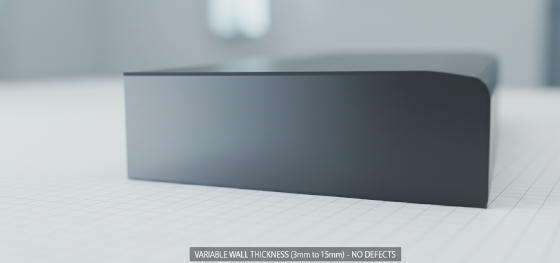
Traditional molding has a "Golden Rule": the wall thickness must be uniform. If you have a part that transitions from 2mm to 6mm, you will get "sink marks"—ugly dimples on the surface where the plastic cooled at different rates. In Reaction injection molding vs conventional molding, this rule is broken. RIM can handle massive changes in wall thickness without any surface defects. JUCHENG can mold a structural base that is 20mm thick in one area and 3mm thick in another, creating a part that has integrated reinforcement ribs and mounting blocks without the "hollowed-out" look of traditional plastic parts.
Can I integrate metal inserts into these thick walls?
Absolutely. RIM is the king of encapsulation. We can mold large steel mounting plates or threaded bushings directly into the part for 100% rigid connections.
Structural foam is another design "Superpower" exclusive to the RIM process. By adding a blowing agent to the mixture, JUCHENG creates parts with a high-density solid exterior skin and a lightweight cellular core. This "Sandwich Structure" provides incredible bending stiffness (rigidity) without adding mass. It’s essentially bionic engineering. For large-scale industrial robot parts that must be stiff enough to support heavy LiDAR units but light enough to move quickly, this variable-density design is a massive performance booster.
Complexity is more affordable in RIM because side-actions and slides are cheaper to build in aluminum molds. If your robot shell needs undercuts for cable exits or complex locking tabs, JUCHENG’s mold makers can integrate these features with +/- 0.05mm precision. In traditional steel molding, every "moving part" in the mold adds $5,000 to $10,000 to the bill. In our Shenzhen hub, we prioritize "Function over Cost," allowing you to keep the complex features that make your robot unique without paying a "complexity tax."
Energy Check: Cold Curing vs. High-Heat Melting
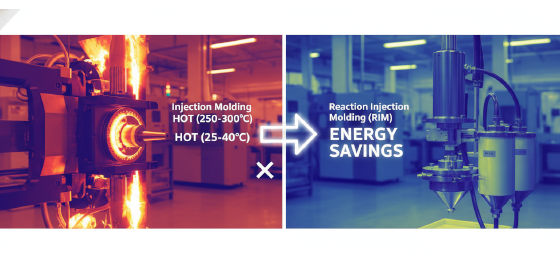
Sustainability is becoming a core requirement for [2026] hardware. In the battle of Reaction injection molding vs conventional molding, RIM is the clear winner for energy efficiency. Conventional molding machines must keep massive barrels of plastic at 300°C 24 hours a day, which consumes a huge amount of electricity. RIM uses "cold-curing" chemistry. The A and B components are stored at room temperature, and the only heat required is the moderate 50°C needed to keep the aluminum mold warm. This 90% reduction in thermal energy not only lowers the carbon footprint but also reduces the "thermal wear" on the mold itself.
Does energy savings mean cheaper parts?
Yes. Lower energy overhead allows JUCHENG to offer more competitive piece prices for low-volume runs, even with more expensive medical-grade resins.
VOC (Volatile Organic Compound) management is the secondary environmental factor. Old-school RIM shops used solvent-based mold releases that were terrible for the atmosphere. JUCHENG utilizes modern, water-based and wax-based release agents in our Shenzhen precision manufacturing hub. We ensure that our Polyurethane Molding Services meet the latest global environmental standards, including REACH and RoHS. This means your parts aren't just "clinically clean" for medical use, they are produced in a way that aligns with your company's ESG (Environmental, Social, and Governance) goals.
Recyclability of the tool is the final "Green" win. When a traditional steel mold reaches its end-of-life, it is heavy and difficult to process. Aluminum molds are 100% recyclable and have high scrap value. Furthermore, JUCHENG’s "Agile Tooling" approach means we can often re-machine an old aluminum mold for a new design, reducing the total material consumption of your R&D cycle. By delivering sustainable hardware solutions, we help our clients build a "Future-Proof" brand that appeals to the increasingly conscious [2026] consumer and industrial market.
JUCHENG Hub: Helping You Choose the Right Path in Shenzhen

Dominating the hardware market requires a partner that doesn't just sell one process, but understands them all. Jucheng Precision operates with a 24/7 manufacturing mindset in our Shenzhen precision manufacturing hub, delivering both high-pressure Custom Plastic Molding and low-pressure RIM solutions. We provide a "Bridge to Production" that allows you to start with the lowest possible risk and scale as your orders grow. We don't just supply parts; we supply the manufacturing intelligence needed to stay ahead of the competition.
Integrating your design with JUCHENG’s expertise ensures that your Reaction injection molding vs conventional molding decision is based on data, not guesswork. We offer comprehensive DFM reviews within 24 hours, identifying potential warpage risks in injection molding or "gate-scars" in RIM before they become field failures. Whether you are building a fleet of warehouse AMRs or a desktop blood-analyzer, Jucheng Precision provides the rigid, precise, and *cost-optimized* foundations that keep your innovation moving through the high-stakes cycles and the years of hard labor.
Our facility is equipped with 150+ CNC machines and dedicated molding cells for both thermosets and thermoplastics, allowing us to manage your entire product family in one location. We manage the complexity of process selection so your engineering team can focus on the AI and the user experience. By combining Shenzhen's speed with industrial-grade material verification and global quality standards, JUCHENG remains the preferred partner for the world's most aggressive hardware challenges. Contact us today to start your next project.
FAQ: Real Answers for Sourcing Managers and Engineers
Is the surface finish of RIM as good as injection molding?
Yes. RIM parts are the gold standard for painting and can even replicate VDI 3400 textures perfectly without the internal stress that ruins high-gloss finishes.
What is the maximum part size for RIM vs injection?
RIM can easily handle parts over 2.5 meters. Injection molding is usually limited to about 1 meter before the tool cost becomes astronomical.
Can I change my design after the mold is made?
It is much easier in RIM. Since we use aluminum molds, we can often weld and re-machine features in 48 hours.
Does JUCHENG handle both processes in-house?
Yes. We provide a single point of accountability for all your custom plastic molding and assembly needs.
Which process is faster for 50 pieces?
RIM. Aluminum tooling takes about 2 weeks, while steel injection tooling can take 2 to 3 months.
Tooling delays and high upfront costs are absolute innovation killers for 2026 hardware. Partnering with Jucheng Precision ensures that your functional iterations are built with the cost-effective reaction injection molding process and the specialized knowledge of Reaction injection molding vs conventional molding the industry demands. Reach out to our Shenzhen manufacturing hub today for a complete DFM review and build the high-fidelity foundation your autonomous fleet requires.

