


Watching a traditional injection molding machine is watching an act of brute force. Molds slam shut. Hot plastic is forced in under incredible pressure. It is loud. It is powerful.
Then you watch a reaction injection molding (RIM) machine. It is quiet. The material flows in gently. A few minutes later, a huge, perfect part emerges. How does this quiet giant work?
The secret is not force. It is chemistry. The reaction injection molding process is a fascinating journey from liquid to solid, and it all happens inside the mold. Let's pull back the curtain.
content:
Starting with Perfect Ingredients
A Controlled, High-Speed Collision
Filling the Mold Without Force
Letting the Chemistry Take Over
Revealing the Finished Part
Starting with Perfect Ingredients
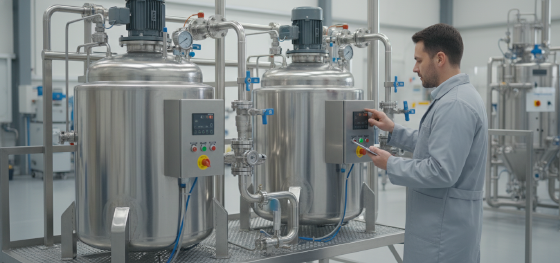
The process begins not at the mold, but in large, temperature-controlled tanks. This is where the two liquid components, usually a polyol and an isocyanate, are held.
Think of this as the "mise en place" in a gourmet kitchen. Every ingredient must be perfect before you start cooking.
The temperature of these liquids must be controlled to within a degree. This keeps their viscosity, or thickness, perfectly consistent. They are also gently stirred or recirculated to ensure there are no variations. This obsession with initial conditions is the secret to a repeatable, high-quality process.
A Controlled, High-Speed Collision
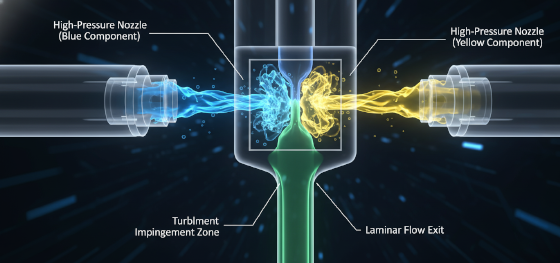
The two liquids remain separate until the moment of action. The heart of the RIM machine is a small, brilliantly engineered device called a mixing head.
Inside this head, a marvel of fluid dynamics occurs. High-pressure pumps fire the two liquids at each other through tiny nozzles at speeds over 300 miles per hour.
This is called "impingement mixing." The intense, turbulent collision forces the two liquids to mix at a molecular level in a fraction of a second. It is a violent, microscopic event that is essential for triggering a fast and uniform chemical reaction.
After this tiny explosion of mixing, the now-blended liquid exits the head as a calm, single stream.
Filling the Mold Without Force
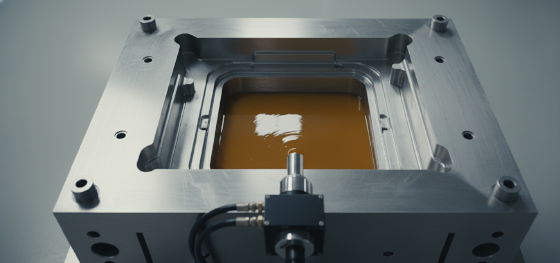
Here is where the process feels counterintuitive. After the high-pressure mixing, the liquid flows into the mold at a very low pressure. It is a gentle process.
The liquid is injected at the bottom of the mold. It fills the cavity smoothly from the bottom up. This "laminar flow" pushes the air out ahead of it, preventing bubbles from being trapped.
This is completely different from the violent, high-speed injection of traditional molding. This gentle approach is why RIM can use less-expensive aluminum molds even for huge parts. The mold does not need to be a fortress of steel to withstand the pressure.
Letting the Chemistry Take Over
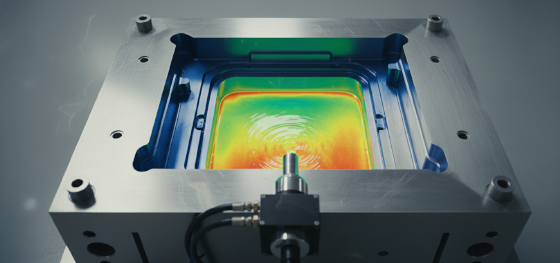
Once the mold is full, the machines step back. The real work is now done by chemistry.
The perfectly mixed liquids trigger an "exothermic" chemical reaction. This means the reaction generates its own heat. The temperature inside the closed mold begins to rise.
This heat is the engine of curing. It causes the molecules to link together, forming long, strong polymer chains. The liquid transforms into a solid. The mold is often heated as well, to provide a stable environment for this reaction to happen evenly.
This silent, internal storm of chemical activity is what creates a strong, stable, and stress-free part.
Revealing the Finished Part
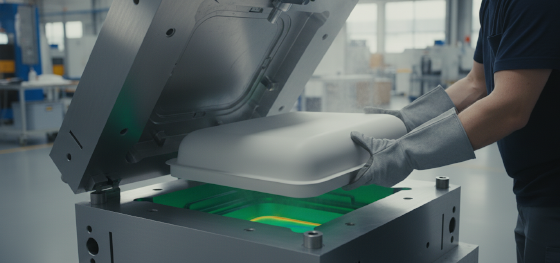
After only a few minutes, the reaction is complete. The mold opens. A finished, solid part is ready to be removed.
What emerges is often a huge, lightweight, and dimensionally perfect component. For a medical device, it is a large enclosure with a flawless, cosmetic surface, ready for the next step.
Understanding the reaction injection molding process is about appreciating its intelligence. It is a process of precise chemistry, not just brute force. This is how it creates such impressive parts with surprising speed and efficiency.
```

