


Staring at a six-figure quote for a hardened steel mold can derail even the most promising prototype robot or medical hardware launch. In the competitive landscape of 2026, engineers must navigate the physical and financial divide between melting solid plastic and reacting liquid chemistry. While traditional high-pressure molding has been the industry workhorse for decades, it often hits a wall when parts exceed one meter in length or require variable wall thicknesses. Understanding the nuances of reaction injection molding vs thermoplastic injection is the essential strategy for developers who need to balance large-format rigidity with rapid iterative speed. The choice between a thermoset and a thermoplastic determines not just your unit price, but the long-term dimensional stability of your machine.
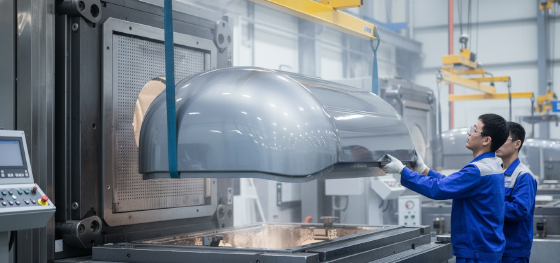
Mechanical performance at scale is where the "Physics of Flow" becomes a financial liability. High-pressure systems require massive clamping forces to contain molten plastic, driving tooling costs into the hundreds of thousands for oversized enclosures. Jucheng Precision addresses these critical economic hurdles by providing high-tier Polyurethane Molding Services that prioritize low-pressure liquid dynamics. By utilizing polyurethane reaction injection molding, we help our clients bypass the "Tooling Debt" associated with traditional Custom Plastic Molding, delivering production-grade shells for diagnostic consoles and autonomous chassis in a fraction of the time.
Operating within the Shenzhen precision manufacturing hub, JUCHENG acts as the technical bridge for global OEMs transitioning from Alpha concepts to commercial fleets. We leverage our fleet of 150+ CNC machines, including 25 5-axis Haas/Mazak units, to create the precise aluminum tooling that enables the RIM process. This guide explores the essential molecular differences, pressure dynamics, and scaling realities required for mastering reaction injection molding vs thermoplastic injection to ensure your innovation reaches the market on a lean budget without sacrificing structural integrity.
Molecular Physics: Cross-Linking vs. Melting Logic
Technical Data: Comparing Tooling Costs and Clamping Forces
Pressure Dynamics: Low Pressure vs. High Pressure Flow
Part Integrity: Why RIM Parts Don't Melt or Sag in Heat?
JUCHENG Hub: The Shenzhen Engine for Large-Scale Hardware
FAQ: Logistics and Capability for Process Selection
Molecular Physics: Cross-Linking vs. Melting Logic
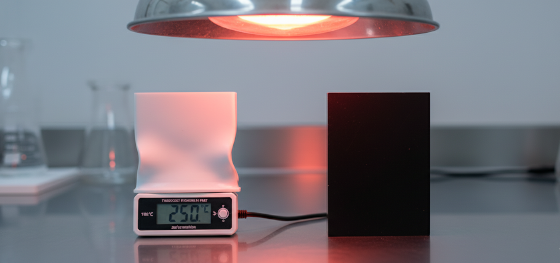
The fundamental difference in reaction injection molding vs thermoplastic injection is found in the way the polymer chains are organized. Thermoplastic injection molding is a thermal cycle: solid pellets are melted, pushed into a cold mold, and frozen back into a solid. This process is reversible; if you heat an ABS part, it will melt. In contrast, the RIM process utilizes cross-linking vs melting logic. Two liquid components, an isocyanate and a polyol, react chemically to form a three-dimensional molecular lattice. Once this thermoset bond is created, it cannot be reversed. This permanent chemical handshake results in parts that possess significantly higher heat resistance and structural stiffness than their thermoplastic counterparts.
Do thermoset parts sag in the sun?
No. Because of the permanent molecular cross-linking, RIM parts maintain their dimensional stability even when surface temperatures exceed the glass transition point of standard ABS or PP.
This molecular rigidity is the primary reason why RIM is the gold standard for large-scale medical diagnostic housings. In the hospital environment, equipment is often subjected to localized heat from internal AI processors and external sterilization lamps. A thermoplastic shell can develop "Thermal Creep," leading to misaligned panels and leaking seals. JUCHENG utilizes high-fidelity polyurethane resins to ensure that your 1.5-meter long console remains perfectly flat and dimensionally constant for its entire 10-year service life, providing the reliable enclosure your sensitive optics and electronics demand.
Operating under ISO 14001 standards, JUCHENG ensures that our thermoset production is optimized for minimal environmental impact. While thermoplastics can be ground up and re-melted, the high energy cost of maintaining a 300°C melt-barrel often negates the recycling benefit. Our RIM process operates at near room temperature, consuming 80% less thermal energy per shot. By delivering "Green Hardware" solutions, we help our global partners meet their sustainability goals while receiving parts that possess the impact toughness and chemical resistance that traditional melting processes simply cannot achieve.
Technical Data: Comparing Tooling Costs and Clamping Forces

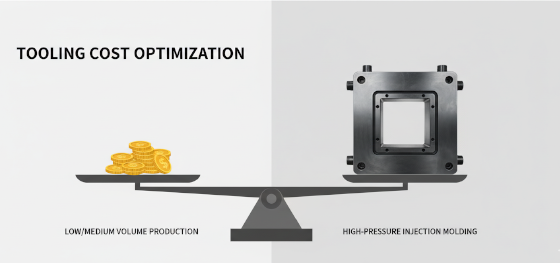
Success in hardware R&D depends on matching the process to your production volume. If your Beta trial requires 500 units, spending $80,000 on steel tooling is a strategic mistake. Jucheng Precision provides technical consultations to help you find the financial break-even point for your project. The following table compares the essential operational and financial variables of reaction injection molding vs thermoplastic injection for a large robotic fender component.
| Variable | RIM (Polyurethane) | Thermoplastic Injection | Budget Impact |
|---|---|---|---|
| Clamping Pressure | 50 - 150 Tons | 1,500 - 3,500 Tons | Enables Oversized Shells |
| Tooling Material | Aluminum 7075 | Hardened P20 Steel | 75% Lower NRE Costs |
| Mold Lead Time | 2 - 3 Weeks | 8 - 12 Weeks | Accelerated Time-to-Market |
| Internal Stress | Zero (Relaxed Cure) | High (Melt Shrinkage) | Zero-Warp Guarantee |
This data illustrates why RIM is the primary "Bridge to Production" for MedTech and AgTech startups. By utilizing aluminum tooling, JUCHENG can deliver T1 samples of a massive diagnostic enclosure in as fast as 15 days. If a field trial reveals a design flaw, modifying an aluminum RIM mold is three times faster and cheaper than modifying a hardened steel injection tool. This flexibility allows your team to iterate on the physical hardware with the same agility as your software team, ensuring a zero-defect launch in the current competitive market.
Pressure Dynamics: Low Pressure vs. High Pressure Flow
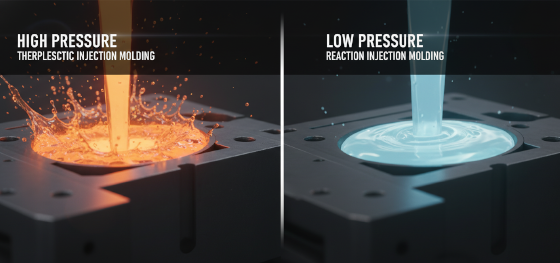
Geometric stability in large-format parts is often ruined by the very pressure used to manufacture them. In the comparison of reaction injection molding vs thermoplastic injection, the difference in internal cavity pressure is monumental. Injection molding forces thick, viscous melt into a mold at pressures exceeding 15,000 psi. This "Hydraulic Hammer" effect stretches the polymer chains and traps air, leading to internal stresses that eventually cause warpage. RIM utilizes low pressure vs high pressure logic, where liquid components enter the mold at less than 100 psi, flowing smoothly into deep ribs and thin-walled sections without internal friction.
How does low pressure improve large shells?
It enables laminar flow, preventing the turbulent "knit lines" that cause structural weak spots in oversized thermoplastic components.
Laminar flow is the secret to achieving the "Perfect Surface" for high-gloss automotive painting. Because the liquid moves slowly and steadily, it displaces the air within the mold perfectly. JUCHENG utilizes specialized "Tilt-Fill" machines that use gravity to guide the liquid polymer, ensuring that 2-meter tall panels for a surgical robot are 100% dense with zero surface pinholes. This eliminates the need for labor-intensive hand-filling and sanding that plagues standard Custom Plastic Molding, directly reducing your R&D budget and improving the perceived value of your machine during trade show demos.
Weight management is also enhanced by the low-pressure RIM cycle. We can incorporate "Structural Foam" cores—where the part has a dense solid skin and a micro-porous center. This sandwich structure provides incredible bending stiffness at 40% less weight than a solid thermoplastic part. This technique is a core competency at our Shenzhen hub, allowing us to build industrial robot parts that are rigid enough to stand up to heavy vibrations but light enough for battery-powered autonomous vehicles to move efficiently over uneven soil.
Part Integrity: Why RIM Parts Don't Melt or Sag in Heat?
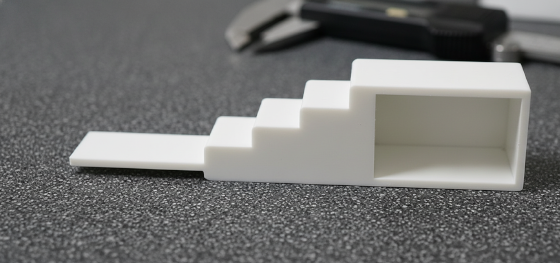
Reliability in the field is dictated by the material's reaction to environmental stress. In the context of reaction injection molding vs thermoplastic injection, the thermal resilience of thermoset polyurethane is a primary advantage. Thermoplastics like ABS or PP begin to soften at relatively low temperatures (70-90°C), making them prone to sagging under their own weight in solar-heavy outdoor applications. JUCHENG’s RIM parts do not have a melting point; they undergo pyrolysis (charring) only at extreme temperatures, meaning they maintain their mechanical integrity in the hot sun or near industrial furnaces.
What is the maximum service temperature for RIM?
We formulate specialized high-heat RIM systems that can withstand continuous exposure to 120°C without dimensional drift, ideal for under-the-hood automotive hardware.
Chemical resistance is another byproduct of the cross-linked matrix. Standard injection-molded parts possess "Environmental Stress Cracking" (ESC) risks, where localized stresses react with cleaning agents like alcohol or bleach to create deep cracks. Because JUCHENG’s RIM parts are cured in a "Relaxed State" at low pressure, they possess zero residual stress. Combined with the naturally inert chemistry of polyurethane, this ensures your medical device enclosures survive thousands of clinical disinfection cycles without surface degradation, a mandatory requirement for ISO 13485 compliance.
The "Thud Factor" of a RIM shell conveys a sense of high-end quality that thin-walled thermoplastics cannot match. When a user taps the enclosure of an MRI scanner, the high-density RIM material provides a solid, acoustically dampened sound. This is essential for machines operating in quiet clinical environments where the rattle of thin plastic can induce patient anxiety. JUCHENG’s medical device prototyping team helps you optimize wall thicknesses to achieve this premium feel, ensuring your hardware doesn't just work like an OEM machine, but feels like one too.
JUCHENG Hub: The Shenzhen Engine for Large-Scale Hardware
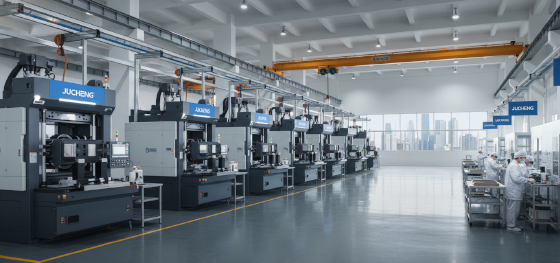
Dominating the hardware market requires a partner that can scale from a single functional prototype to a commercial deployment of 5,000 units without losing a micron of accuracy. Jucheng Precision operates with a 24/7 manufacturing mindset in our Shenzhen precision manufacturing hub, delivering high-tolerance RIM components and structural industrial robot parts with lead times as fast as 15 business days. we provide a "Bridge to Production" that ensures your innovations move from concept to pilot run with 100% metallurgical and chemical confidence.
Integrating your structural design with JUCHENG’s expertise ensures that your reaction injection molding vs thermoplastic injection decision is based on performance data, not guesswork. we offer a free DFM analysis in 24 hours, identifying potential thermal-expansion risks or machining bottlenecks in your design before they become field failures. Whether you are building an autonomous vineyard scout or a multi-part surgical robot, Jucheng Precision provides the rigid, precise, and chemically optimized foundations that keep your innovation moving through the high-stakes cycles and the years of hard labor.
Our facility is equipped with oversized hydraulic presses and dedicated quality labs, allowing us to manage the entire hardware lifecycle in one location. we manage the complexity of multi-material bonding and automotive-grade painting so your engineering team can focus on the motion control and the AI. By combining Shenzhen's speed with industrial-grade material verification and global quality standards, JUCHENG remains the preferred partner for the world's most aggressive hardware challenges. Contact us today to start your next project.
FAQ: Logistics and Capability for Process Selection
Is RIM tooling really 70% cheaper than injection molding?
Yes. By utilizing high-strength 7075 aluminum and low-pressure machines, we eliminate the need for heavy steel molds and massive clamping presses.
What is the minimum quantity for a RIM order?
We have No MOQ, allowing you to source 1 to 50 units for Alpha and Beta testing without the crushing cost of mass-production tools.
Can RIM parts be painted to match automotive standards?
Absolutely. RIM is the preferred material for painting due to its high surface energy and unyielding flatness.
How do you ensure parts are environmentally friendly?
Our ISO 14001 certification guarantees a clean manufacturing process with high energy efficiency and standardized material waste management.
What is the maximum part size JUCHENG can mold?
We regularly produce structural panels and fenders up to 2.5 meters in length using our oversized RIM equipment.
Tooling debt and thermal warping are absolute innovation killers for large-scale robotics. Partnering with Jucheng Precision ensures that your functional iterations are built with the cost-effective polyurethane reaction injection molding and specialized reaction injection molding vs thermoplastic injection knowledge the industry demands. Reach out to our Shenzhen manufacturing hub today for a complete DFM review and build the unyielding foundation your autonomous fleet requires.

