


Is your manufacturing process limiting your design? Or is it liberating it? This is one of the most important questions a product designer can ask.
For too long, great ideas have been constrained by the harsh realities of traditional manufacturing. A beautiful, flowing curve is straightened because it is too hard to machine. A large, seamless panel is broken into smaller pieces because the mold is too expensive.
But what if there was a process that said "yes" more often than it said "no"? A process that embraces complexity. A process that loves large parts. This is the world of rim reaction injection molding. It is a technology of design freedom.
content:
Escaping Traditional Manufacturing Rules
Permission to Go Big
Embracing Complex, Organic Shapes
Breaking Free from High Tooling Costs
Designing with a Liberated Mindset
Escaping Traditional Manufacturing Rules
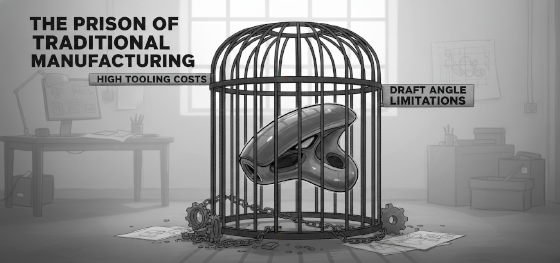
Traditional manufacturing processes, like injection molding or CNC machining, are amazing. But they have rules. Strict rules.
Injection molding requires draft angles. It struggles with very thick walls. And most importantly, the steel molds are incredibly expensive, especially for large parts. This high tooling cost puts a huge financial prison around a designer's creativity.
CNC machining is more flexible. But it is a slow, subtractive process. Making a very large part can take a huge amount of time and waste a lot of material. It is not cost-effective for more than a few pieces.
These constraints force designers to compromise. They simplify. They scale down. They break their beautiful, seamless vision into smaller, less elegant parts.
Permission to Go Big

RIM molding gives you permission to design big. The process is uniquely suited for making huge plastic parts.
Because the process is low-pressure, the clamping forces required to hold the mold together are much lower. This means you can have very large molds on relatively small machines. It is not uncommon to see RIM parts that are the size of a car door or a large table.
This liberates designers. They can think on a grander scale. They can design a huge, single-piece enclosure for a medical MRI machine. They can create a full-body panel for a tractor. They are no longer forced to break their design into a clumsy assembly of smaller panels.
Embracing Complex, Organic Shapes
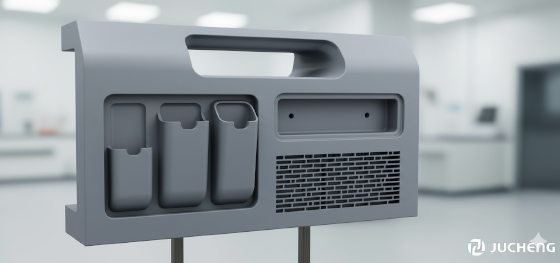
This process also allows you to embrace complexity. The liquid nature of the RIM materials can do amazing things.
The low-viscosity liquid flows easily into every tiny detail of a mold. This means you can mold in complex features that would be very difficult with other processes.
You can create parts with dramatic variations in wall thickness. A part can have a thin 3mm wall in one area, and a thick, solid 25mm boss in another. This is very difficult in traditional injection molding.
You can also encapsulate other components. This is called overmolding. You can place a metal frame or an electronic insert into the mold, and the liquid polyurethane will flow around it, creating a single, integrated part.
This allows a designer to consolidate many small parts into one single, elegant molding.
Breaking Free from High Tooling Costs
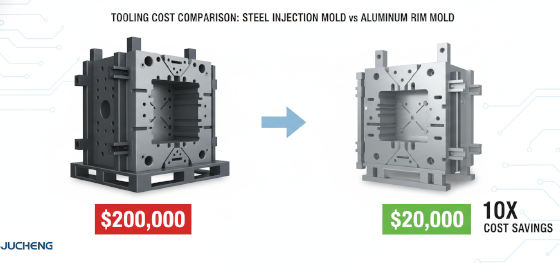
This is the freedom that enables all the others. Breaking free from astronomical tooling costs.
As we have discussed, the low-pressure nature of the reaction injection molding process means you do not need expensive steel molds. Molds can be made from aluminum.
Aluminum is much cheaper than steel. And it is much faster to machine. This means the cost of a RIM tool can be 10 times lower than the cost of a steel injection mold for the same part. The lead time for the tool can be weeks, not months.
This completely changes the economics of product development. It makes it financially viable to create mid-volume production runs (from a few hundred to a few thousand parts) of very large and complex designs. It opens up possibilities that were simply not affordable before.
Designing with a Liberated Mindset
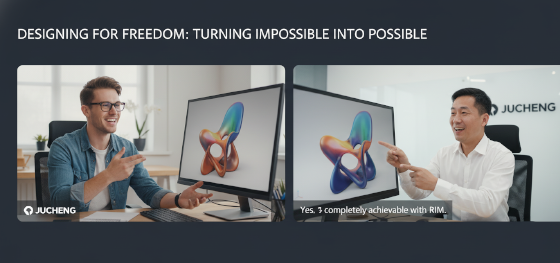
To use this freedom, you need a partner who understands it. A partner who, when they see your ambitious, large, and complex design, does not say "That's impossible." They say, "That's a perfect job for RIM."
At JUCHENG, our engineers are experts in this technology. We can look at your design and provide DFM feedback that is not about limiting your creativity, but about enabling it.
We can help you optimize your part for the RIM process. We can show you how to add features and complexity without adding significant cost.
Rim reaction injection molding is more than just a manufacturing process. It is a tool that empowers designers to think bigger, to be bolder, and to create the products they have always imagined.

