


Your new product is big. A full-size automotive bumper. A large medical device enclosure. An equipment panel that is a meter wide.
You face a difficult choice. Traditional injection molding for a part this size requires a steel tool that costs a fortune and takes months to build. 3D printing is too slow, too expensive at volume, and the surface finish is not good enough for a final product.

This is a classic manufacturing trap. The gap between a one-off prototype and affordable mass production. But there is a powerful technology designed specifically to fill this gap. It is time you learned about reaction injection molding.
content:
The Core Magic: Low-Pressure Chemistry
When 'Size' is the Problem (RIM vs. Injection Molding)
When 'Finish & Speed' are the Problem (RIM vs. 3D Printing)
The Material Palette: The Power of Polyurethane
A Strategic Choice for Your Project
The Core Magic: Low-Pressure Chemistry

To understand the power of rim reaction injection molding, you first need to understand that it is fundamentally different from traditional molding.
Traditional molding involves melting solid plastic pellets and injecting them into a mold under extreme pressure and heat. The reaction injection molding process is different. It starts with two separate liquids, a polyol and an isocyanate.
These two liquids are stored in separate temperature-controlled tanks. When it is time to make a part, they are pumped at a high pressure into a small mixing head. Here, they are intimately mixed together.
The magic is what happens next. The mixed liquid flows gently, at a very low pressure, into the mold cavity. As the two components mix, they trigger an exothermic chemical reaction. This reaction causes the material to expand, cure, and solidify directly in the mold, forming a solid part.
It is this low-pressure, in-mold chemical reaction that gives RIM all of its unique advantages.
When 'Size' is the Problem (RIM vs. Injection Molding)
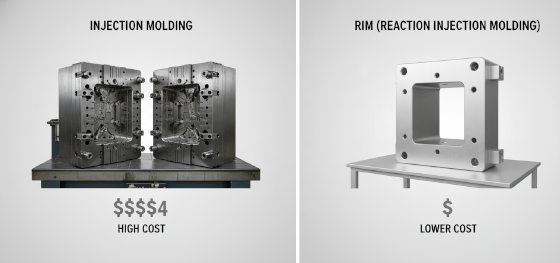
The biggest advantage of low pressure is that you do not need an incredibly strong and expensive mold.
Traditional injection molding requires pressures of 10,000 psi or more. To withstand this force, the mold must be made from hardened steel. For a large part, a steel mold can cost $100,000 or more and take months to build. This makes it impossible for low to mid-volume projects.
RIM operates at pressures of only 100 to 1,500 psi. This is a tiny fraction of the force. Because the pressure is so low, the mold does not need to be made from steel. It can be made from a much cheaper and faster-to-machine material: aluminum.
An aluminum RIM tool for a large part can be made in just a few weeks, and at a fraction of the cost of a steel tool. This is a game-changer. It unlocks the ability to create hundreds or thousands of large, high-quality molded parts, affordably.
When 'Finish & Speed' are the Problem (RIM vs. 3D Printing)

So, why not just 3D print a large part? There are two main reasons: surface quality and speed at volume.
A 3D printed part, especially from a large-format FDM machine, will always have visible layer lines. It requires a huge amount of manual sanding and finishing to get a smooth, "Class-A" surface ready for painting.
A part made with reaction injection molding, however, comes out of the mold with a perfectly smooth, cosmetic surface. It is ready for painting with minimal preparation. This is a huge advantage for appearance parts.
3D printing is also slow. Printing a single, huge part can take many days. If you need 100 parts, the time adds up quickly. With RIM, once the mold is made, you can produce a part every hour. This makes it far more scalable for mid-volume production.
For even higher strength, the process of structural reaction injection molding (SRIM) can be used. This involves placing reinforcing fibers, like a glass mat, inside the mold before injecting the liquid. The resulting part is a strong, stiff, lightweight composite.
The Material Palette: The Power of Polyurethane
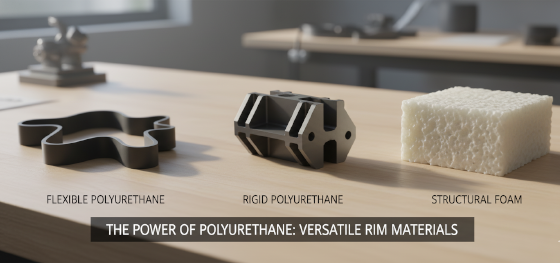
The main material family used in RIM is polyurethane. This is where the term polyurethane reaction injection molding comes from.
Polyurethane is not one single material. It is an incredibly versatile family of polymers. By changing the specific chemical formulation, a manufacturer can create a huge range of properties.
You can have a soft, flexible, rubber-like elastomer. This is perfect for making bumpers or overmolded grips. You can have a rigid, solid plastic. This is used for making dimensionally stable housings and enclosures. And you can have a rigid structural foam. This creates a part with a solid outer skin and a lower-density core, which results in an incredibly stiff and lightweight part.
A Strategic Choice for Your Project
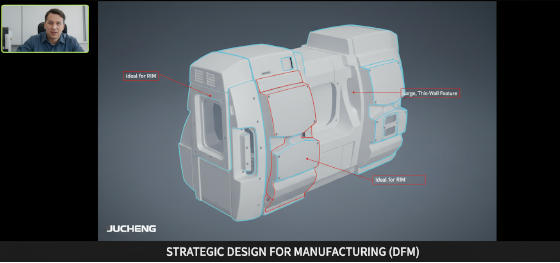
Reaction injection molding is a powerful and often overlooked technology. It is a strategic choice for the right kind of project.
If your project involves low to mid-volume production (from 50 to a few thousand units) of large, lightweight, and cosmetic parts, then RIM is likely the smartest and most cost-effective solution.
It bridges the gap perfectly. It offers the design freedom and surface quality of molding, but with a tooling cost and lead time that is much closer to prototyping. Understanding this technology is a key advantage for any product developer.

