


Achieving a flawless, non-reflective satin aesthetic on aluminum instrument bezels, medical enclosures, and high-end consumer hardware is a primary goal in custom sheet metal fabrication. Specifying professional sheet metal bead blasting provides your components with a highly consistent, matte texture that excels in diffusing glare while hiding minor handling blemishes. This mechanical finishing process utilizes spherical glass media under controlled pressure to peen the metal surface, creating an elegant satin look without removing any parent material.

Wasting capital on raw panels that show every tiny scratch, display inconsistent machining patterns, or suffer from poor coating adhesion is a major setback for high-end product rollouts. If your fabrication partner utilizes aggressive, angular grits on delicate alloys, the raw sheets will warp, thin, or develop rough surfaces that ruin the cosmetic appeal. Transitioning to a non-destructive glass bead-peening process completely eliminates these surface defects.
Let's compare spherical glass beads directly against angular cutting grits, analyze how micro-dimpling masks machining blemishes, and explore why this process serves as the ultimate prep step for premium electro-chemical coatings.
Glass Bead Blasting vs. Traditional Sandblasting
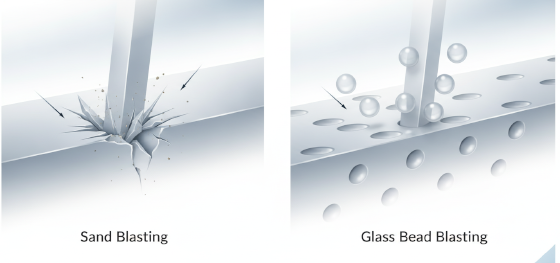
How do the physical mechanics of spherical glass beads compare to angular grits?
Spherical glass beads gently dimple and compress the metal surface at a microscopic level, whereas angular sandblasting media aggressively cuts and scratches the surface.
Understanding the physical impact of your abrasive media is vital to protecting part geometry. Traditional sandblasting utilizes sharp, angular grains (such as aluminum oxide or steel grit) that shear away material. While sandblasting is highly effective for removing heavy rust or mill scale, it leaves a very rough, highly textured profile.
Conversely, cosmetic bead blasting utilizes microscopic, spherical glass beads. When these spheres strike the metal, they act as tiny ball-peen hammers, creating millions of microscopic, overlapping dimples. This cold-working process does not shear away any parent metal, making it exceptionally safe for thin-gauge sheets and high-precision CNC-machined features on hybrid assemblies.
Masking Tooling Marks and Minor Scratches
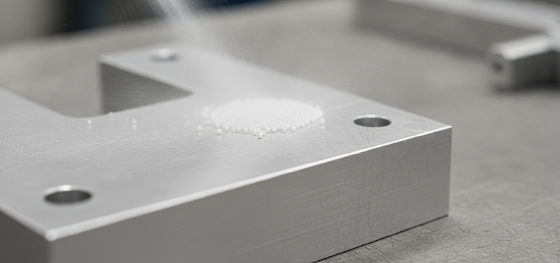
How does the micro-dimpling effect hide manufacturing blemishes and press brake marks?
The millions of overlapping micro-dimples diffuse reflecting light in all directions, completely masking fine CNC tool paths and light scratches.
Raw aluminum and stainless steel sheets often display minor surface imperfections straight from the press brake. CNC punch patterns, bending die marks, and raw handling scuffs can easily ruin the cosmetic appeal of high-end parts. Attempting to hide these blemishes under paint without pre-treatment is highly ineffective, as the gloss layer will only highlight the underlying defects.
Our finishing team utilizes progressive bead blasting to mask these tooling marks completely. The non-directional matte finish scatters light evenly across the panel, creating a beautiful satin-matte luster. This highly uniform texture is exceptionally forgiving to daily human handling, easily hiding fingerprint oils that would instantly ruin a highly polished mirror surface.
The Perfect Prep Step for Anodizing and Plating
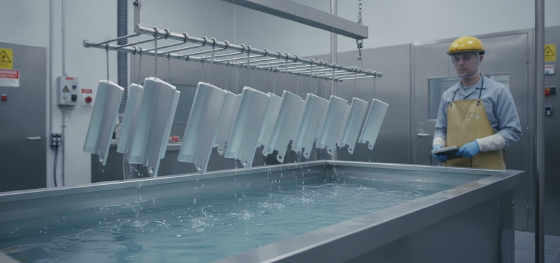
Why is glass bead blasting considered the ultimate pre-treatment for electrochemical finishes?
It cleans and micro-textures the surface to maximize the adhesion of electroplated layers and provides an exceptionally uniform satin foundation for anodizing.
To achieve a highly consistent, premium colored finish on non-ferrous alloys, incorporating this mechanical preparation into your turnkey sheet metal surface treatment flow is critical. Before aluminum parts undergo electro-chemical anodizing, their surfaces must be perfectly clean. Blasting the metal with clean glass beads removes any organic residues while establishing a uniform micro-roughness.
This textured foundation ensures that the subsequently grown anodized oxide layer exhibits a flawless, velvety matte finish with zero color variations. It is the gold standard process to achieve the classic matte-silver finish seen on premium consumer laptops, high-end smartphones, and sterile medical device housings.
| Finishing Process | Abrasive Media Profile | Surface Roughness (Ra) | Best Application Match |
|---|---|---|---|
| Glass Bead Blasting | Spherical glass beads (Fine peening) | 0.4 to 0.8 µm (Smooth satin) | Premium electronics, medical device chassis |
| Traditional Sandblasting | Angular aluminum oxide (Sharp cutting) | 1.5 to 3.0 µm (Rough anchoring) | Heavy structural steel, mill scale removal |
| Abrasive Belt Brushing | Silicon carbide belt (Directional scratching) | 0.6 to 1.2 µm (Linear grain) | Luxury appliance faces, consumer bezels |
Cosmetic Bead Blasting Services at Jucheng Precision
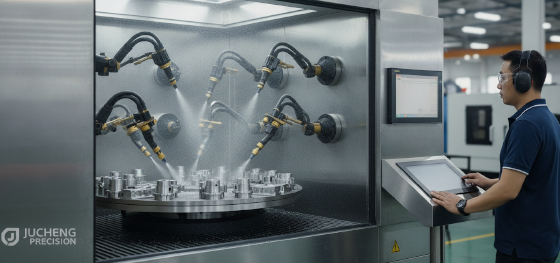
How does Jucheng Precision manage consistent linear grains on folded parts?
We operate advanced, climate-controlled blasting cabinets integrated with precise pressure regulators, checking all alignments before we cycle our nozzles.
Our advanced sandblasting and bead-peening booths are fully integrated into our 8000-square-meter facility. This unified workflow allows us to cut, bend, blast, and anodize your parts under one roof, eliminating the need to ship semi-finished parts to third-party finishing shops. It completely prevents transit scratches and eliminates the finger-pointing common when using multiple suppliers.
We process a wide range of materials, including lightweight aluminum, high-yield stainless steel, and easily formable carbon steel during high-precision sheet metal fabrication cycles. Our technical department provides a 24-hour free DFM analysis to check your CAD models, checking tolerances and hinge clearances before production. Supported by our no MOQ policy and rapid delivery guarantee, we manage your project from initial flat pattern cutting to final, high-durability anodizing and assembly.
FAQ: Critical Questions About Sheet Metal Bead Blasting
Our engineering team has compiled professional solutions to the most common quality challenges faced during industrial bead blasting runs:
How does bead blasting affect the structural strength of thin sheet metal panels?
Bead blasting actually improves the mechanical strength of the metal surface. The physical impact of the spherical glass beads compresses the outer crystalline layer, inducing a highly beneficial compressive residual stress. This surface peening effect increases the material's fatigue limits, preventing the initiation of micro-cracks and extending the service life of custom brackets under high-vibration conditions.Can glass bead blasting cause dimensional changes on high-precision machined threads?
No. Because spherical glass beads do not cut or remove any parent metal, the process is completely non-destructive and preserves the tight dimensional tolerances of your critical threads and machined holes. However, we utilize specialized masking plugs to cover high-precision bearing fits to prevent any microscopic surface changes.How does Jucheng Precision prevent surface contamination during the blasting process?
We keep our non-ferrous brushing area strictly segregated from our carbon steel processing bays to prevent airborne iron dust cross-contamination. If steel particles embed in the soft aluminum during blasting, they will initiate galvanic corrosion. Our finishing team utilizes certified aluminum-only abrasive belts, performs thorough alkaline cleaning, and runs automated clear anodizing to ensure every finished component maintains its flawless corrosion resistance.How does Jucheng Precision prevent panel warpage during custom sheet metal bead blasting orders?
Thin-gauge panels (under 1.5mm) can easily warp under the high physical pressure of glass bead peening due to uneven compressive stresses. We prevent warpage by using fine, lightweight glass beads, reducing our blasting pressure below 40 PSI, and maintaining a constant, acute nozzle angle to sweep the surface gently. Our quality control team checks flatness across a grid of coordinates using physical dial indicators, ensuring every panel remains flat.

