


Engineering robust, load-bearing frames for factory floors and heavy warehouses requires a deep understanding of structural stress distribution. Developing a secure sheet metal storage rack design ensures that your heavy-duty shelving can handle immense weight without buckling, bending, or collapsing under continuous stress, while maximizing the structural load capacity to prevent structural collapses. For material handling designers, this industrial architecture is the key to delivering safe, modular, and long-lasting storage solutions to warehouses and logistics centers.
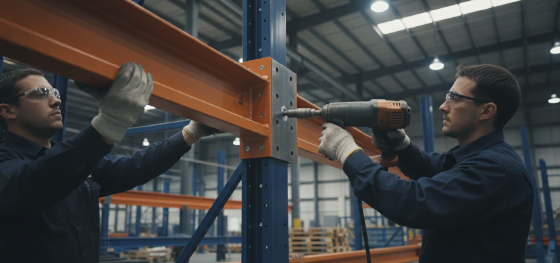
Suffer from industrial shelving that sags, bends, or loses structural alignment under heavy pallets, risking product damage and severe workplace hazards? When heavy frames are designed without pre-calculating the load deflection limits, weld penetration depths, or upright gauge thickness, it leads to immediate structural failures and high replacement costs. Proactively integrating exact load-bearing math, modular slot punch patterns, and robust structural welds is the best way to secure your warehouse safety.
Let's examine how load calculations dictate material thickness choices, explore modular slot punching patterns on upright columns, and review the proper welding techniques to achieve permanent joint stability.
content:
Load-Bearing Calculations and Material Thickness
Modular Rack Designs with Precision Punching
Heavy-Duty Welding for Rack Stability
Manufacturing Durable Storage Racks with JUCHENG
FAQ: Critical Questions About Sheet Metal Storage Rack Design
Load-Bearing Calculations and Material Thickness

How do you determine the correct steel thickness for a heavy-duty storage rack beam?
We calculate the thickness based on the maximum expected load and the span length, ensuring the beam profile remains well below the maximum deflection limit under full capacity.
The primary structural goal of any heavy-duty shelving is to maximize its active load capacity under severe continuous stress. To support heavy pallets or steel coils, designers utilize thick-gauge hot-rolled or cold-rolled carbon steel sheets. Using thin-gauge metals for load-bearing rails is an extreme safety risk, as the material will buckle under fatigue.
During the engineering phase, we run detailed finite element analysis (FEA) to determine how the physical load distributes across the horizontal beams. This calculation dictates the minimum material thickness and the optimum beam profile height. For instance, forming the flat plate into a step-beam profile with double-folded top edges dramatically increases the moment of inertia, preventing physical sag without requiring excessively thick plates:
| Steel Gauge | Beam Profile Height | Recommended Span Length | Typical Load Capacity per Pair |
|---|---|---|---|
| 14 GA (1.90 mm) | 100 mm | 2400 mm | Approx. 1500 kg |
| 12 GA (2.66 mm) | 120 mm | 2700 mm | Approx. 2500 kg |
| 10 GA (3.42 mm) | 140 mm | 3000 mm | Approx. 4000 kg |
Designing the Perfect Bend
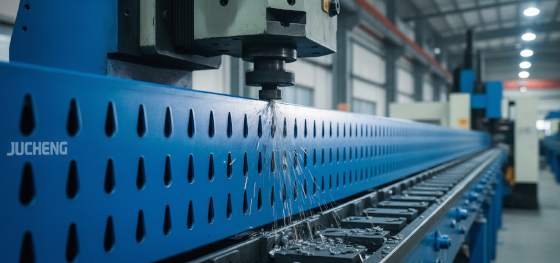
How do precision keyhole punch patterns enable modular shelf adjustments?
We punch continuous, uniform teardrop or butterfly slot patterns along the vertical columns, allowing horizontal beams to lock securely in place at various heights without hardware.
When implementing sheet metal storage rack design blueprints, utilizing modular punched columns is the standard approach to enable easy adjustments. To support modular configurations, upright columns are fabricated from folded heavy-gauge steel channels. We utilize high-speed CNC punching stations to punch highly consistent grids of slots along the front face of these columns.
The geometry of these slots (such as standard teardrop or butterfly shapes) must be extremely precise. The interlocking tab connectors welded onto the ends of the horizontal beams slide into these slots, locking tightly under the downward gravity force of the load. This hardware-free locking mechanism allows warehouse operators to rapidly adjust shelf heights while maintaining high lateral stability under extreme shift vibrations.
Heavy-Duty Welding for Rack Stability
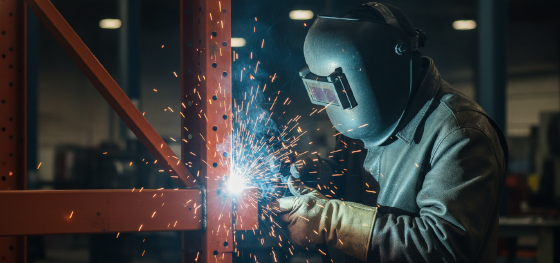
Why is structural welding quality critical for industrial rack stability?
Beam connector plates experience high torsional and shear stresses, demanding deep weld penetration to prevent joint cracking under full load capacities.
While modular columns are assembled using mechanical interlocking tabs, the connector plates themselves must be permanently secured to the horizontal beams. This joint experiences immense shear stress and torsional force, making high-strength, heavy-duty welding mandatory. Any weld porosity or incomplete penetration will cause rapid crack propagation under heavy loads.
To ensure a certified joint, our certified welders utilize heavy-duty MIG welding, using high-tensile filler wires to fuse the end plates to the hollow structural tubing. We also design continuous, full-length weld beads along the joints to ensure uniform stress distribution. After welding, every beam is cleaned and inspected to ensure the joint is structurally sound and free from micro-defects before surface preparation.
Manufacturing Durable Storage Racks with JUCHENG
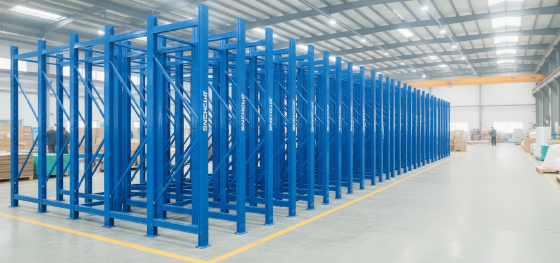
How does JUCHENG fabricate high-capacity structural storage racks with extreme precision?
We operate heavy CNC laser cutters, high-tonnage press brakes, and automated MIG welding lines, running specialized finishing setups to prevent surface oxidation.
Integrating these load-bearing metrics, modular slot arrays, and welded seams into your early sheet metal design cycle is the single most effective way to eliminate production defects. JUCHENG integrates these advanced geometric and material validations into our digital manufacturing network, ensuring that your CAD files translate into fully finished, durable structural frames with extreme dimensional precision.
We process a wide range of raw sheets, including high-strength galvanized steel, heavy carbon steel, and lightweight structural panels. Our technical department provides a 24-hour free DFM analysis to check your CAD models, checking tolerances and load-bearing parameters before production. Supported by our no MOQ policy and rapid delivery guarantee, we manage your project from initial flat pattern cutting to final, high-durability electrostatic powder coating and packaging.
FAQ: Critical Questions About Sheet Metal Storage Rack Design

What is the maximum allowed deflection limit for an industrial storage rack beam?
Under standard safety codes (such as RMI standards), the maximum horizontal beam deflection under a fully distributed load must not exceed 1/180 of the span length (L/180). For a 2700mm beam, this represents a maximum physical deflection limit of 15mm. Exceeding this deflection compromises structural stability, requiring thicker steel profiles.
How do you protect industrial storage racks from forklift impact damage?
Forklift collisions are a major cause of warehouse rack collapses. To prevent catastrophic failure, we recommend designing thick-gauge steel column protectors (guard rails) anchored directly into the concrete floor around the base of the uprights, physically isolating the structural frame from heavy vehicle impacts.
Why is powder coating preferred over liquid painting for warehouse shelving?
Industrial storage racks experience continuous scratching and scraping from sliding wood pallets and heavy metal bins. Electrostatic powder coating is cured at high temperatures, creating a thick, highly impact-resistant surface barrier that resists chipping, scratching, and wear significantly better than thin liquid spray paint.
How does JUCHENG support custom sheet metal storage rack design projects?
Our technical department reviews your CAD designs during our complimentary DFM stage. If your rack design features columns that are too thin to support your target loads, or beams with excessive spans that risk buckling, we suggest clear modifications like increasing the steel gauge, adding reinforcement ribs, or optimizing weld depths, delivering safe and highly durable storage solutions.

