


Your box of new parts has arrived. Inside are your Silicone prototype parts. They look correct. But how can you be sure they are good?
Evaluating the quality of a silicone prototype goes much deeper than just checking the shape. A good part is a valuable tool. It gives you accurate information for your project. A bad part can give you misleading results and cause big problems later.
This guide will show you exactly what to look for. It is a simple but detailed checklist for inspecting the quality of your parts.
content:
Hardness (Durometer): The Most Important Feeling
Physical Quality: Look for These Defects
Functional Quality: Does It Do the Job?
Your Inspection Checklist
Hardness (Durometer): The Most Important Feeling

The first thing to check is the hardness. For a silicone prototype, this is maybe the most critical property.
Hardness is measured on a scale called "durometer," usually on the Shore A scale. A low number, like 20A, is very soft and gel-like. A high number, like 70A, is firm and stiff, like the rubber on a car tire.
Why does this matter? Imagine you are designing a new automotive door seal. If the seal is too hard, the door will be difficult to close. If it is too soft, it will not seal out water and wind correctly. The durometer must be exact.
You probably specified a durometer when you ordered your parts. For example, "Shore 40A." A professional manufacturer will use a tool called a durometer to test each batch of parts. This ensures the hardness is correct. Ask your supplier for this data. It is a key sign of a quality process.
Physical Quality: Look for These Defects
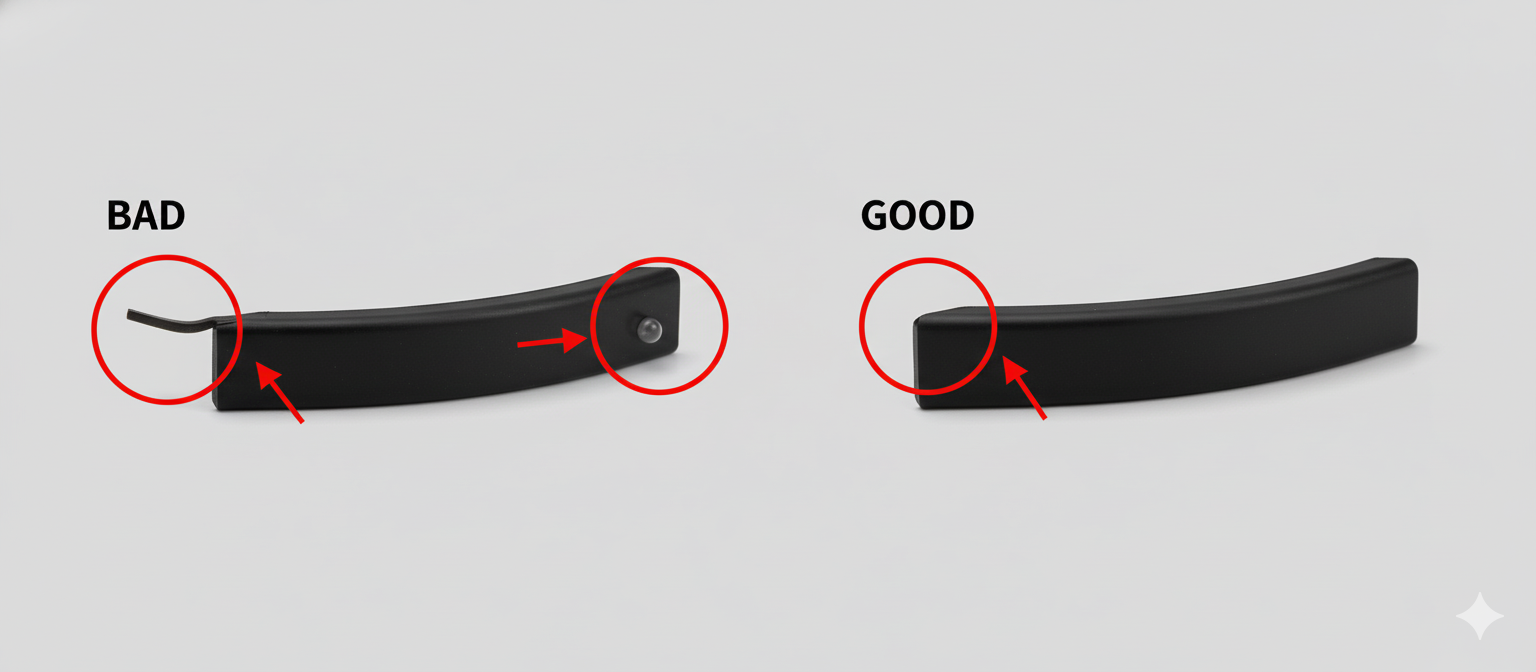
Next, you need to inspect the parts with your eyes. A good part should be perfect. A bad part will have small but important flaws.
Look for these common defects:
Air Bubbles.
These look like tiny empty pockets inside the part or on the surface. Bubbles are a major problem. They create a weak spot. A part with bubbles will tear easily. They are caused by a poor vacuum process during casting. A good manufacturer will have a powerful vacuum system to eliminate all bubbles.Flash.
This is a thin, extra flap of silicone on the edge of the part. It happens where the two halves of the mold meet. A small amount of flash is normal. But a good maker will carefully trim it off by hand. Your final parts should have no flash. They should be clean.Sink Marks.
These are small dips or depressions on the surface of the part. They usually happen on thicker sections. They are caused by the silicone shrinking as it cures. An experienced maker knows how to design the mold to prevent sink marks.Inconsistent Color.
If your part is colored, the color should be perfectly uniform. There should be no swirls or light spots. This shows the color pigment was mixed thoroughly.
Finding any of these defects means the manufacturing process was not well controlled.
Functional Quality: Does It Do the Job?

A part can look perfect. But it also needs to work correctly.
One key functional property for seals and gaskets is "compression set." This measures how well the silicone bounces back after being squeezed. A good gasket will bounce back almost completely. A bad gasket will stay partially squashed. This means it will leak over time. Good quality silicone material has a low compression set.
Another key property is bond strength. This is for overmolded parts. Try to peel the soft silicone away from the hard plastic part. On a good part, this should be almost impossible. The two materials should be permanently bonded. A weak bond means the overmolding process was not done correctly.
The quality of the raw material and the skill of the maker directly impact the functional quality of your Silicone prototype parts.
Your Inspection Checklist
Use this checklist when you receive your parts.
Feel the Hardness. Does it feel like the durometer you specified? Does it match your expectation?
Look for Defects. Check each part for bubbles, flash, and sink marks. Is the color even?
Measure the Dimensions. Use calipers to check a few key dimensions. Are they accurate?
Test the Function. Squeeze it. Bend it. If it is a seal, see if it compresses and returns. If it is overmolded, test the bond.
High-quality Silicone prototype parts are a sign of a high-quality manufacturing partner. They show that the maker has skill, good equipment, and a strong quality process. These are the parts that give you the confidence to move forward with your project.

