


Kinetic violence remains the primary saboteur of automated food and medical handling. In the hyper-agile landscape of 2026, the transition from rigid mechanical assembly to the "soft-touch" reality of organic items represents a massive leap in manufacturing complexity. When an industrial robot attempts to sort ripe fruit or move fragile glass test tubes, the traditional "solid metal" end-effector becomes an instrument of destruction. If the gripper applies even a few Newtons of excessive force, the payload shatters, leading to massive waste and system downtime. Navigating this requirement for conformal, non-destructive contact requires the strategic deployment of Soft robotics gripper manufacturing. Jucheng Precision operates as a high-fidelity elastomeric sanctuary in the Shenzhen precision manufacturing hub, providing the chemical and mechanical depth needed to deliver fingers and effectors that possess the tactile soul of the human hand. Within the broader framework of custom robotic end-of-arm tooling, we bridge the gap between "rigid command" and "compliant execution," ensuring your autonomous systems can handle the most delicate objects with absolute mechanical sovereignty.
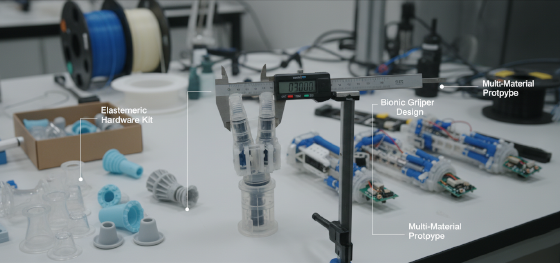
Establishing a resilient soft-robotic supply chain in 2026 demands the rejection of "hobbyist" silicone casting kits. Amateurs often attempt to mold robotic fingers using unverified resins, unaware that improper vacuum degassing leads to internal micro-voids that trigger catastrophic tearing under pneumatic pressure. Jucheng Precision eliminates these "Atmospheric Failures" by enforcing an industrial-grade Soft robotics gripper manufacturing protocol. We utilize high-strength platinum-cure silicones and specialized polyurethanes that offer the exact Shore A durometer required for your specific payload. Whether you are developing a bionic hand for Medical Robotics or a high-speed sorter for an automated greenhouse, our facility provides the material science and metrological rigor required for global market entry. This guide deconstructs the necessity of geometric compliance, the physics of liquid-resin replication, and why JUCHENG’s "Compliance Protocol" is the mandatory foundation for anyone developing Soft robotics gripper manufacturing projects for 24/7 industrial use.
Why is compliance mandatory for handling fragile items?
How to use vacuum casting for rubber-like grippers?
What are the rules for selecting Shore A durometer?
How does JUCHENG guarantee food and medical safety?
FAQ
Why is compliance mandatory for handling fragile items?
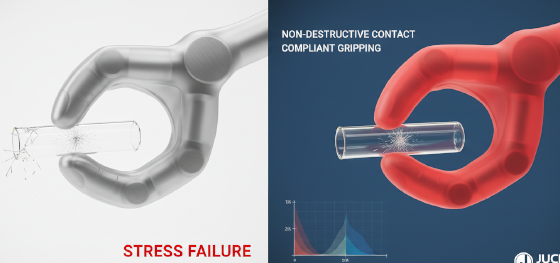
Contact mechanics dictate that a rigid surface cannot distribute pressure evenly across an irregular organic shape. In the world of Soft robotics gripper manufacturing, the goal is "Conformal Envelopment." When a rigid metal finger strikes a curved glass surface, the contact area is infinitesimally small, resulting in extreme localized pressure that exceeds the material's yield point. A soft-robotic finger, conversely, deforms upon contact, spreading the clamping force across a massive surface area. This physical compliance acts as a "mechanical shock absorber," allowing the robot to secure a high-friction grip using 80% less motor torque. Jucheng Precision engineers utilize this "Passive Intelligence" to protect your payloads. We turn "force-based gripping" into "geometry-based securement," ensuring that even the most high-speed pick-and-place cycles remain non-destructive for delicate consumer electronics and biological samples.
How to use vacuum casting for rubber-like grippers?
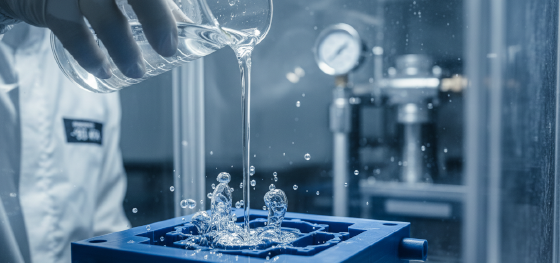
Replication fidelity in elastomers is achieved through the management of atmospheric pressure. Soft robotics gripper manufacturing primarily leverages polyurethane vacuum casting to produce high-fidelity, production-grade components without the six-figure investment of a compression mold. The process begins with a 5-axis CNC-machined master pattern, which is used to create a flexible RTV silicone tool. Liquid polyurethane or silicone resins are then mixed and degassed under a deep vacuum of 29 inches of Mercury. This total evacuation of air ensures that every microscopic rib and internal pneumatic chamber is filled with 100% dense polymer. Jucheng Precision utilizes this technology to deliver batches of 10 to 50 identical soft fingers in as fast as 7 days. We provide the manufacturing insurance needed to iterate rapidly on finger geometry, allowing you to test different "Grip-Patterns" in real-world conditions before freezing the design for mass production.
What are the rules for selecting Shore A durometer?
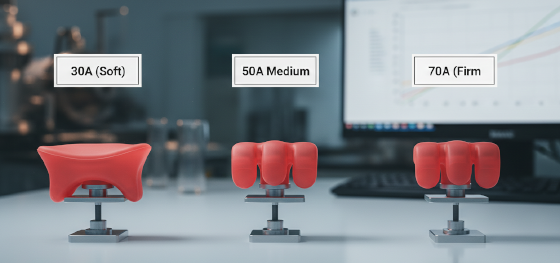
Tactile authority is dictated by the "Squish Factor" of the elastomer. In the Soft robotics gripper manufacturing matrix, selecting the correct Shore A hardness is the most critical material decision. Jucheng Precision offers a specialized library of resins ranging from Shore 10A (gel-like softness) to Shore 90A (hard rubber). For picking up soft agricultural products like tomatoes or berries, we typically recommend a Shore 30A resin, which maximizes conformal contact with minimal pressure. For industrial sorting of plastic or metal parts, a Shore 60A to 70A material provides the necessary tear resistance and durability for high-cycle use. We don't just "pour rubber"; we calibrate the molecular cross-linking to ensure your fingers possess the "Rebound Energy" needed to return to their original shape millions of times, preventing the "Elastomeric Creep" that ruins the accuracy of autonomous grippers over time.
How does JUCHENG guarantee food and medical safety?

Manufacturing excellence at Jucheng Precision is built on the foundation of single-source biological safety. We recognize that Soft robotics gripper manufacturing for the food and medical sectors demands more than just flexibility—it demands "Chemical Purity." Our facility operates dedicated cleanroom bays for the casting of FDA-compliant, food-safe silicones and biocompatible polyurethanes. We provide full material lot traceability and Certificate of Analysis (COA) records for every batch, ensuring your grippers are free of phthalates and heavy metals. By utilizing our integrated overmolding capabilities, we can bond these safe "skins" directly onto 3D-printed or CNC-machined rigid bones, creating a monolithic part that is easy to sterilize and free of bacteria-trapping seams. Stop gambling your brand’s reputation on uncertified resins. Leverage our decade of high-performance replication mastery to validate rapidly and launch with a certified, non-destructive touch.
FAQ
Q: Which material is better for Soft robotics gripper manufacturing, silicone or TPU?
A: Silicone offers superior heat resistance and food-safe properties, while TPU provides better abrasion resistance and is easier to overmold onto rigid plastics like ABS.
Q: Can JUCHENG create internal air chambers in soft fingers?
A: Yes. We utilize multi-part silicone molds and water-soluble 3D-printed cores to cast complex internal pneumatic cavities for "Bellows-Style" soft robotic movement.
Q: How durable are these soft grippers for 24/7 use?
A: Utilizing high-tear-strength industrial polyurethanes, Jucheng Precision produces grippers that can survive millions of flex cycles, far outperforming consumer-grade rubbers.
Q: What is the lead time for a prototype soft-gripper set?
A: JUCHENG delivers custom vacuum-cast soft robotic components in as fast as 7 to 10 business days from CAD approval.

