


Robotic throughput remains the ultimate judge of factory floor efficiency. In the high-velocity world of automated logistics and precision assembly, the "Hand" of the robot is the primary bottleneck for performance. If the End-of-Arm Tooling (EOAT) is over-engineered and heavy, it increases the dynamic inertia of the system, forcing the motors to slow down and increasing the wear on the expensive harmonic drives. For hardware innovators in 2026, the primary adversary is not the code—it is the physical mass of the effector. Navigating the requirements for high-strength, low-weight interaction requires the strategic deployment of custom robotic end-of-arm tooling. Jucheng Precision operates as a specialized manufacturing sanctuary in the Shenzhen precision manufacturing hub, providing the technical depth to deliver grippers, suction mounts, and tactile interfaces that possess the mechanical spine needed for 24/7 autonomous operation. Within the broader framework of Robotics Automation Manufacturing, we bridge the gap between "generic effectors" and "application-specific sovereignty," ensuring your robot moves with absolute agility and precision.

Establishing a failure-proof effector supply chain demands the rejection of traditional "solid-metal" thinking. Amateurs often default to heavy machined steel grippers that mar the surface of delicate products and strain the robot's joints. Jucheng Precision eliminates this "Mechanical Drag" by offering an integrated multi-process ecosystem of MJF 3D printing, vacuum casting, and precision CNC. Whether you are developing a prototype robot for warehouse sorting or a specialized effector for Medical Robotics, our facility provides the material science and metrological rigor required for 2026 market entry. We turn "gripping concepts" into "functional tactile interfaces," ensuring your custom robotic end-of-arm tooling is as light as your design permits and as tough as the application demands. This guide deconstructs the necessity of additive lightweighting, the physics of soft polymer compliance, and why JUCHENG’s "Turnkey Protocol" is the mandatory foundation for anyone developing next-generation effectors.
content:
Mechanical Velocity: The Physics of Lightweighting EOAT
Tactile Sovereignty: Soft Grippers and Compliant Polymers
Pneumatic Integrity: CNC Machining for Suction Manifolds
Iteration Velocity: From Digital CAD to Factory Floor in Days
Frequently Asked Questions: Custom Robotic Tooling
Mechanical Velocity: The Physics of Lightweighting EOAT

Inertia dictates the duty-cycle of an industrial robotic system. Every gram removed from the end of a six-axis arm translates into lower motor torque requirements and faster directional changes. For custom robotic end-of-arm tooling, Jucheng Precision utilizes Multi Jet Fusion (MJF) 3D printing with carbon-fiber reinforced Nylon (PA12-CF). This technology allows for "Generative Design" architectures—creating complex, hollow lattice structures that possess the structural modulus of aluminum but at a fraction of the mass. By utilizing additive manufacturing for the primary gripper body, we reduce the "Payload Penalty," allowing your robot to carry larger parts or move at 20% higher velocities without triggering vibration alarms. We don't just "print parts"; we engineer skeletal assets that optimize the kinetic energy of your entire robotic cell, documented for survival in high-cadence production lines.
Tactile Sovereignty: Soft Grippers and Compliant Polymers
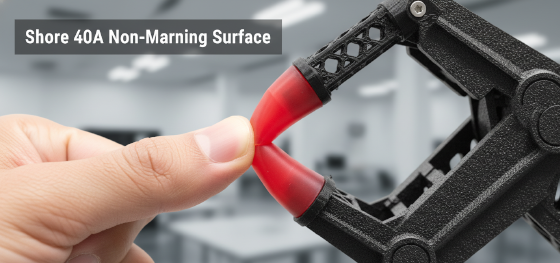
Compliance represents the primary defense against product damage during autonomous handling. If your robot is picking up fragile consumer electronics or organic medical samples, rigid fingers are a failure mode. custom robotic end-of-arm tooling at Jucheng Precision leverages polyurethane vacuum casting to create bespoke soft grippers. We offer a library of elastomers ranging from gel-like Shore 30A to tire-tough 90A. Our facility specializes in overmolding soft-touch skins directly onto 3D-printed or CNC-machined rigid skeletons. This "Dual-Durometer" approach provides a rigid structural backbone with a non-marring, high-friction interface. Unlike generic suction cups, our cast fingers are engineered for "Frictional Sovereignty"—gripping parts with minimal force to prevent surface scratching or deformation. We turn "hard robotic hands" into "extensions of human sensitivity," ensuring your EOAT handles your product with surgical fidelity.
Pneumatic Integrity: CNC Machining for Suction Manifolds

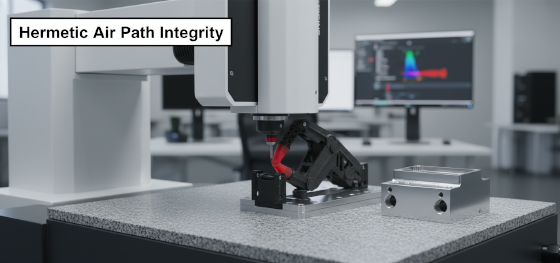
Hermetic integrity dictates the reliability of vacuum-based robotic picking. In the domain of custom robotic end-of-arm tooling, the manifold—the component that routes air to multiple suction points—must be perfectly airtight. Jucheng Precision provides 5-axis CNC machining for high-precision aluminum and stainless steel manifolds. We utilize sub-micron tolerances for O-ring grooves and internal air channels to prevent "Pneumatic Bleed," which causes dropped parts and system downtime. We understand that in an industrial robot parts assembly, the interface between the arm's air supply and the custom tool is the most vulnerable link. Our machining bay ensures that every mounting flange is orthogonal and every thread is verified with a go/no-go gauge. We turn "drilled blocks" into "high-efficiency pneumatic hubs," ensuring your suction-based EOAT maintains its vacuum grip through millions of pick cycles.
Iteration Velocity: From Digital CAD to Factory Floor in Days

Manufacturing agility is the core byproduct of JUCHENG’s integrated ecosystem. We don't believe in the "One-Month Lead Time" for a simple gripper update. Our facility is optimized for the rapid development of custom robotic end-of-arm tooling. We utilize our 150+ CNC machines and industrial 3D printers to offer 3-day turnaround times for iterative design cycles. When you upload a new version of your effector to our facility, our engineers perform a complimentary "Weight and Flow Audit" before production begins. We help you identify "Material Traps" that increase cost and mass without adding value. This velocity allows your team to fail fast and succeed faster, refining the grip and movement of your robot in real-time. We don't just "take orders"; we act as your strategic manufacturing accelerator, ensuring your service robots or warehouse fleet is equipped with the most advanced hardware in the industry.
JUCHENG Protocol: Zero-MOQ Mastery for End Effectors
Manufacturing excellence at Jucheng Precision is built on the foundation of single-source accountability. We don't believe you should manage three vendors for one gripper. We house elite 3D printing for the body, vacuum casting for the fingers, and CNC machining for the mount—all under one ISO 9001 certified roof. We provide full material lot traceability and CMM inspection reports for every custom robotic end-of-arm tooling batch, providing the "Paper Trail of Quality" required for automotive and med-tech industries. Stop gambling your robot's performance on heavy, unoptimized effectors. Leverage our decade of Robotics Automation Manufacturing mastery to validate rapidly and launch profitably. Contact our technical team today for a free DFM review and see how we can turn your digital effector intent into a lightweight, indestructible physical reality that is documented for success.
Frequently Asked Questions: Custom Robotic Tooling
Question: What is the best material for high-speed robotic grippers?
Answer: For 2026 designs, we recommend PA12-CF (Carbon Fiber Reinforced Nylon) via MJF 3D printing. It offers the highest stiffness-to-weight ratio and can produce complex internal air channels for suction integration.
Question: Can JUCHENG help design the custom robotic end-of-arm tooling interface?
Answer: Yes. Our engineers provide expert DFM feedback to ensure your tool’s mounting flange matches the mechanical standards (ISO 9409-1) of major robot brands like Fanuc, KUKA, and Universal Robots.
Question: How durable are vacuum cast urethane fingers for EOAT?
Answer: Extremely durable. By selecting high-tear-strength polyurethanes, we create fingers that can survive millions of cycles without cracking, outperforming standard 3D printed TPU in both grip and longevity.
Question: What is the turnaround time for a custom aluminum manifold?
Answer: JUCHENG can CNC machine a custom aluminum manifold for your custom robotic end-of-arm tooling in as fast as 3 to 5 business days, including surface treatments like hard-anodizing.

