


There is a certain respect a machinist has for stainless steel. It is a beautiful material. Strong. Incorruptible. But it does not give up its shape easily. It fights back.

Machining aluminum is a conversation. Machining plastic is a simple instruction. But stainless steel cnc machining is a battle. It is a battle against the very properties that make the material so desirable.
Winning this battle requires more than just a powerful machine. It requires strategy, the right weapons, and a deep understanding of the opponent. This guide is a look inside that fight.
Understanding Stainless Steel's Personality
Challenge #1: Work Hardening
Challenge #2: Poor Thermal Conductivity
Choosing Your Fighter: 303 vs. 304 vs. 316
Our Approach: A Game of Strategy and Force
Understanding Stainless Steel's Personality
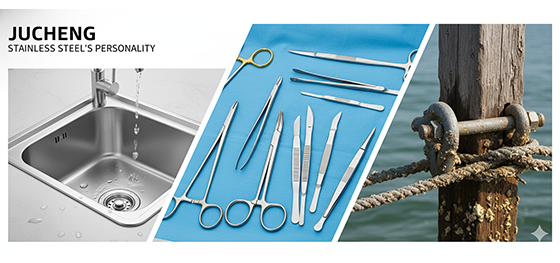
What makes stainless steel "stainless"? It is the addition of a key alloying element: chromium. The chromium reacts with oxygen to form a very thin, stable, and invisible passive layer of chromium oxide on the surface. This layer is the steel's armor. It protects the iron in the steel from rusting.
This makes it the material of choice for applications where cleanliness and corrosion resistance are critical. You see it everywhere, from kitchen sinks and surgical tools to boat fittings and chemical tanks. It is one of the most versatile of all CNC machining materials. But the same properties that make it so tough in the real world also make it a formidable opponent on the machine bed.
Challenge #1: Work Hardening

The first and most notorious challenge of stainless steel cnc machining is "work hardening."
This means the material has a tendency to become significantly harder as it is being machined. The pressure and heat from the cutting tool actually change the microscopic crystal structure of the surface layer you just cut.
This is a huge problem. It means that the next pass of the cutting tool is not cutting the original material anymore. It is trying to cut a new, much harder surface. This causes the tool to wear down incredibly fast. It can lead to tool breakage, poor surface finish, and dimensional inaccuracies.
The only way to fight work hardening is with aggression. A machinist must use a slow, steady, and deep cut. You must get "under" the work-hardened layer from the previous pass. Timid, light cuts are a recipe for disaster.
Challenge #2: Poor Thermal Conductivity
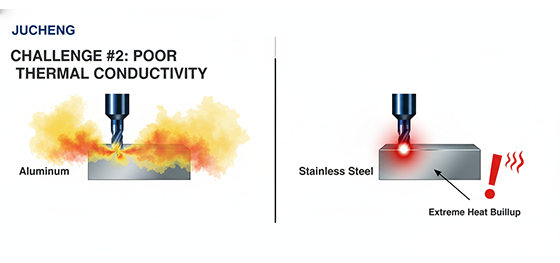
The second major enemy is heat. Stainless steel is a terrible conductor of heat. This is the opposite of aluminum, which dissipates heat quickly.
When you are cutting stainless steel, all the intense heat generated by the friction has nowhere to go. It does not get absorbed into the part. Instead, it concentrates directly on the cutting edge of the tool.
This extreme heat is the number one killer of cutting tools. It can cause the tool's sharp edge to soften, deform, or even melt on a microscopic level. This is why a constant, high-pressure flood of specialized coolant is absolutely essential. The coolant's job is to act as a firefighter, constantly trying to pull the destructive heat away from the cutting zone.
Choosing Your Fighter: 303 vs. 304 vs. 316
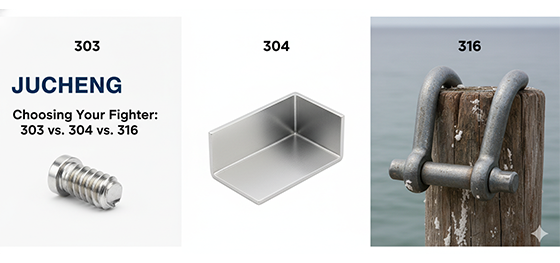
Not all stainless steels are created equal. Choosing the right grade is a critical design decision.
SS 304 is the most common and versatile "workhorse." It offers excellent corrosion resistance for most general applications. It is the material of kitchen sinks.
SS 316/316L is the "marine grade." It has molybdenum added to its composition. This gives it superior resistance to chlorides, like salt. It is the essential choice for any part used in a marine or coastal environment. It is also the standard for many medical applications, and our ISO 13485 certification ensures we handle it with the required traceability.
SS 303 is the "free-machining" grade. It has sulfur added to it. The sulfur helps to break the chips, making it much easier and faster to machine than 304 or 316. However, this comes at a cost. The sulfur reduces its corrosion resistance and makes it unsuitable for welding.
| Property | SS 303 | SS 304 | SS 316/316L |
|---|---|---|---|
| Machinability | Excellent | Fair | Poor |
| Corrosion Resistance | Good | Excellent | Superior (Marine Grade) |
| Weldability | Poor | Good | Excellent |
Our Approach: A Game of Strategy and Force

Successfully machining stainless steel is a combination of brute force and smart strategy.
You need very rigid and powerful CNC machines that will not vibrate under the high cutting forces. At JUCHENG, our investment in high-end, heavy-duty machines is a key part of our capability.
You also need the right strategy. This means using the right coated carbide tools. It means programming toolpaths with smooth, arcing movements instead of sharp turns. And it means taking a deep, confident cut to get below the work-hardened layer.
This is not a job for a generalist. It requires a partner with specific, hard-won experience. Our deep knowledge of this beautiful but challenging material is your guarantee of a high-quality, precise, and truly stainless part.

