


Imagine a material that is virtually immune to all chemicals. A material with one of the lowest coefficients of friction known to science. A material that is an excellent electrical insulator. It sounds like an engineer's dream.
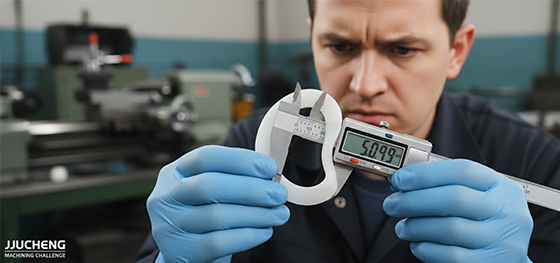
This material is Polytetrafluoroethylene, or PTFE. You probably know it by its most famous brand name, Teflon®. But for a machinist, this dream material can be a nightmare.
Its unique properties also make it incredibly difficult to machine with precision. The art of ptfe teflon cnc machining is a game of finesse, temperature control, and a deep respect for the material's strange personality. This guide will take you inside that challenge.
content:
Understanding PTFE's Unique Personality
A Machinist's Nightmare: A Slippery, Soft Opponent
Secret #1: Razor-Sharp Tools and Icy Temperatures
Secret #2: A Gentle Touch in Clamping
Your Partner in a Demanding Material
Understanding PTFE's Unique Personality

PTFE is a fluoropolymer, and its personality is defined by one thing: extreme stability. The chemical bonds between its fluorine and carbon atoms are incredibly strong.
This is the source of its superpowers. It gives it near-universal chemical resistance. It is unaffected by almost all acids, bases, and solvents. This makes it an essential material for seals, gaskets, and linings in the chemical and medical industries.
This strong bond also means nothing wants to stick to it. This gives it its famous "non-stick" property and a very low coefficient of friction. It is a fantastic material for low-friction bearings and sliding surfaces.
But this chemical stability also makes it very, very soft. And that softness is the source of all our manufacturing challenges.
A Machinist's Nightmare: A Slippery, Soft Opponent
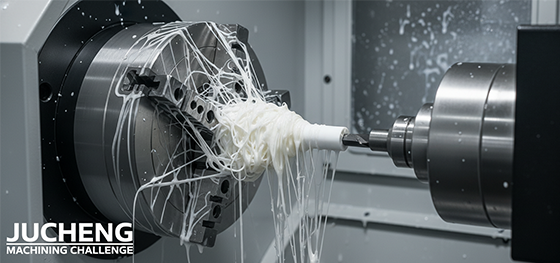
When you try to machine PTFE, it does not cut cleanly like other CNC machining materials. It does not form a nice, brittle chip. Instead, it behaves like a very hard wax.
It tends to deform and "smear" rather than be cut. The cutting tool generates heat, which makes the material even softer. The chips are long, stringy, and can easily get tangled around the tool, ruining the part. Achieving a clean, sharp edge or a smooth surface is incredibly difficult.
Its softness also means it is very difficult to hold. If you clamp a block of PTFE too tightly in a machine vise, the material will compress and deform. This means all your machined dimensions will be wrong once you release the clamping pressure. It is like trying to machine a block of hard cheese.
Finally, it has a very high rate of thermal expansion. It expands and contracts a lot with changes in temperature. A part that is perfectly in tolerance in a cool inspection room might be out of tolerance in a warmer operating environment.
Secret #1: Razor-Sharp Tools and Icy Temperatures

So how do experts successfully achieve ptfe teflon cnc machining? It requires a set of special techniques.
First, the cutting tools must be beyond sharp. They must be razor sharp. We use brand new, solid carbide tools with a special "up-sharp" geometry designed to slice the material cleanly, rather than push it. The tool's rake and clearance angles are critical.
Second, you must control the heat. This is done with a very aggressive use of coolant. A high-pressure flood of coolant is aimed directly at the cutting edge. This does two things. It instantly carries away the heat, keeping the material hard and preventing it from getting gummy. It also forcefully blasts the stringy chips away from the cutting zone. For some super-critical jobs, machinists even use cryogenic (super-cooled) air.
Secret #2: A Gentle Touch in Clamping
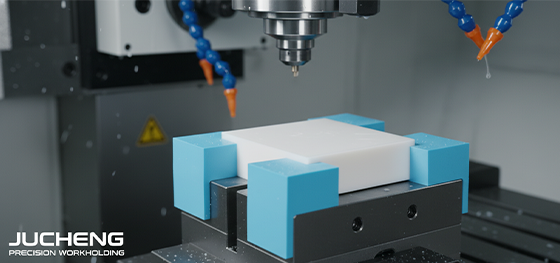
The second secret is about holding the material. You cannot just clamp it in a standard steel vise. You must use a gentle touch.
An expert machinist will use special "soft jaws" made from a material like aluminum. They might also design a custom fixture that holds the part over a very large surface area. The goal is to distribute the clamping force, holding the part securely but without squeezing it.
The machining strategy itself is also adjusted. Instead of taking one deep, aggressive cut, we take multiple, very light finishing passes. This puts less stress on the material and helps to maintain dimensional accuracy.
Finally, the part must be inspected in a temperature-controlled environment to account for its thermal expansion.
Your Partner in a Demanding Material

PTFE is a true wonder material. Its properties are unmatched for certain critical applications. But it is not a material for amateurs.
If your design requires a part made from PTFE, it is absolutely essential that you work with a manufacturing partner who has deep experience with it. Ask them about their tooling. Ask them about their clamping strategies. Ask them how they control for thermal expansion.
At JUCHENG, we have the specialized tools and, more importantly, the years of hands-on experience required to tame this slippery opponent. We know the secrets. We can turn a difficult-to-machine block of PTFE into a precise, reliable, and perfectly finished component that your critical application can depend on.

