


Every great product starts as a series of questions. Will the internal components fit? Is the enclosure strong enough to survive a drop? How will the final product look and feel in a customer's hand?
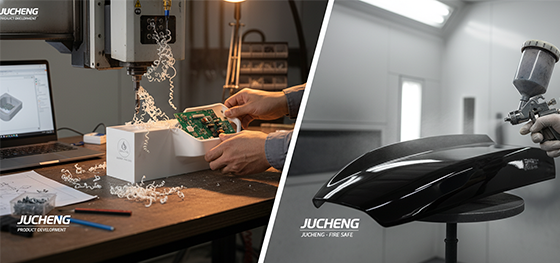
Answering these different questions often requires different prototypes at different stages of development. A rough model for early fit checks. A strong model for functional tests. A beautiful model for marketing photos.
But what if there was one material that could elegantly and cost-effectively answer all these questions? A material that acts as a universal language throughout the design journey. There is. And its name is ABS. For product developers, the process of abs cnc machining is the backbone of modern prototyping.
content:
General Purpose ABS: Your Perfect Starting Point
Flame Retardant ABS: A Critical Choice for Safety
Finishing: The Secret Superpower of ABS
Design Considerations for Machining ABS
General Purpose ABS: Your Perfect Starting Point
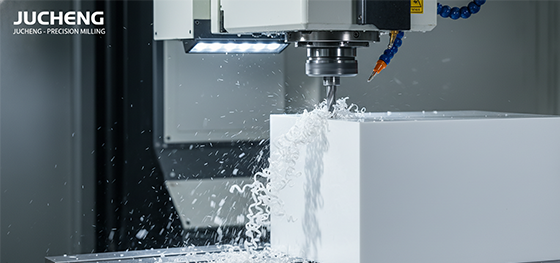
ABS (Acrylonitrile Butadiene Styrene) is arguably the most popular and versatile of all prototyping plastics. It is the default choice for a huge range of projects. The reason for this dominance is simple: it offers the best all-around balance of properties.
It occupies a perfect sweet spot among CNC machining materials. It is significantly stronger, stiffer, and tougher than low-cost commodity plastics like Polypropylene (PP) or HDPE. This means it can be used to create robust functional prototypes that can withstand real-world handling and assembly.
At the same time, it is much, much more affordable than high-performance polymers like Polycarbonate (PC) or PEEK. This allows design teams to iterate frequently without breaking their budget.
From a manufacturer's perspective, standard ABS has a very agreeable personality. It is a stable and predictable material to machine. It is not overly soft or gummy, so it holds its shape well and allows for good dimensional accuracy. It is also not excessively hard or abrasive, meaning it does not cause rapid tool wear. It produces clean, manageable chips, which contributes to a good initial surface finish. This good machinability translates directly into faster production times and lower costs.
This unique combination of decent strength, low cost, and excellent machinability makes general-purpose ABS the perfect material for early and mid-stage prototypes. It is the ideal choice for form and fit testing, and for creating the first functional assemblies of a new product.
Flame Retardant ABS: A Critical Choice for Safety
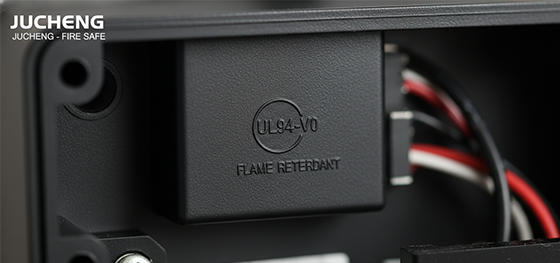
For any product that contains electronics, from a simple smart-home device to a complex medical instrument, safety is a non-negotiable requirement. Plastic housings for these devices must be made from materials that resist ignition and slow the spread of fire.
This is where Flame Retardant ABS becomes an essential choice. This is a special grade of ABS where flame-retardant additives have been compounded into the raw polymer. These additives are designed to disrupt the chemical process of combustion, causing the material to self-extinguish once a flame source is removed.
The performance of these materials is rated by a globally recognized safety standard called UL94. A "V-0" rating is a very common and excellent rating required for many consumer electronics. It signifies that in a controlled laboratory test, a vertical sample of the material will stop burning within 10 seconds.
When you are creating a functional prototype for an electronic device, using the correct flame-retardant grade is essential. It allows you to perform critical thermal management and safety testing on a prototype that is truly representative of your final, certified product. It is a crucial step on the path to regulatory approval.
| Property | General Purpose ABS | Flame Retardant ABS (UL94 V-0) |
|---|---|---|
| Strength & Toughness | Good | Good (May be slightly lower due to additives) |
| Cost | Low | Moderate |
| UL94 V-0 Rating | No | Yes |
| Best For | Early Prototypes, Form/Fit Tests | Functional Electronic Prototypes, Pre-compliance Testing |
Finishing: The Secret Superpower of ABS
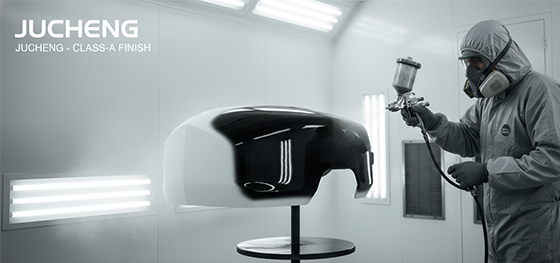
Perhaps the greatest superpower of abs cnc machining is its incredible ability to be finished. This is what allows it to be used across the entire development journey, from the first rough functional model to the final, beautiful appearance prototype.
A raw machined ABS part has a good, clean, matte finish. But this is just the starting point. The material is very easy and forgiving to sand. A skilled technician can sand the surface to a perfectly smooth, flawless state, removing all traces of the cutting tool marks.
This perfectly prepared surface is an ideal canvas for painting. You can achieve any color, any gloss level, and any texture imaginable. With the right painting process, we can make an ABS part look like it is made from high-gloss piano black material, soft-touch rubber, or even brushed aluminum. This is how we create visual prototypes that are indistinguishable from a final product, perfect for investor meetings and marketing photoshoots.
ABS is also one of the easiest plastics to glue and solvent bond. This allows us to create large, complex assemblies by bonding several smaller machined parts together seamlessly. And it is easy to print on, for adding logos and other graphics. This amazing versatility in finishing is what truly makes ABS the king of prototyping plastics.
Design Considerations for Machining ABS
While ABS is very forgiving, there are a few design tips to get the best results. Like all thermoplastics, ABS can be sensitive to heat. When machining very thin or delicate features, it is important to use sharp tools and proper cooling to prevent the part from warping or melting.
It is also important to design with generous radii on internal corners. While this is a general rule for all CNC machining, it is especially important for plastics to prevent stress concentrations.
Working with a partner who understands the nuances of plastic machining is key. At JUCHENG, our DFM process is not just for injection molding. Our engineers will review your design for CNC machining as well. We can provide expert advice on design features and material selection to ensure your ABS prototype is not just fast and affordable, but also a perfect, functional representation of your final design.

