


Mechanical boundaries vanish when liquid chemistry meets continuous textile reinforcement. In the hyper-agile landscape of 2026, many hardware engineers encounter a "Structural Ceiling" where standard reaction injection molding materials lack the modulus to survive heavy-duty industrial loads. When a project demands the replacement of a stamped steel truck bed or a load-bearing aerospace floor panel, relying on short-fiber fillers is a strategy for failure. Navigating this requirement for extreme strength-to-weight ratios requires the strategic deployment of structural reaction injection molding srim. Jucheng Precision operates as a high-fidelity composite sanctuary in the Shenzhen precision manufacturing hub, providing the technical depth to deliver oversized structural components that outperform metal in both fatigue life and corrosion resistance. We don't just "mold shells"; we engineer encapsulated fiber architectures that ensure your largest designs remain structurally sovereign in the most abusive field environments.
Establishing a resilient launch for metal-replacement hardware demands the rejection of traditional "plastic" thinking. Amateurs often view polymers as cosmetic covers, unaware that the integration of continuous glass or carbon fiber mats can elevate a part's stiffness to rival aerospace alloys. Jucheng Precision eliminates the "Mass Penalty" by positioning SRIM as the hero for Large plastic parts manufacturing. By pre-placing reinforcement fabrics into low-pressure aluminum molds before the liquid PU injection, we deliver monolithic structural assets for 70% less in upfront Tooling CapEx than high-pressure die casting. This guide deconstructs the physics of fiber-mat encapsulation, the mechanical delta between RRIM and SRIM, and why JUCHENG’s "Composite Protocol" is the mandatory foundation for anyone developing Low volume large plastic parts for the 2026 transportation and defense sectors.
What is SRIM and how does it differ from traditional RRIM?
Why is SRIM the ultimate metal replacement strategy for large parts?
How does continuous fiber mat integration impact mechanical stiffness?
What are the technical challenges of 3D pre-form placement in SRIM?
How does JUCHENG deliver aerospace-grade SRIM in Shenzhen?
Frequently Asked Questions: SRIM Technology
What is SRIM and how does it differ from traditional RRIM?
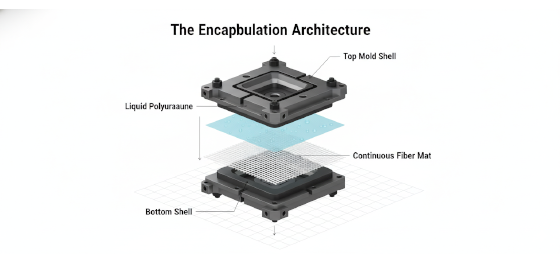
Structural differentiation in the RIM family is a byproduct of reinforcement morphology. structural reaction injection molding srim is a manufacturing process that utilizes a "Skeleton-First" approach. Unlike RRIM, which mixes microscopic milled fibers directly into the liquid resin, SRIM involves pre-placing a continuous fiber mat—often glass, carbon, or aramid—inside the mold cavity before it is closed. When the liquid Polyol and Isocyanate are injected, they flow *through* the fabric, saturating the fibers at a molecular level before the cross-linking reaction solidifies the matrix. This distinction is critical: continuous fibers provide a path for stress to travel across the entire part, whereas short fibers in RRIM can only resist localized loads. Jucheng Precision leverages this "Monolithic Reinforcement" to deliver Custom large plastic enclosures that possess the structural modulus of aluminum but with the fatigue resistance of a modern wind turbine blade.
Why is SRIM the ultimate metal replacement strategy for large parts?
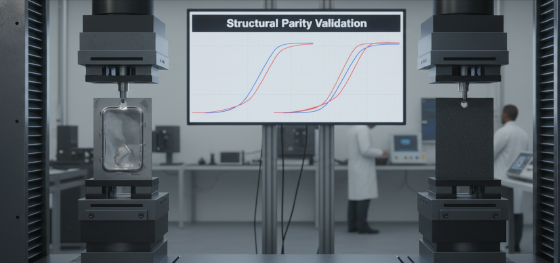
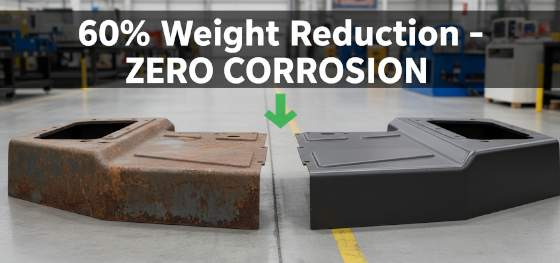
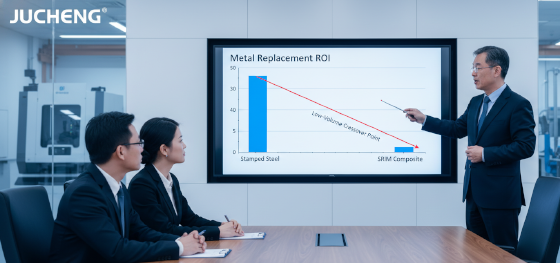
Strength-to-weight ratios dictate the ROI of modern transportation hardware. For every pound of steel removed from a heavy truck or an aircraft interior, the lifelong operational cost plummets. structural reaction injection molding srim provides the highest mechanical performance in the RIM family, effectively matching the yield strength of stamped steel while reducing mass by up to 60%. Below is the technical performance matrix our engineers use to guide metal-to-SRIM conversion for Large plastic parts manufacturing:
| Strategic Property | Stamped Carbon Steel | JUCHENG SRIM (Carbon Fiber) |
|---|---|---|
| Specific Stiffness | 1.0x (Base) | 3.5x (Weight Winner) |
| Corrosion Resistance | Poor (Needs Paint/Plating) | Immune (Inert Polymer) |
| Impact Energy Absorption | Low (Deforms permanently) | Extreme (Elastic recovery) |
| Part Consolidation | Limited (Welding required) | High (Monolithic design) |
How does continuous fiber mat integration impact mechanical stiffness?
Mechanical leverage in SRIM is dictated by the "Aspect Ratio" of the reinforcement. While RRIM uses fibers measured in millimeters, SRIM utilizes fibers that span the entire length of the component. This allows for "Directional Reinforcement"—the ability to align the fiber weave in the direction of the expected mechanical load. If your drone chassis experiences a high-torsion force, Jucheng Precision engineers rotate the fiber pre-form to counteract that specific vector. structural reaction injection molding srim transforms a flexible polyurethane into a rigid, non-linear spring. The continuous glass or carbon strands prevent the part from elongating under tension, effectively raising the flexural modulus from 500 MPa to over 15,000 MPa. We turn "plastic shells" into "structural frames," providing the mechanical spine needed for oversized automotive floor pans and satellite mounting plates.
What are the technical challenges of 3D pre-form placement in SRIM?
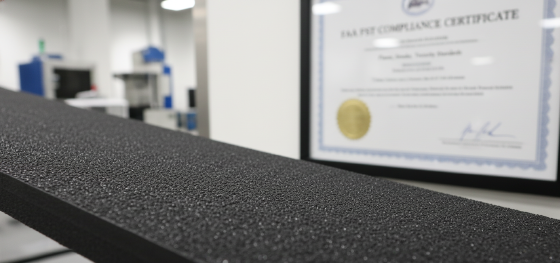
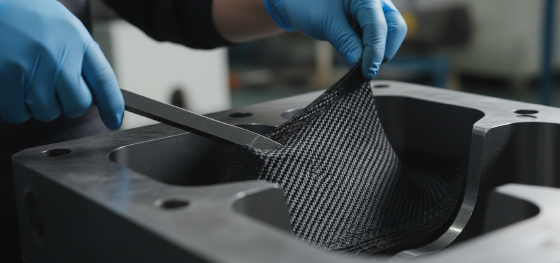
Manufacturing "Pre-form Discipline" is the hallmark of a master composite house. The most difficult aspect of structural reaction injection molding srim is ensuring the fiber mat doesn't bunch up or "wash away" during the resin injection. If the fabric shifts, you get resin-rich areas (weak spots) and dry fibers (delamination risks). Jucheng Precision toolmakers utilize 5-axis CNC machining to create specialized "Fabric Tensioners" within the mold. We don't just "drop in a mat"; we drape it over complex 3D contours using robotic assist or master manual layup techniques. We utilize Painting and finishing large plastic parts protocols to ensure the final composite skin is as beautiful as it is strong, hiding the underlying fiber weave with automotive-grade coatings. We turn "raw composites" into "certified hardware," ensuring your high-mass structural parts fit perfectly and survive the most aggressive vibration audits.
How does JUCHENG deliver aerospace-grade SRIM in Shenzhen?
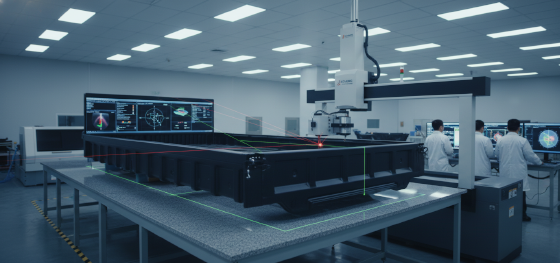
Engineering excellence at Jucheng Precision is built on the foundation of single-source accountability for high-performance polymers. We recognize that Large plastic medical enclosures and aerospace frames require more than just a shape; they require a validated pedigree of strength. Our facility, housing over 150 machines and specialized composite cleanrooms, is optimized for the rigorous "Layup-to-Launch" roadmap. We provide full material lot traceability and CMM dimensional inspection reports for every SRIM batch, ensuring your project meets the strict requirements of the FAA and ISO 13485 auditors. Stop gambling your structural integrity on brittle short-fiber mockups. Leverage our decade of continuous-fiber mastery to validate rapidly and launch profitably. Contact our technical team today for a free DFM review and an itemized Large plastic molding cost audit for your next structural breakthrough.
Frequently Asked Questions: SRIM Technology
Question: Can SRIM parts be recycled?
Answer: Because SRIM utilizes thermoset polyurethane and continuous fibers, it cannot be re-melted. However, Jucheng Precision works with recycling partners to grind end-of-life SRIM parts for use as high-strength filler in concrete or asphalt.
Question: What is the lead time for an SRIM structural part?
Answer: Due to the complexity of the fiber pre-form design, SRIM tooling typically takes 4-5 weeks. This is still 50% faster than a comparable stamped-metal tool or a massive high-pressure injection mold.
Question: How does SRIM handle "Insert Molding"?
Answer: Jucheng Precision specializes in molding metal brackets and threaded fasteners directly into the SRIM matrix. The continuous fibers wrap around the hardware, providing pull-out resistance that is ten times higher than standard plastic.

