


Manufacturing sovereignty in oversized hardware is won through the mastery of liquid polymer kinetics. In the hyper-competitive landscape of 2026, many design engineers encounter a "Structural Wall" when scaling from handheld devices to meter-long industrial enclosures. Traditional Large plastic parts manufacturing relies on high-pressure injection molding, a process that requires multi-ton steel tools and six-figure financial anchors. Navigating this bottleneck requires the strategic deployment of reaction injection molding materials. This technology represents the bridge between "experimental scaling" and "market-ready reality," utilizing low-pressure thermoset chemistry to deliver components that possess the mechanical soul of metal with the lightweight agility of high-performance polymers. Jucheng Precision operates as a high-fidelity manufacturing sanctuary in the Shenzhen precision manufacturing hub, providing the technical depth to ensure your largest designs remain capital-efficient and structurally stable. We don't just "fill boxes"; we engineer a specialized chemical ecosystem where oversized hardware survives the laboratory and dominates the market.

Establishing a resilient launch for large-format hardware demands the rejection of traditional "solid plastic" dogmas. Amateurs often struggle with the "Sink Mark Crisis" and "Warpage Debt" when attempting to mold parts larger than one meter. Jucheng Precision eliminates these "Biological Failures" of the supply chain by positioning Reaction Injection Molding (RIM) as the primary hero for Low volume large plastic parts. By utilizing liquid polyurethane and polydicyclopentadiene (DCPD) systems, we can mold 15mm strengthening ribs behind 3mm cosmetic walls without a single surface blemish. Whether you are developing a specialized medical MRI shroud or a heavy-duty industrial robotic chassis, our RIM material solutions allow you to bypass the CapEx barrier and launch your product in weeks, not months. This guide deconstructs the physics of molecular cross-linking, the necessity of fiber reinforcement, and why JUCHENG’s "Material Protocol" is the mandatory foundation for anyone developing Custom large plastic enclosures for 2026 market entry.
How do reaction injection molding materials differ from injection molding resins?
When should you choose rigid polyurethane for oversized enclosures?
How do elastomeric RIM materials provide high-impact protection?
Why use foamed polyurethane for oversized weight reduction?
How do RRIM and SRIM replace metal frames in heavy-duty assemblies?
What makes DCPD the material of choice for heavy machinery hoods?
How to ensure flame retardant compliance (UL94 V-0) in large parts?
Technical Matrix: Navigating Reaction Injection Molding Material Properties
Frequently Asked Questions: RIM Materials
How do reaction injection molding materials differ from injection molding resins?
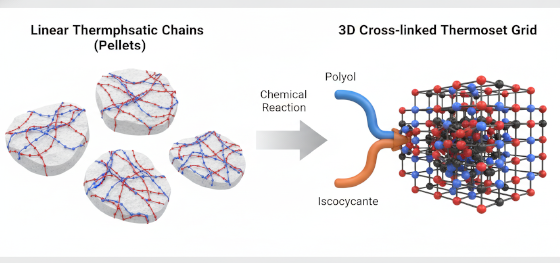
Molecular synthesis inside the mold cavity represents the primary divide between these two industrial technologies. In standard molding, the material arrives as solid thermoplastic pellets that are physically melted and rammed into a tool. In the world of reaction injection molding materials, the material arrives as two separate low-viscosity liquid components—Polyol and Isocyanate. These liquids are mixed in JUCHENG’s high-pressure impingement head and injected into the tool at room temperature. The part is not just "shaped"; it is "created" via a permanent chemical cross-linking reaction. This exothermic event forms a 3D molecular grid that is far more stable than the linear chains of a thermoplastic. Because the liquids flow like water, they fill oversized 2-meter cavities at pressures under 100 psi, allowing for the use of lightweight aluminum tools. We turn "chemical potential" into "mechanical assets," delivering parts that don't sag or creep under their own weight.
When should you choose rigid polyurethane for oversized enclosures?
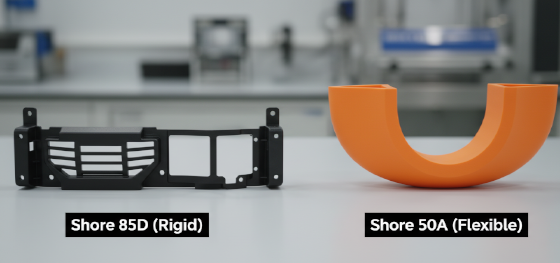
Dimensional sovereignty dictates the selection of rigid RIM for Large plastic medical enclosures and server rack bezels. Rigid polyurethane reaction injection molding is the material of choice when you require the high flexural modulus of ABS combined with the "unbreakable" ductility of Polycarbonate. Jucheng Precision engineers utilize rigid PU to manufacture CT scanner shrouds that must maintain sub-millimeter tolerances across massive spans. Unlike injection molding, where thick sections cause sink marks, rigid RIM allows us to mold heavy internal mounting points directly behind Class-A cosmetic surfaces. We simulate the haptics of production-grade plastics, delivering oversized hardware that captures intricate Mold-Tech textures and accepts automotive-grade paints with spectacular adhesion. We provide the structural spine required for professional enclosures that must survive 24/7 clinical or industrial operation.
How do elastomeric RIM materials provide high-impact protection?

Kinetic energy absorption is a byproduct of low-cross-link-density chemistry. Elastomeric reaction injection molding utilizes specialized "long-chain" polyols that allow the material to stretch and recover without permanent deformation. These materials mimic the performance of Polypropylene (PP) and high-end synthetic rubbers. Jucheng Precision leverages elastomeric RIM for the production of oversized fenders, tractor bumpers, and protective strips for warehouse robotics. Because the material is isotropic, it distributes impact stress evenly through the molecular matrix, preventing the localized shattering common in brittle polymers. Whether your project is a 1.5-meter off-road vehicle shroud or a vibration-damping base for heavy equipment, our elastomeric solutions provide the "Molecular Forgiveness" needed to survive real-world abuse without compromising the Large plastic molding cost.
Why use foamed polyurethane for oversized weight reduction?
Mechanical leverage on a large scale is won through the creation of a "Sandwich Structure." Structural foam reaction injection molding involves introducing a chemical blowing agent that expands the internal core of the part while the mold surface creates a dense, solid skin. This results in a component that is 30% lighter than solid plastic but significantly stiffer due to its increased thickness. Jucheng Precision utilizes structural foam for How to manufacture large plastic parts where mobility is a requirement, such as mobile diagnostic workstations. By doubling the wall thickness to 10mm using foam, we exponentially increase the "Moment of Inertia," delivering a rigid housing that a clinician can push with one hand. We turn "excess mass" into "structural stiffness," slashing your shipping costs and improving user ergonomics simultaneously.
How do RRIM and SRIM replace metal frames in heavy-duty assemblies?
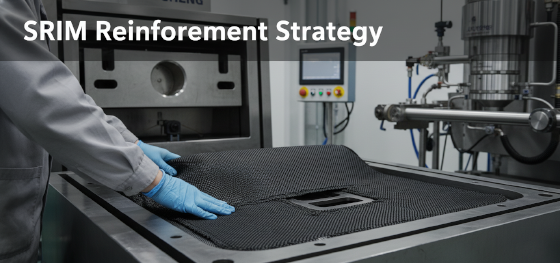
Strength-to-weight ratios are redefined when liquid resins meet fiber reinforcement. reinforced reaction injection molding rrim involves adding microscopic glass or mineral fillers into the liquid Polyol to anchor the dimensions and reduce thermal expansion (CLTE). Jucheng Precision utilizes RRIM for automotive body panels that must stay flat under a sweltering sun. For even higher loads, we deploy structural reaction injection molding srim, where continuous fiber mats (glass or carbon) are pre-placed in the mold before injection. SRIM provides the mechanical spine to replace stamped steel floor pans and heavy aerospace interior frames. We bridge the gap between "plastic shells" and "structural frames," delivering aerospace-grade composite performance for 70% less in upfront CapEx than traditional metal forming tools. We don't just provide parts; we provide the "Reinforcement Sovereignty" required for heavy transport and defense applications.
What makes DCPD the material of choice for heavy machinery hoods?
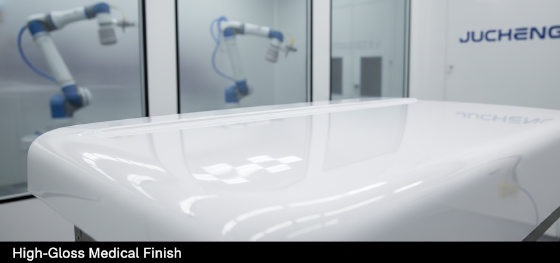
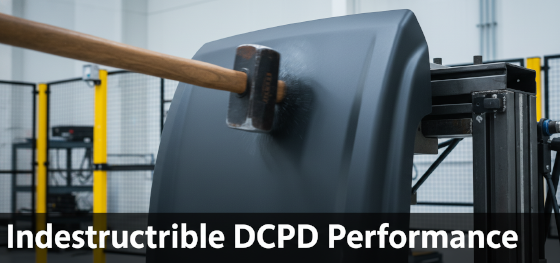
Uncompromising toughness defines the value of Polydicyclopentadiene (DCPD). In the world of reaction injection molding materials, DCPD stands alone as the most impact-resistant polymer available for large-format hardware. It possesses a viscosity close to water, allowing it to fill 3-meter long molds with extreme ease. Jucheng Precision utilizes DCPD for excavator hoods, tractor covers, and commercial truck air deflectors. This material is virtually indestructible; it survives sub-zero impacts that would shatter fiberglass and ignores the corrosive chemicals of the construction site. While DCPD requires specialized primers for Painting and finishing large plastic parts, JUCHENG’s integrated finishing bay is equipped to deliver a Class-A automotive finish on these heavy-duty assets. We turn "vulnerable equipment" into "unbreakable hardware," ensuring your brand survives the most hostile jobsites on Earth.
How to ensure flame retardant compliance (UL94 V-0) in large parts?
Safety-critical environments demand materials that refuse to fuel a fire. For Large plastic medical enclosures and IT server rack bezels, achieving a UL94 V-0 rating is a non-negotiable legal mandate. Jucheng Precision provides Flame retardant RIM polyurethane systems that are engineered to self-extinguish within seconds of ignition and produce zero flaming drips. Unlike additive resins that melt and burn, our V-0 RIM formulations maintain their structural integrity during thermal runaway events. We provide the material lot traceability and safety documentation required to pass global regulatory audits. By front-loading this compliance during the low-volume manufacturing phase, we allow your team to validate the design with 100% confidence, ensuring your hardware is as safe for the clinician as it is for the patient.
Technical Matrix: Navigating Reaction Injection Molding Material Properties
Engineering confidence is built on the foundation of the Technical Data Sheet (TDS). Selecting a material for a 2-meter panel requires an interrogation of flexural modulus and thermal stability. To assist in your early-stage routing, Jucheng Precision provides the following definitive comparison of reaction injection molding material properties across our primary resins:
| Material Class | Tensile Strength | Flexural Modulus | Key Advantage |
|---|---|---|---|
| Rigid PU | 75 MPa | 2,800 MPa | Mirror-like Surface |
| Elastomeric PU | 25 MPa | 400 MPa | High Elongation |
| Structural Foam | 45 MPa | 1,800 MPa | Weight Reduction |
| DCPD | 45 MPa | 1,900 MPa | Indestructible |
Frequently Asked Questions: RIM Materials
Question: How big can JUCHENG produce parts using these materials?
Answer: Our Shenzhen facility handles parts up to 2.5 meters in length. The low viscosity of reaction injection molding materials like DCPD and PU makes them the undisputed champions for oversized industrial hardware.
Question: Can RIM materials be silk-screened or laser-marked?
Answer: Yes. Jucheng Precision provides in-house screen printing and laser etching services. Because RIM parts are chemically stable, they provide a superior substrate for permanent branding and traceability.
Question: How does the cost of RIM compare to standard injection molding for 500 parts?
Answer: On average, our clients save 80% on Large plastic molding cost by switching to RIM for small batches. The low-pressure aluminum tools eliminate the six-figure financial anchor of high-volume steel.
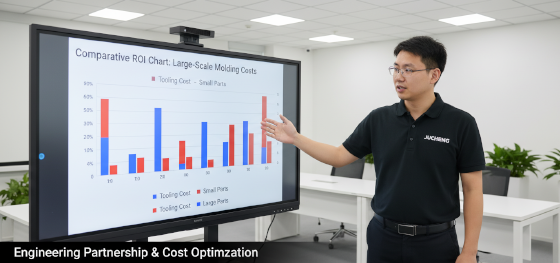
Manufacturing sovereignty on a large scale requires a partner who values your ROI over their machine uptime. Jucheng Precision eliminates the friction of vendor-hopping by offering integrated CNC, RIM, and high-fidelity finishing under one ISO 9001 certified roof. Stop gambling your large-format design on crude shells or expensive steel. Leverage our decade of large-scale replication mastery to validate rapidly and scale profitably. Contact our technical team today for a free DFM review and see how we can turn your digital intent into a structurally sovereign, large-scale reality that is documented for success.

