


Sourcing hardware from five different scattered factories guarantees an absolute assembly nightmare. Procurement teams often split their orders, sending metal brackets to a CNC shop across town while ordering plastic shells from a separate overseas vendor to save pennies. Blaming the logistics manager when these components arrive completely refusing to bolt together happens far too often. Resolving these catastrophic tolerance mismatches requires abandoning fragmented supply chains entirely. Securing reliable Unmanned aerial vehicle parts demands a single, unified factory ecosystem that holds absolute accountability for every single millimeter of the final assembly.

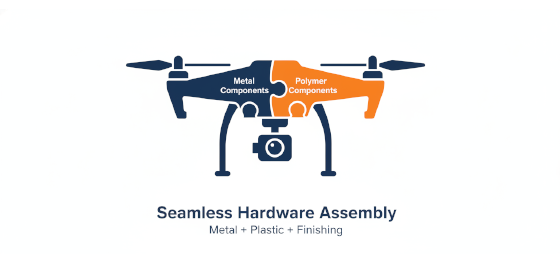
Managing complex aerospace projects requires seamless material integration. Flight engineers constantly mix heavy load-bearing aluminum with featherweight polymers to maximize battery endurance. Bridging the physical gap between these drastically different materials is notoriously difficult. Executing Custom Drone and UAV Parts Manufacturing properly means your factory partner must possess deep expertise in both subtractive metallurgy and advanced chemical casting.
Protecting your commercial rollout schedule means eliminating the finger-pointing that ruins hardware startups. Let's dissect why multi-vendor procurement destroys product tolerances, how integrating distinct materials requires extreme precision, and why consolidating your supply chain inside a turnkey Shenzhen facility saves your launch date.
content:
The Multi-Vendor Trap: Why Do Components Clash?
Multi-Material Magic: Blending Metals and Polymers
Technical Data: Benchmarking Supply Chain Logistics
JUCHENG Hub: Shenzhen's Turnkey Assembly Core
FAQ: Honest Answers About Hardware Kitting and NDA Security
The Multi-Vendor Trap: Why Do Components Clash?

Why do perfectly machined metal brackets fail to align with injection-molded plastic shells?
Because different factories use different calibration standards; if the CNC shop machines exactly to the CAD file but the plastic molder fails to calculate material shrinkage correctly, the mounting holes will drift permanently out of alignment.
Fragmenting your production orders creates a massive liability gap. When the metal refuses to fit the plastic, the machine shop blames the molder, and the molder blames the machine shop. Meanwhile, your assembly line grinds to a complete halt, and your company absorbs the massive financial loss of scrapping the mismatched parts.
Eliminating this catastrophic risk requires forcing one vendor to own the entire physical assembly. A turnkey contract manufacturer actively test-fits the raw metal skeleton against the freshly cast polyurethane covers before anything gets shipped, guaranteeing absolute zero-gap tolerances upon delivery.
Multi-Material Magic: Blending Metals and Polymers

How do engineers securely join heavy aluminum chassis arms to delicate plastic sensor domes?
By utilizing advanced manufacturing techniques like heat-staking threaded brass inserts directly into the plastic, providing a crush-proof metallic anchor point for the heavy-duty aluminum bolts.
Designing an aircraft entirely out of aluminum creates a heavy flying brick that blocks GPS signals. Designing it entirely out of plastic creates a fragile toy that shakes itself to pieces. Commercial flight hardware demands a hybrid approach. You need unyielding aerospace aluminum for the motor mounts, and flexible, radio-transparent polymers for the exterior weather shielding.
Executing this hybrid strategy effectively requires a supplier with incredibly diverse machinery. We routinely utilize 5-axis CNC mills to carve the structural aluminum core, while simultaneously pouring a custom Drone housing prototype in our vacuum casting bay, ensuring both drastically different materials mate flawlessly.
Technical Data: Benchmarking Supply Chain Logistics

Calculating the true cost of ownership requires looking far past raw part prices. The logistical matrix below highlights the hidden financial bleeding that occurs when startups fragment their hardware sourcing.
| Procurement Strategy | JUCHENG Turnkey Consolidation | Multi-Vendor Fragmentation |
|---|---|---|
| Tolerance Accountability | Absolute (We own the final fitment) | None (Constant finger-pointing) |
| Global Freight Costs | Single consolidated shipment | Multiple expensive inbound shipments |
| Intellectual Property Risk | Very Low (One strict NDA signed) | Extremely High (Files sent globally) |
| Cosmetic Finish Matching | Perfect (Painted in the same booth) | Poor (Different shops use different paint batches) |
Shipping bare metal parts from a machine shop to a separate paint facility exposes them to scratches and oxidation. By keeping the entire fabrication and finishing cycle inside a single building, you entirely neutralize the transit damage that ruins high-end commercial aesthetics.
JUCHENG Hub: Shenzhen's Turnkey Assembly Core

Why trust Jucheng Precision with your complete multi-material bill of materials?
Because we maintain a massive 8,000 square meter facility equipped with advanced CNC bays, cleanroom painting lines, and rapid plastics departments to execute every phase of your CAD design seamlessly.
Scaling a commercial fleet requires relentless speed. We drastically accelerate your time to market by milling your structural chassis on our Mazak machines while our plastics team pours your exterior weather domes simultaneously. We test-fit the final sub-assemblies before boxing them up.
Stop chasing delayed shipments from disorganized brokers. Send your complete multi-component CAD assemblies to our engineering team today. We provide a ruthless DFM analysis, consolidate your supply chain, and deliver perfectly mated flight hardware ready for immediate takeoff.
FAQ: Honest Answers About Hardware Kitting and NDA Security
Can you deliver hardware as a complete "ready-to-assemble" kit?
Absolutely. We regularly package the finished CNC metal, the cast plastics, and all required threaded fasteners into highly organized custom foam kits, making your final assembly incredibly fast.
How do you protect our unreleased aircraft designs from competitors?
We enforce strict confidentiality principles, signing legally binding NDAs and physically restricting access to our assembly bays to ensure your experimental CAD files remain entirely secure.
Do you assemble the electrical motors and wiring harnesses in-house?
We focus strictly on fabricating flawless mechanical structures and exterior enclosures. We leave the complex wiring, motor integration, and flight controller programming to your internal aerospace technicians.
What happens if the metal brackets don't fit the plastic shells perfectly?
Because we manufacture both components internally, this rarely happens. If a tolerance issue arises during our internal test-fit phase, we immediately halt production and adjust the machinery before anything ships to you.

