


Sending expensive electronics into the crushing depths of the ocean leaves absolutely zero room for manufacturing errors. Procurement teams often underestimate the brutal physical reality of deep-sea environments, assuming standard flight hardware can simply be sealed with heavy silicone. Executing Custom Drone and UAV Parts Manufacturing for underwater operations requires an entirely different metallurgical approach. Saltwater ruthlessly attacks cheap metals, triggering rapid galvanic corrosion that eats through thin walls in a matter of weeks. When the structural integrity fails, microscopic leaks destroy the motherboards and sink your entire financial investment instantly.
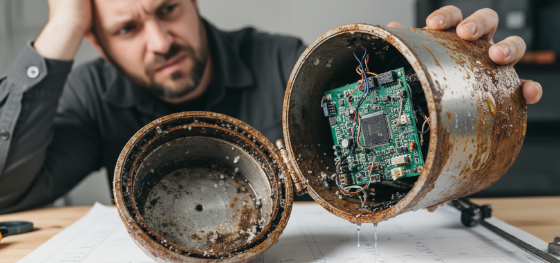
Securing a reliable ROV enclosure prototype demands flawless subtractive machining to create impenetrable watertight seals. Simply bolting two flat pieces of metal together underwater guarantees a catastrophic flood. Operating out of our Shenzhen precision manufacturing hub, Jucheng Precision utilizes advanced 5-axis milling to carve exact, microscopic compression grooves that lock out extreme oceanic pressures.
Navigating this high-stakes maritime industry means calculating exact material tolerances before you cut steel. Let's dissect the terrifying crushing forces involved, compare ultimate marine-grade alloys, and define exactly how CNC precision keeps your subsea robotics completely dry.
content:
Crushing Depths: The Unique Challenges of ROVs
CNC Machining: The Key to Watertight Seals
Technical Data: Best Materials for Saltwater
JUCHENG Hub: Hard Anodizing and Assembly
FAQ: Honest Answers About O-Rings and Titanium
Crushing Depths: The Unique Challenges of ROVs

Why do standard sealed boxes collapse instantly when submerged in deep oceanic trenches?
Extreme hydrostatic pressure exerts massive crushing force from every single direction, causing weak geometric shapes and thin metallic walls to physically buckle and implode upon themselves.
Designing for the abyss requires thick, cylindrical geometries that naturally distribute external pressure evenly across the hull. Attempting to use a flat-sided square box for your ROV enclosure prototype invites disaster, as the water pressure will violently push the flat panels inward, crushing your delicate batteries and sensors.
Validating these heavy-duty designs requires specialized hyperbaric testing chambers. Hardware founders quickly realize that sealing out rain requires minimal effort, but holding back massive walls of pressurized seawater demands military-grade mechanical engineering.
CNC Machining: The Key to Watertight Seals

How do factories guarantee zero water intrusion around camera lenses and cable tethers?
By utilizing advanced 5-axis CNC machines to cut microscopic O-ring compression grooves with absolute zero-gap tolerances, ensuring the rubber gasket seats perfectly under immense pressure.
Relying on cheap casting or 3D printing for these critical mating surfaces is a death sentence for marine robotics. Evaluating a basic Drone housing prototype for light rain resistance is drastically different than engineering a physical barrier to stop pressurized deep-sea water from exploding through a seam.
Protecting the internal cavity relies entirely on compressing a rubber O-ring exactly twenty to thirty percent. If your machine shop mills the groove a fraction of a millimeter too deep, the rubber will not compress enough, creating a tiny channel for water to flood the chassis. Our CNC operators verify every single sealing groove using optical lasers before the part leaves the spindle.
Technical Data: Best Materials for Saltwater

Selecting the wrong alloy guarantees rapid galvanic decay. The engineering matrix below highlights the top-tier materials capable of surviving continuous, unprotected exposure to aggressive oceanic environments.
| Marine Material | Key Underwater Advantage | Primary ROV Application |
|---|---|---|
| Titanium (Grade 5) | Absolute immunity to saltwater corrosion, unbelievable strength-to-weight ratio. | Ultra-deep ocean exploration hulls. |
| Stainless Steel 316L | Highly resistant to pitting, incredible compressive strength. | Heavy-duty camera housings, external thruster mounts. |
| Aluminum 6061-T6 (Anodized) | Excellent machinability and heat dissipation, but requires chemical sealing. | Main chassis frames for shallow water mapping. |
| POM Plastic (Delrin) | Zero water absorption, completely immune to galvanic rust, excellent rigidity. | Non-structural sensor mounts, tether clamps. |
Matching your required diving depth to your material budget is crucial. While Titanium offers the ultimate bulletproof solution for thousands of meters deep, machining it destroys expensive CNC drill bits rapidly, driving up your piece price. Deploying 316L Stainless Steel provides a fantastic, cost-effective alternative for most commercial subsea inspection rigs.
JUCHENG Hub: Hard Anodizing and Assembly

Why must you keep aluminum machining and anodizing within the exact same factory?
Shipping raw machined aluminum parts across town exposes them to immediate oxidation and physical scratching, ruining the microscopic sealing surfaces before they can be chemically hardened.
Keeping your supply chain tight prevents catastrophic field failures. If a third-party plating shop applies the anodizing layer unevenly, your perfectly machined O-ring groove will suddenly be out of tolerance. We execute Type III hard anodizing completely in-house, adding a thick, impenetrable oxide armor without distorting your critical sealing geometries.
Stop risking your deep-sea equipment on unverified machine shops. Send your complex cylindrical CAD files to our engineering team today. We verify your ROV enclosure prototype compression tolerances mathematically and deliver unyielding marine hardware built for the abyss.
FAQ: Honest Answers About O-Rings and Titanium
Can I use a square or rectangular housing for shallow-water submersibles?
Yes, but only for very shallow depths (like swimming pools). Any significant depth requires cylindrical or spherical designs to prevent the flat panels from violently imploding inward.
Does anodizing aluminum make it completely immune to saltwater?
Type III hard anodizing provides massive protection, but any deep scratch will expose the raw metal underneath to aggressive galvanic corrosion. Titanium remains the only truly immune metal.
Why is POM (Delrin) preferred over nylon for underwater plastic parts?
Nylon actively absorbs water over time, causing the material to swell and change dimensions. POM possesses virtually zero water absorption, maintaining strict mechanical tolerances indefinitely underwater.
Do you provide pressure testing services for these machined housings?
We strictly provide extreme-tolerance CNC machining and surface finishing. Final hydrostatic hyperbaric pressure testing must be conducted by the client's internal engineering team upon delivery.

