


Designing commercial drones forces engineering teams into a brutal, continuous battle against gravity. Slapping off-the-shelf hobbyist components onto a heavy-duty commercial chassis guarantees catastrophic structural failure during high-wind operations. Procurement managers desperately need suppliers capable of blending extreme lightweighting with military-grade rigidity. Relying on cheap plastic brackets to secure a heavy-lift agricultural sprayer destroys the entire product lifespan instantly. Sourcing strictly optimized Custom Drone and UAV Parts Manufacturing solves this dangerous payload dilemma permanently.
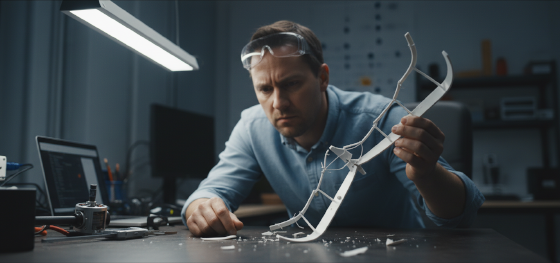
Watching an expensive LiDAR scanner smash into the concrete because a weak motor mount vibrated itself to pieces is a terrifying financial loss. Aerospace hardware cannot tolerate guesswork. Operating from our Shenzhen precision manufacturing hub, Jucheng Precision engineers uncompromising flight hardware built specifically to survive harmonic vibrations and aggressive weather.
Scaling your aerial fleet securely means understanding exactly which fabrication method suits your unique payload requirements. Let's dissect the core aerospace machining strategies, analyze the most durable lightweight alloys, and map out the ultimate supply chain for next-generation uncrewed vehicles.
content:
The Payload Problem: Why Off-the-Shelf Parts Fail?
Factory Tech: Milling, Printing, and Casting
Flight Materials: Balancing Metals and Polymers
Industry Applications: Farms, Oceans, and Mapping
JUCHENG Hub: Shenzhen's Advanced Aerospace Arsenal
FAQ: Honest Answers About GPS Signals and Waterproofing
The Payload Problem: Why Off-the-Shelf Parts Fail?
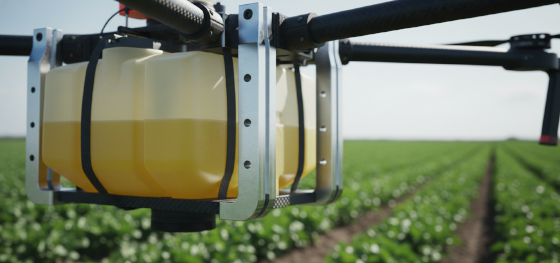
Why do commercial fleets refuse to use standard injection-molded hobby brackets?
Standard consumer parts cannot withstand the aggressive harmonic vibrations, extreme payload torque, and severe UV radiation that industrial flight controllers face daily.
Cheap plastic molding works perfectly for indoor toys, but it shatters instantly when attached to a fifty-pound commercial drone. Carrying expensive thermal cameras or heavy agricultural pesticides requires absolute structural certainty. Deploying custom Unmanned aerial vehicle parts guarantees your mounting points will never snap mid-flight.
Weight reduction dominates every single engineering conversation in this sector. Shaving just fifty grams off a complex camera gimbal extends the battery flight time significantly. Custom fabrication allows designers to strip away all unnecessary mass through precise topological optimization.
Factory Tech: Milling, Printing, and Casting
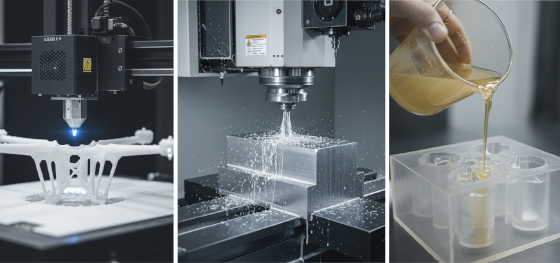
Which specific factory technologies produce the most reliable flight hardware?
Combining 5-axis CNC milling for rigid structural metal, industrial 3D printing for aerodynamic testing, and vacuum casting for low-volume plastic shells creates a perfect prototyping triad.
Carving structural components out of solid aerospace-grade aluminum requires immense machine rigidity. Utilizing advanced Drone chassis CNC machining delivers absolute zero-gap tolerances for critical motor mounts. This extreme precision ensures your rotors remain perfectly aligned, completely eliminating the aggressive harmonic vibrations that destroy internal motherboards.
Freezing a CAD design without physically testing its wind resistance is a massive financial risk. Ordering a UAV frame prototype through our industrial SLS printing bays provides immediate physical validation. Hardware teams can quickly test aerodynamic drag and camera clearances before committing to expensive steel injection molds.
Paying for massive steel tooling just to launch a pilot fleet of fifty drones destroys your initial R&D budget. Securing a Drone housing prototype via vacuum casting completely bypasses those NRE fees. You receive weather-sealed polyurethane covers that look and perform exactly like mass-produced ABS plastic.
Flight Materials: Balancing Metals and Polymers
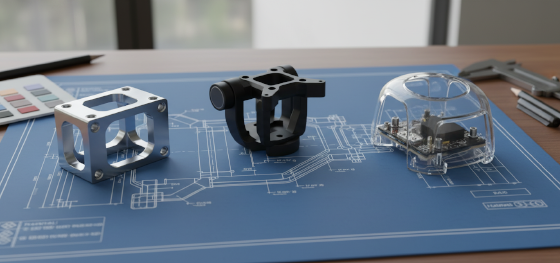
Why can't you use metal for the entire exterior drone housing?
Solid metallic chassis frames completely block internal GPS and telemetry radio signals, making specialized engineering plastics absolutely mandatory for the outer protective shells.
| Material Category | Key Engineering Advantage | Primary Flight Application |
|---|---|---|
| Aluminum 7075 / 6061 | Unbeatable strength-to-weight ratio and heatsink capabilities. | Main chassis arms, high-torque motor mounts. |
| Magnesium Alloys | Lightest structural metal, incredible vibration dampening. | Ultra-light camera gimbals, sensor brackets. |
| Polycarbonate (PC) / ABS | High impact resistance, does not block radio frequencies. | Outer protective shells, GPS domes. |
| Stainless Steel 316L | Extreme corrosion resistance and pressure survival. | Deep-sea robotic exploration housings. |
Protecting delicate flight controllers from rain and dust requires durable, impact-resistant polymers. Blending Polycarbonate with ABS creates an incredibly tough shell that survives harsh crash landings. Using glass-filled Nylon adds extreme stiffness to propeller guards without adding unnecessary metallic weight.
Industry Applications: Farms, Oceans, and Mapping

Which niche commercial markets require the most aggressive custom manufacturing?
Agricultural sprayers demand intense chemical resistance, deep-sea exploration vehicles demand extreme pressure seals, and infrastructure mapping drones require absolutely zero-vibration camera mounts.
Navigating deep ocean trenches introduces terrifying physical challenges. High-pressure saltwater violently attacks standard metals and crushes weak plastics. Machining a rugged ROV enclosure prototype from 316L stainless steel guarantees your internal subsea electronics survive crushing oceanic depths flawlessly.
Mapping critical infrastructure requires massive battery packs and perfect aerodynamic balance. Developing a lightweight Survey drone body prototype ensures your expensive LiDAR equipment remains perfectly stable during long-range inspection flights. We cut these frames to absolute microscopic tolerances to eliminate imaging blur.
Spraying corrosive pesticides across hundreds of acres subjects hardware to brutal chemical wear. Machining a heavy-duty Agricultural drone bracket from solid aluminum and applying thick protective powder coating ensures the drone survives daily toxic exposure. These heavy-lift rigs require unyielding structural integrity to carry massive liquid payloads safely.
JUCHENG Hub: Shenzhen's Advanced Aerospace Arsenal

Why do top commercial flight brands consolidate their manufacturing in Shenzhen?
Combining extreme 5-axis CNC milling, rapid 3D prototyping, and aesthetic marine-grade anodizing under one roof entirely eliminates multi-vendor liability gaps.
Fragmenting your supply chain across different machine shops guarantees shipping delays and mismatched tolerances. Executing flawless Custom Drone and UAV Parts Manufacturing requires a single, unified factory ecosystem. Jucheng Precision houses 150+ CNC machines and dedicated assembly labs directly inside our facility.
Stop trusting disjointed brokers with your aerospace hardware. Send your intricate 3D CAD files to our engineering team today for a comprehensive DFM analysis. We will strip unnecessary weight from your design, select the perfect aerospace alloys, and deliver flight-ready components at unbeatable commercial speeds.
FAQ: Honest Answers About GPS Signals and Waterproofing

Can you CNC machine completely hollow, lightweight drone arms?
Yes. Complex internal hollows typically require splitting the design into two halves and bolting them together, or utilizing advanced 5-axis milling to carefully hollow out the core.
How do you protect aluminum drone frames from outdoor corrosion?
Applying Type III hard anodizing immediately after the CNC machining process creates an impenetrable oxide layer that completely seals the metal against saltwater and rain.
Will carbon fiber composite materials outperform CNC aluminum?
Carbon fiber offers incredible stiffness, but CNC machined aluminum provides far superior impact resistance, better heat dissipation for motors, and allows for highly complex integrated threaded mounts.
How fast can you deliver a complete set of prototype parts globally?
Depending on geometric complexity, our rapid tooling and high-speed CNC bays routinely deliver fully finished, flight-ready prototypes globally in as little as 4 to 15 business days.

