


Deploying high-value hardware into 24/7 solar exposure creates a silent chemical crisis for precision agriculture robotics. While software handles navigation, the sun’s high-energy photons relentlessly attack the molecular bonds of the robot's exterior. Unprotected polymers turn yellow, become chalky, and eventually crack under minimal mechanical stress. Selecting specialized UV resistant plastics for farm robots is the only way to prevent catastrophic enclosure failure during the peak of the [2026] growing season.
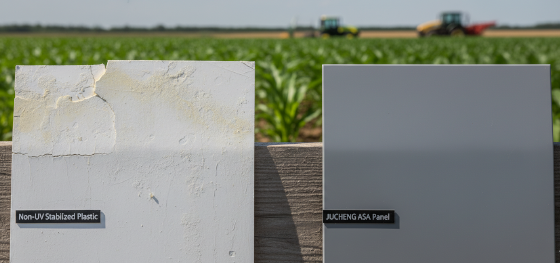
Continuous ultraviolet radiation triggers a process known as photodegradation. This chemical reaction breaks down polymer chains, reducing the material's impact strength and making it brittle enough to shatter from a simple gravel strike. Relying on standard indoor-grade ABS or untreated Polycarbonate is a recipe for field recalls. Jucheng Precision eliminates this risk by utilizing weather-rated resins and industrial coatings designed for the harshest open-field environments.
Operating within the Shenzhen precision manufacturing hub, JUCHENG offers an integrated approach to outdoor hardware longevity. We combine material science expertise with advanced CNC and molding processes to deliver components that maintain their structural integrity and color for years. This guide breaks down the critical material choices and secondary treatments required to build sun-proof agricultural hardware.
content:
Photodegradation Science: Why Plastics Fail
Comparative Data: Outdoor Polymer Performance
ASA: The Superior Alternative to Standard ABS
Industrial 2K Coatings for Enhanced UV Blocking
JUCHENG: Advanced Weather-Proofing Hub
FAQ: Outdoor Material Durability
Photodegradation Science: Why Plastics Fail
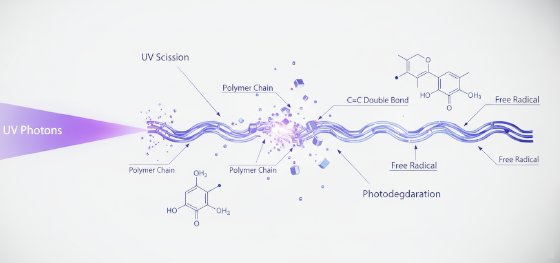
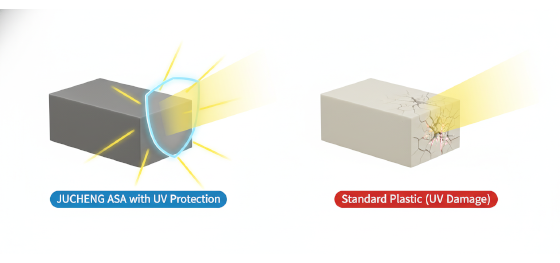
Solar energy is a powerful catalyst for free-radical oxidation in synthetic polymers. Ultraviolet rays, particularly the UV-A and UV-B spectrum, possess enough energy to exceed the carbon-carbon bond strength in many common plastics. When these bonds break, the material undergoes a series of chain scission reactions. This internal destruction manifests outwardly as "chalking"—the formation of a white, powdery residue that indicates the polymer matrix is physically disintegrating.
Impact resistance drops dramatically once photodegradation begins. A panel that could withstand a 10-joule impact during its first week in the field may fail at only 2 joules after six months of intense exposure. For autonomous harvesters or weeding drones, this means a small branch or a kicked-up stone can lead to a shattered shell, exposing the high-voltage interior to humidity and dust. JUCHENG mitigates this by sourcing resins with integrated HALS (Hindered Amine Light Stabilizers) that neutralize free radicals before they can propagate.
Color fading is often the first visible sign of failure. While aesthetics might seem secondary, fading often signals a loss of thermal regulation properties. Dark-colored enclosures that fade to gray or white may absorb heat differently, potentially confusing infrared sensors or thermal cameras integrated into the robot’s navigation system. Ensuring consistent color retention through high-quality UV resistant plastics for farm robots is essential for maintaining the predictable thermal signature of the entire machine.
Comparative Data: Outdoor Polymer Performance
Choosing the wrong material for an outdoor enclosure is a financial liability. Jucheng Precision provides technical design reviews to ensure your chosen polymer matches the expected lifecycle of your robot. The following data compares common plastics used in AgTech to demonstrate the superiority of weather-stable options like ASA and UV-stabilized PC.
| Material | UV Stability | Impact Toughness | Primary Benefit |
|---|---|---|---|
| ASA (Acrylate) | Exceptional | High | No Yellowing |
| PC (UV Stabilized) | High | Very High | Shatter Resistance |
| Nylon 12 (PA12) | Moderate | High | Chemical Resistance |
| ABS (Untreated) | Very Low | Moderate | Indoor Use Only |
ASA (Acrylic Styrene Acrylonitrile) is the industry standard for unpainted outdoor enclosures. Unlike ABS, which contains butadiene (a chemical highly sensitive to UV), ASA replaces it with a saturated acrylate elastomer. This molecular shift makes the material inherently resistant to the sun's rays without requiring constant secondary treatments. It maintains its physical properties and high-gloss or matte appearance even after years of continuous exposure in the [2026] farm environment.
ASA: The Superior Alternative to Standard ABS
Navigating the transition from prototype to production often involves switching from ABS to ASA for outdoor performance. ASA shares almost identical processing parameters with ABS, meaning the same molds and CNC programs can often be used for both. This allows for a seamless "bridge to production" where early-stage internal tests use cheaper ABS, but field-ready units are produced using UV resistant plastics for farm robots like high-impact ASA.
Dimensional stability remains exceptional with ASA. In the Shenzhen precision manufacturing hub, JUCHENG utilizes ASA for large-scale drone housings and sensor docks that must maintain tight tolerances across fluctuating temperatures. Standard plastics can expand and contract irregularly when heated by direct sunlight, causing sensor misalignment. ASA’s low coefficient of thermal expansion ensures that your LiDAR and camera systems remain calibrated regardless of the time of day.
Moisture resistance is a critical secondary benefit of ASA. Agricultural robots are frequently cleaned with high-pressure water or exposed to heavy dew and rain. ASA does not absorb moisture as readily as Nylon or ABS, preventing the "swelling" that can lead to gasket failure. By choosing ASA, you are selecting a material that resists both the sun's fire and the farm's water, providing a dual-layer of protection for the internal electronics.
Industrial 2K Coatings for Enhanced UV Blocking
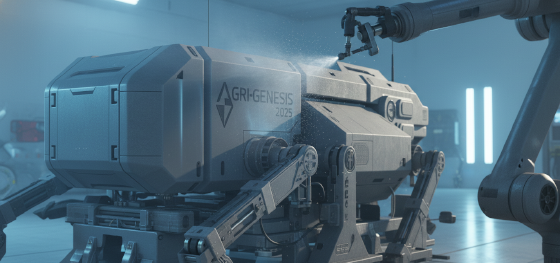
Secondary coatings provide an extra defensive barrier for materials that are functionally required but naturally UV-sensitive. If your design necessitates the extreme strength of Carbon-Filled Nylon or clear Polycarbonate, JUCHENG applies automotive-grade 2K urethane topcoats to provide the necessary protection. These coatings act as a "sunscreen" for the part, containing high concentrations of UV absorbers that prevent photons from ever reaching the polymer substrate.
Dust-free painting facilities at JUCHENG ensure that these coatings are applied with zero contamination. Even a single speck of dust can create a microscopic void in the UV coating, providing a "toehold" for solar degradation to begin. We utilize electrostatically charged painting systems to ensure 100% coverage on complex geometries, including deep recesses and sharp corners where traditional spray painting often fails to reach.
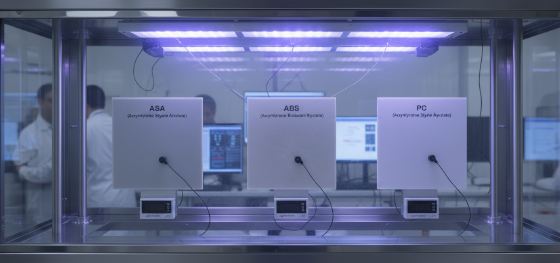
Testing these coatings involves accelerated weathering chambers. At Jucheng Precision, we simulate years of UV exposure in weeks to verify that our coating-substrate combinations will not peel, flake, or lose their blocking effectiveness. This level of verification is critical for AgTech OEMs who offer 5-to-10-year warranties on their autonomous fleets. Investing in high-end UV resistant plastics for farm robots with secondary coatings is a small upfront cost that prevents massive future liability.
JUCHENG: Advanced Weather-Proofing Hub

Manufacturing sun-proof hardware requires more than just buying the right resin; it requires a deep understanding of the molding and machining variables that affect outdoor life. Jucheng Precision manages every stage of the process, from initial DFM to final assembly, within our Shenzhen precision manufacturing hub. Our fleet of 150+ CNC machines and multi-ton injection presses is dedicated to producing the ruggedized shells that the future of farming demands.
Verification of material purity is a cornerstone of our quality control. Recycled or low-grade plastics often contain impurities that accelerate photodegradation. JUCHENG uses only virgin, certified resins from global leaders like Covestro and SABIC, ensuring that every batch of ASA or UV-stabilized PC meets the specific Shore D hardness and Charpy impact standards required for your project. We provide full material certifications for every shipment, giving your engineering team peace of mind during field trials.
Rapid iteration is our strength. We understand that the [2026] market moves fast, and getting a working, sun-protected prototype into the field can be the difference between winning or losing a season. Whether you need 10 vacuum-cast units for pilot testing or 5,000 injection-molded enclosures for a commercial rollout, JUCHENG provides the "Bridge to Production" necessary to scale without compromise. Our team is ready to analyze your designs for UV vulnerability and suggest the most cost-effective path to field-ready durability.
FAQ: Outdoor Material Durability
What is the best plastic for 10-year outdoor use?
ASA. It provides the best balance of UV stability and mechanical toughness.
Can standard ABS be used outdoors?
No. ABS yellow and becomes brittle within months of direct sun exposure.
Does painting plastic protect it from UV?
Yes. Automotive-grade topcoats act as a total UV barrier for the substrate.
How do you verify UV resistance?
We use Xenon Arc or QUV accelerated weathering tests to simulate long-term exposure.
Is ASA more expensive than ABS?
Slightly. However, the cost is significantly lower than the price of a field failure.
Solar degradation is a non-negotiable threat in the AgTech sector. Partnering with Jucheng Precision ensures that your large-scale enclosures are built with the UV-resistant ASA and specialized PC techniques the industry demands. Reach out to our Shenzhen manufacturing hub today for a complete DFM review and secure the future of your autonomous fleet.

