


Procurement executives hemorrhage capital when committing to hardened steel molds before ruthlessly validating market demand. Locking a flawed mechanical geometry into eighty thousand dollars of impenetrable H13 tool steel guarantees absolute financial disaster when early-stage engineering change orders (ECOs) strike. Navigating the treacherous gap between 3D printed concept models and multi-million-unit mass manufacturing demands a financially calculated intermediate step.
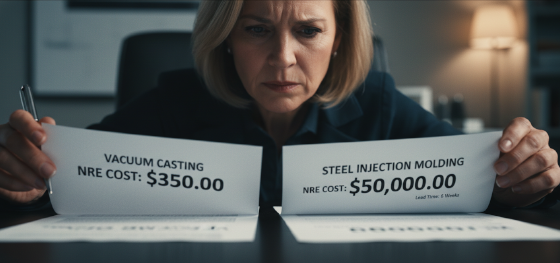
Selecting between Vacuum Casting vs Injection Molding dictates the cash flow survival of your hardware launch. Vacuum casting utilizes soft silicone to replicate high-fidelity polyurethane parts in mere days without devastating upfront tooling fees. Conversely, injection molding forcefully shoots molten thermoplastics into rigid metal cavities, prioritizing extreme cycle speeds and ultimate dimensional repeatability.
Mastering this specific break-even amortization curve prevents catastrophic budget blowouts during bridge production. Hardware teams must brutally evaluate silicone thermal degradation, mold draft angles, and raw non-recurring engineering (NRE) expenses. Precision economics relies entirely on matching the fabrication methodology to the exact lifecycle volume of the plastic component.
How Do Vacuum Casting and Injection Molding Mechanics Differ?
When Should You Use Vacuum Casting for Bridge Production?
When MUST You Avoid Silicone Molds for Plastic Parts?
Why Is Injection Molding Mandatory for High-Volume Scaling?
What Are the True NRE Break-Even Costs for Both Processes?
How Does Jucheng Optimize Low-Volume Manufacturing in Shenzhen?
What Are the Most Critical Rapid Molding FAQs?
How Do Vacuum Casting and Injection Molding Mechanics Differ?
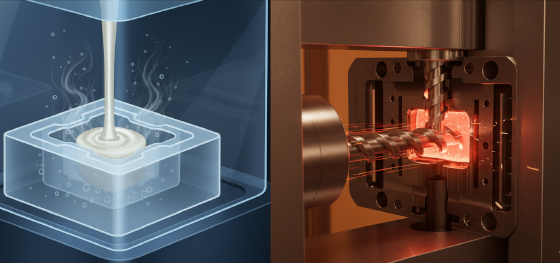
Vacuum casting utilizes negative atmospheric pressure to draw liquid polyurethane into a soft silicone cavity, whereas injection molding uses mechanical hydraulic rams to blast molten polymer into rigid steel.
Creating a silicone mold requires suspending a highly polished CNC or SLA master pattern inside a vat of liquid silicone. Once the silicone cures, technicians slice it open manually to extract the master, leaving a perfect negative void. Operating inside a vacuum chamber extracts all trapped oxygen, ensuring the poured polyurethane resin fills every microscopic texture flawlessly without air bubbles.
Injection molding introduces terrifying kinetic forces. Heavy steel dies slam shut under hundreds of tons of clamping pressure to resist the explosive force of the incoming 700-degree molten plastic. This brutal environment demands slow-wire EDM machining and intense thermal cooling channels to prevent the steel from heat checking over millions of repetitive shots.
When Should You Use Vacuum Casting for Bridge Production?
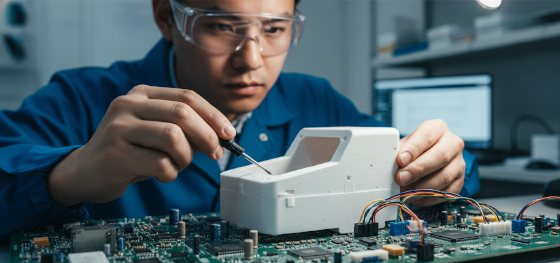
Specify urethane casting exclusively for investor trade shows, clinical medical device trials, and extremely low-volume market testing requiring less than fifty identical units.
Securing regulatory certification often demands testing physical components that precisely mimic final production materials. Advanced polyurethane blends flawlessly replicate the shore hardness of TPR rubber or the impact resistance of ABS. You receive fifty production-grade aesthetic parts in ten days, completely bypassing the agonizing twelve-week steel tooling bottleneck.
Furthermore, soft silicone inherently forgives complex geometries. Because the mold is flexible, operators can manually peel it away from slight undercuts or negative draft angles that would physically lock and destroy a rigid steel mold. This geometric leniency accelerates aggressive R&D iterations.
When MUST You Avoid Silicone Molds for Plastic Parts?

Deploying silicone molds for production runs exceeding twenty units guarantees catastrophic thermal degradation, resulting in massive parting line flash and destroyed dimensional tolerances.
Polyurethane resins trigger a violent exothermic chemical reaction as they cross-link and cure inside the cavity. This intense generated heat physically bakes and dries out the surrounding silicone. By the twentieth casting cycle, the mold loses its elasticity, tears along sharp corners, and begins leaking liquid resin outward, creating unacceptable razor-sharp flash.
You must absolutely reject vacuum casting when mechanical blueprints demand genuine UL-rated engineering thermoplastics like PEEK or 30% glass-filled nylon. Urethanes merely simulate these properties; they cannot match the extreme thermal deflection limits or chemical resistance required for harsh under-hood automotive environments.
Why Is Injection Molding Mandatory for High-Volume Scaling?
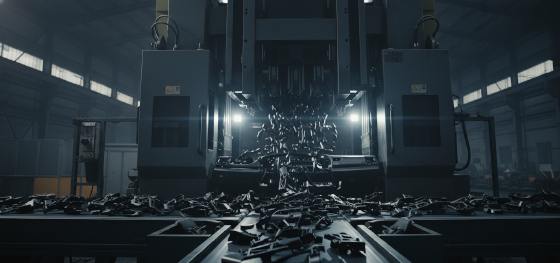
Commit to hard tooling the exact moment sales forecasts guarantee continuous production batches, as steel dies amortize exorbitant NRE costs down to negligible pennies per part.
Injection molding dominates global supply chains through sheer velocity. Once the CNC machining of the H13 steel cavity is complete, the machine ejects a perfectly formed, complex geometric enclosure every twelve seconds. This relentless, automated rhythm clears massive fulfillment backlogs instantly, a feat biologically impossible for manual silicone pouring.
High-pressure packing actively eliminates internal sink markers on thick-walled sections. By forcefully injecting extra resin during the cooling shrinkage phase, the machine ensures pristine, flat cosmetic surfaces. Unyielding steel guarantees that part number one million measures identically to part number one.
| Manufacturing Metric | Vacuum Casting (Urethane) | Injection Molding (Steel) | Financial & Design Impact |
|---|---|---|---|
| Upfront NRE Tooling Cost | $300 - $1,500 | $10,000 - $80,000+ | Silicone molds save startup cash flow |
| Per-Unit Part Cost | High ($15 - $50+) | Extremely Low ($0.10 - $2.00) | Steel dies dominate long-term margins |
| Tooling Lifespan | 15 - 25 Parts Max | 500,000 to 1 Million+ Parts | Silicone burns out rapidly from heat |
| Lead Time to First Part | 7 to 10 Days | 6 to 12 Weeks | Vacuum casting crushes time-to-market |
What Are the True NRE Break-Even Costs for Both Processes?

Calculating the exact intersection where high unit prices overwhelm cheap silicone determines the absolute financial trigger point for cutting hard steel.
Assume a complex medical bezel costs $500 for a silicone mold, plus $20 per poured unit. Manufacturing 20 parts costs $900 total. Producing a steel injection mold costs $15,000, but drops the unit price to $1.00. Making those same 20 parts via injection molding incinerates $15,020. Vacuum casting wins flawlessly.
However, scaling to 2,000 units radically shifts the dynamic. 2,000 urethane parts require purchasing 100 separate silicone molds (due to burnout), dragging the total invoice past $45,000. The injection molding route handles 2,000 units for a combined total of only $17,000. Data-driven executives never push soft tooling past its mathematical breaking point.
How Does Jucheng Optimize Low-Volume Manufacturing in Shenzhen?

Operating within the Shenzhen precision manufacturing hub, Jucheng entirely bridges the fatal gap between urethane pouring and hard steel production under a unified quality ecosystem.
Navigating [2026] supply chain pressures requires eliminating disjointed vendor handoffs. We deploy high-end SLA printers to generate flawless master patterns for our vacuum chambers, while simultaneously programming 5-axis CNC mills for your eventual transition to hardened injection dies. We scale your hardware seamlessly from unit one to one million.
Our engineering teams aggressively execute Free DFM reviews on your CAD geometry. If you request vacuum casting on a part heavily riddled with deep zero-draft ribs, we immediately flag the tearing risk before mixing the silicone. Backed by strict ISO9001:2015 oversight and a No MOQ policy, we engineer absolute survivability.
What Are the Most Critical Rapid Molding FAQs?

Resolving hardcore chemical and thermal variables prevents devastating delays when transitioning from concept prototypes to functional physical hardware.
Can vacuum cast parts match the structural strength of injection molded parts?
Polyurethane resins are chemically engineered to mimic standard thermoplastics, but they fundamentally lack the highly aligned polymer chains generated under massive injection pressure. While they perform excellently for visual verification and light functional testing, they will fail earlier under severe kinetic fatigue compared to true injected ABS.
Do silicone molds require draft angles like steel molds?
Silicone is inherently flexible, allowing technicians to physically stretch the mold to release parts with zero degrees of draft or minor undercuts. However, incorporating standard 1-to-2 degree draft angles drastically reduces the friction during extraction, preventing the delicate silicone walls from tearing and extending the tool's lifespan.
What role does the master pattern play in vacuum casting?
The master pattern dictates the absolute final quality of every single poured copy. If the CNC or 3D printed master contains microscopic layer lines or scratches, the silicone will copy those flaws perfectly, transferring them onto every urethane replica. Elite surface polishing of the master is non-negotiable.

