


Engineering failure often begins with a semantic misunderstanding. When a datasheets labels a casting resin as "ABS-like," it is making a promise about mechanical stiffness, not chemical identity. This distinction is where prototyping programs die. A vacuum cast snap-fit might feel exactly like the production intent design during a boardroom demo, yet shatter catastrophically during a -20°C drop test. The root cause lies in the fundamental Material Comparison: Urethane vs Thermoplastics. One is a thermoset polymer formed through an irreversible chemical cross-linking reaction; the other is a thermoplastic formed by reversible thermal phase change. While Jucheng Precision can manipulate liquid urethanes to simulate the tensile modulus and hardness of almost any production plastic, we cannot alter the laws of molecular physics. To successfully navigate the transition from prototype to product, engineers must understand exactly where the "simulation" holds true and where the physical reality diverges.

The Chemistry of "Like": Irreversible vs Reversible
Thermal Deflection: Analyzing HDT Limits
Impact Toughness: The Ductility Gap
Optical Stability: UV Resistance and Yellowing
JUCHENG Advisory: Matching Resins to Reality
The Chemistry of "Like": Irreversible vs Reversible

Injection molding utilizes thermoplastics. These materials consist of long, entangled polymer chains that slide past one another when heated and lock into place when cooled. This process is physical and reversible; you can melt a LEGO brick and reshape it. Vacuum casting utilizes thermosets. When the Polyol (Side A) and Isocyanate (Side B) mix, they undergo an exothermic chemical reaction. This forms a rigid, three-dimensional grid of covalent bonds. Once cured, a thermoset cannot be melted. If you heat it past its limit, it will char and degrade rather than flow.
"ABS-like" polyurethane is chemically closer to a potting compound or an adhesive than it is to actual Acrylonitrile Butadiene Styrene. It is engineered to mimic the *feel* and *stiffness* of ABS, but it lacks the exact solvent resistance and thermal melt properties. This means you cannot ultrasonically weld two vacuum cast parts together because they won't melt. You must use epoxy or mechanical fasteners. Understanding this non-reversible nature is critical for assembly planning.
Thermal Deflection: Analyzing HDT Limits
Heat Deflection Temperature (HDT) is the most common failure point for urethane simulants. A production-grade Nylon 66 part might easily withstand 150°C in an under-the-hood automotive environment. A standard "Nylon-like" vacuum casting resin often softens significantly at 80°C or 90°C. If your validation protocol involves a high-temperature soak, standard casting resins will warp and fail, delivering false negative data about your design geometry.
Jucheng Precision combats this by utilizing specialized high-temp resins like Hei-Cast 8263, which can push HDT up to 120°C after a verified post-cure cycle in our ovens. However, engineers must be explicit about their thermal requirements. We need to know if the part will exist in an air-conditioned office or a scorching engine bay. We can match the thermal profile, but we must select the specific resin formulation that contains the necessary cross-linking density to survive the heat.
Impact Toughness: The Ductility Gap
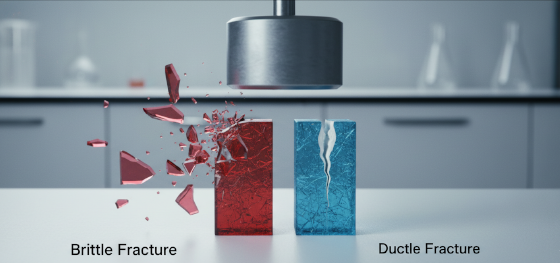
Snap-fits rely on ductility—the ability of a material to stretch elastically and return to its original shape. Real Polypropylene (PP) is incredibly ductile; you can bend a living hinge back and forth a million times. Many "PP-like" casting resins mimic the look and hardness of PP but lack its elongation at break. They are often more brittle. If you design an aggressive snap-fit that strains the material by 15%, a standard urethane might snap off during assembly.
This "Ductility Gap" is bridged by premium impact-modified urethanes. We utilize materials like Hei-Cast 8150 or Axson PX 223 which are formulated to offer high impact strength and elongation values (often exceeding 20-30%). For parts requiring extreme toughness, such as handheld device bumpers or drone landing gear, we steer clients toward these specific grades to ensure the prototype survives the drop test just like the final molded part would.
Optical Stability: UV Resistance and Yellowing

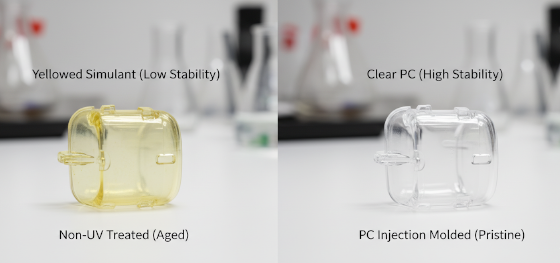
Production Polycarbonate (PC) and Acrylic (PMMA) are inherently UV stable or stabilized with additives. Thermoset urethanes, by their chemical nature, are prone to oxidation and UV degradation, which manifests as "yellowing" over time. A clear prototype lens might look water-white on day one but turn an ugly amber color after three months of exposure to sunlight.
For cosmetic validation, this is unacceptable. Jucheng Precision exclusively uses premium optical-grade resins like Axson PX 5212 for clear parts. We process these materials in a strict vacuum environment to remove micro-bubbles and often apply a UV-blocking clear coat as a post-process. While no urethane is perfectly immune to UV forever, our stabilized process ensures your prototypes maintain their crystal-clear aesthetic throughout the entire sales and marketing cycle, mimicking the longevity of high-end glass or plastic.
JUCHENG Advisory: Matching Resins to Reality
We act as your material library. The Jucheng Precision warehouse stocks over 15 distinct vacuum casting resins, each chosen to target a specific production thermoplastic. We do not guess; we map data. When you tell us your final part is Sabic Cycolac ABS, we pull the datasheets. We compare the Tensile Modulus, Flexural Strength, and Shore Hardness. We then recommend the specific Hei-Cast or Axson formulation that aligns mathematically with your target. We turn the ambiguous term "ABS-like" into a specific engineering reality, ensuring your prototype validation data is robust, defensible, and accurate.

