


Scaling a hardware product involves traversing a perilous financial gap known as the "Valley of Death." This is the awkward, dangerous volume range between fifty and five thousand units. At this stage, you have graduated beyond the "quantity-one" prototype, meaning 3D printing is now financially toxic due to its linear cost structure. Yet, you are nowhere near the massive volume required to amortize a fifty-thousand-dollar steel production mold. Startups and established OEMs alike frequently stall here, unable to fulfill initial market demand because they lack a bridge strategy. Mastering Low Volume Manufacturing Methods is about selecting the specific fabrication technology that aligns with your immediate quantity and cash flow. It is not about finding the "best" process; it is about finding the process that offers the lowest total cost of ownership for your specific batch size. Jucheng Precision operates as a bridge builder, deploying CNC machining, vacuum casting, and rapid tooling to carry your project safely from concept to mass production.

The Valley of Death: Why Standard Prototyping Fails at Scale
Subtractive Precision: CNC Machining for 1-50 Units
Aesthetic Replication: Vacuum Casting for 20-100 Units
Bridge Tooling: Aluminum Molds for 100-5,000 Units
Strategic Matrix: Choosing Your Production Path
The Valley of Death: Why Standard Prototyping Fails at Scale

Hardware economics are governed by the "Amortization Curve." High-pressure die casting and injection molding are incredibly cheap per part, but only after you have paid the massive entry fee for the tool. Conversely, 3D printing has zero entry fee but a high, flat per-part cost. The "Valley of Death" exists where these two curves have not yet intersected. If you need 300 units for a clinical trial, printing them might cost $30,000 due to machine time. Machining a steel mold might also cost $30,000. You are trapped in a zone where standard methods destroy your margin. Low volume manufacturing strategies exist to flatten this curve, providing intermediate solutions that offer reasonable unit costs with minimal upfront capital expenditure.
Subtractive Precision: CNC Machining for 1-50 Units
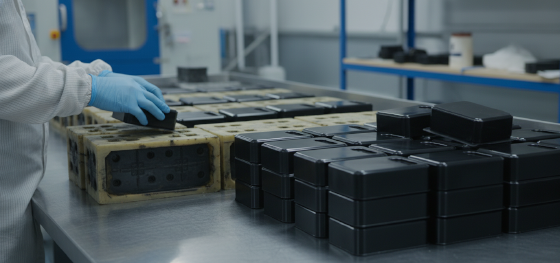
Computer Numerical Control (CNC) machining dominates the lower end of the volume spectrum, particularly for structural metal components. When your requirement is between one and fifty units, the sheer speed of "chip making" trumps the need for tooling. We can take a block of 6061 Aluminum or 316 Stainless Steel and carve your geometry directly. There is no mold to design, no silicone to cure, and no shrinkage compensation to calculate. You get real, production-grade material properties immediately. However, CNC is inherently slow. It is a "point-by-point" removal process. As volume creeps past fifty units, the machine time required to cut each part individually begins to create a bottleneck, and the cost efficiency stagnates because you are paying for every minute the spindle spins.
Aesthetic Replication: Vacuum Casting for 20-100 Units
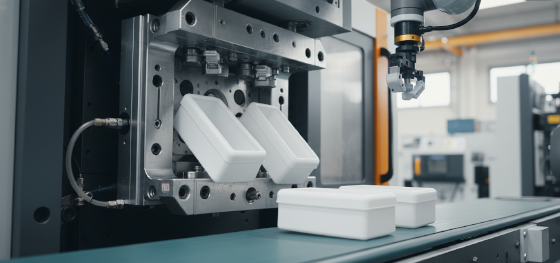
Polyurethane casting is the cosmetic specialist of the low-volume world. When the requirement shifts to 20 to 100 complex plastic enclosures that must look like injection-molded parts, silicone tooling is the undisputed king. The setup cost is fractional—typically just a few hundred dollars for the master pattern and the mold. This allows for a very low barrier to entry. We can produce parts with varying wall thicknesses, complex undercuts, and overmolded rubber grips that would be nightmare-inducingly expensive to machine via CNC. The limitation here is mold life. Silicone degrades chemically. After 20 shots, the tool is dead. If you need 500 parts, we would need to pour 25 separate molds, at which point the labor cost begins to erode the savings.
Bridge Tooling: Aluminum Molds for 100-5,000 Units
Rapid Tooling is the heavy artillery of the low-volume arsenal. This process bridges the gap between the soft silicone mold and the hard production steel mold. By machining the mold cavity out of high-grade 7075 Aluminum or P20 semi-hardened steel, Jucheng Precision can slash tooling costs by 40% to 60% compared to a traditional Class A production tool. Aluminum cuts faster, cools faster, and requires less polishing effort. This mold allows you to inject real thermoplastics—ABS, PC, Nylon—getting actual production material properties. The tool won't last a million cycles, but it will easily run 5,000 shots. For a bridge run of 1,000 units, this is the most chemically and economically accurate method available, effectively acting as a "Bridge to Production" while the final steel tool is being cut.
Strategic Matrix: Choosing Your Production Path
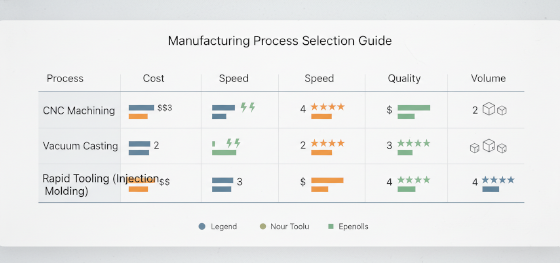
Selecting the correct path requires a dispassionate look at your "Volume-to-Cost" ratio. If your Bill of Materials requires fewer than 10 units, stick to 3D printing; the high unit cost is cheaper than any setup fee. If you need 20 to 50 cosmetic units for a marketing photoshoot or trade show, vacuum casting provides the best finish per dollar. If you need 50 to 100 high-strength metal brackets, CNC machining is your only viable option. However, the moment your demand forecast crosses the 200-unit threshold, you must look at Rapid Tooling. Jucheng Precision manages this entire lifecycle. We don't just sell you a part; we design a manufacturing roadmap that evolves with your market success. We ensure you never pay for a steel mold when a silicone one would suffice, and never rely on slow casting when you should be injecting.

