

E-Coating Die Cast Parts: Conquering Complex Internal Rust
Views: 1 Author: Allen Xiao Publish Time: 2026-05-27


Spraying liquid color onto highly complex geometric hardware creates a miserable manufacturing bottleneck. Traditional spray guns physically cannot push thick polymers into deep internal cavities, leaving critical interior walls completely bare and vulnerable to rapid oxidation. Relying on basic spray techniques for automotive engine brackets guarantees those hidden pockets will rust from the inside out. Executing high-volume e-coating die cast parts completely destroys this geometric limitation by submerging the entire component into a highly electrified liquid bath.
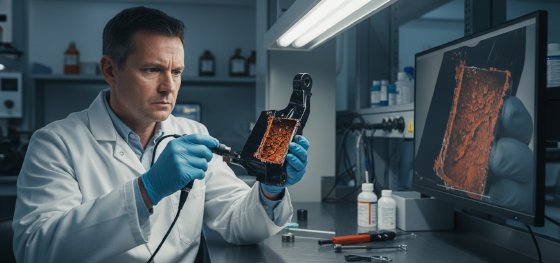
Procurement directors scaling massive commercial fleets cannot tolerate inconsistent paint thickness. Standard painting relies heavily on manual operators, inevitably resulting in ugly drips, sags, and uneven corners that ruin assembly tolerances. Deploying electrophoretic deposition (EPD) solves this human error instantly. Operating our massive Shenzhen precision manufacturing hub, JUCHENG utilizes this advanced chemical bonding process to deliver absolutely flawless, micro-thin polymer armor across thousands of units simultaneously.
Protecting heavy machinery demands impeccable surface execution. Let's explore why electrical dipping defeats the notorious Faraday cage effect, how it meets strict automotive salt-spray standards, and why this specific die casting surface finish acts as both an indestructible primer and a premium standalone aesthetic.
content:
Beating the Faraday Cage: Reaching the Blind Spots
Automotive Survival: Surviving Brutal Salt Spray
Strategic Coating: Standalone Finish or Premium Primer?
JUCHENG Hub: Shenzhen's Automated Dipping Arsenal
FAQ: Honest Answers About Hole Tolerances and UV Fade
Beating the Faraday Cage: Reaching the Blind Spots
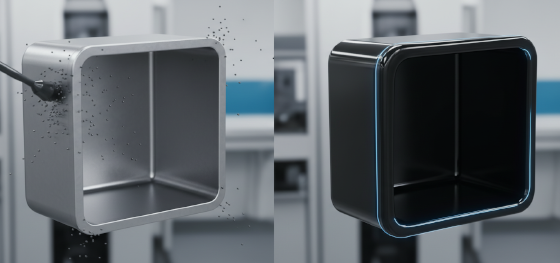
How do electrical liquid baths coat internal crevices that spray guns cannot reach?
Submerging the grounded metal into a positively charged tank of liquid epoxy forces the paint particles to magnetize and wrap around every single microscopic corner flawlessly.
Robotic spray guns struggle aggressively with electromagnetic physics. Shooting charged powder or wet paint into a deep metallic box creates a repellent magnetic shield known as the Faraday cage effect, forcing the paint to bounce off the exterior lips while leaving the inside totally bare.
Switching to electrified liquid immersion entirely bypasses this physical repulsion. The liquid formulation floods the internal chambers completely, while the electrical current actively pulls the epoxy molecules tightly against the raw alloy, guaranteeing one hundred percent coverage without a single drop of wasted paint.
Automotive Survival: Surviving Brutal Salt Spray
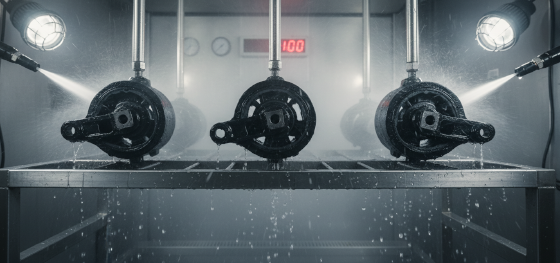
Passing rigorous automotive salt-spray testing requires unyielding chemical defense. Car manufacturers violently reject hardware that shows even a microscopic speck of red rust after spending weeks inside a highly corrosive salt-fog testing chamber.
Deploying robust e-coating die cast parts ensures commercial survival in these brutal environments. The baked epoxy layer cures with an incredibly tight molecular density, preventing highway moisture and winter road salt from ever touching the vulnerable raw metal underneath.
Engineers universally specify this stealthy black finish for under-hood brackets, suspension joints, and heavy-duty transmission casings where ultimate environmental survival completely outranks vibrant cosmetic beauty.
Strategic Coating: Standalone Finish or Premium Primer?
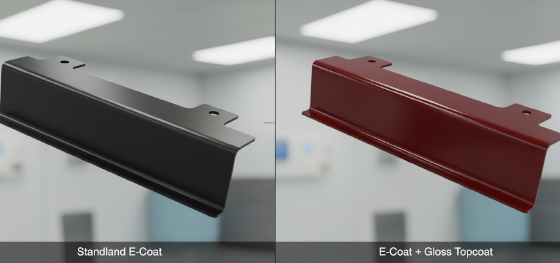
Deciding how to deploy this electrical coating dictates your final assembly budget. Many industrial clients leave the cured black epoxy exactly as it is, utilizing its sleek, uniform, semi-gloss aesthetic as the final, rugged exterior finish for heavy machinery.
Combining this process with secondary topcoats unlocks the ultimate cosmetic armor. If you are researching how to paint die cast parts for a luxury consumer product, utilizing E-coating as the foundational primer provides an indestructible mechanical grip for subsequent vibrant liquid paints.
Skipping this foundational dip on complex geometries often leads to horrific paint peeling later. Fusing the base epoxy electrically to the substrate guarantees the decorative top layer will never blister or flake off during field deployment.
JUCHENG Hub: Shenzhen's Automated Dipping Arsenal
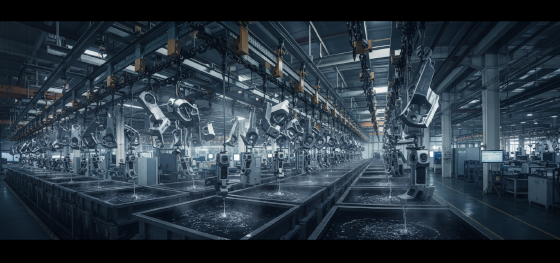
Fragmenting your supply chain by sending raw hardware to a separate dipping facility introduces severe oxidation risks. Castings begin degrading the moment they leave the injection press, making immediate surface protection absolutely mandatory for high-yield production runs.
Housing our massive electrophoretic tanks directly beside our CNC machining centers eliminates this transit liability entirely. We mill the microscopic threads, wash the hardware ultrasonically, and dip the parts immediately to seal the pristine metallic surfaces.
Stop paying for rejected batches ruined by ugly paint drips and internal rust. Send your complex automotive CAD files to our engineering team today. We will map the electrical dipping parameters and deliver perfectly coated, corrosion-proof structural assemblies.
FAQ: Honest Answers About Hole Tolerances and UV Fade

Does this electrified liquid coating ruin the tight tolerances of my tapped screw holes?
Unlike heavy powder coats, this specific epoxy layer applies incredibly thin and uniformly (typically around 10 to 25 microns), meaning secondary masking is rarely required for standard threaded holes.
Can you apply bright, vibrant colors using this exact immersion technique?
Technically yes, but commercial operations almost universally stick to matte or semi-gloss black. Formulating custom vibrant colors in massive 10,000-gallon dipping vats is mathematically cost-prohibitive.
Will aggressive UV sunlight degrade the black epoxy finish over time?
Standard epoxy-based E-coats possess relatively poor UV resistance and will slowly fade or chalk if left in direct sunlight. Outdoor consumer products must receive a UV-resistant acrylic topcoat to prevent this.
How do you prevent air bubbles from getting trapped inside the part during the dip?
Custom racking design solves this physical challenge. Our tooling engineers design specialized hanging jigs that tilt the parts at precise angles, allowing all trapped air to escape as the hardware enters the liquid.


ㆍPrivacy: We respect your privacy. Here you can find an example of a non-disclosure agreement. By submitting this form, you agree to our terms & conditions and privacy policy.
