


In the relentless world of high-volume manufacturing, every second shaved off a machine cycle is a victory for the bottom line. Imagine a workshop where the machines never stop, where automatic bar feeders operate through the night, and where the floor is covered in a constant snowfall of tiny, brittle metal chips. This is the environment where 1215 carbon steel is the undisputed king. It is a material designed not for extreme structural strength, but for pure, unadulterated speed.
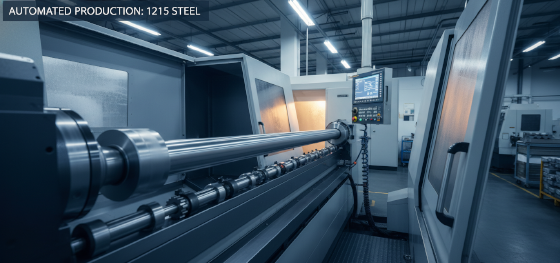
When your project calls for thousands or even millions of precision-turned parts, the choice of material becomes a primary driver of your ROI. 1215 carbon steel machining represents the ultimate solution for high-speed production. It belongs to the family of "Free-Machining" steels, engineered specifically to break chips effortlessly and preserve tool life at speeds that would melt other alloys. At Jucheng Precision, we utilize our fleet of high-speed Swiss lathes and automated turning centers to push 1215 to its limits, delivering exceptionally low-cost parts without sacrificing dimensional integrity.
For engineers and purchasing managers, the value of 1215 lies in its predictability. As a cornerstone of our CNC Steel Machining services, this alloy allows for "lights-out" manufacturing, where the risk of tool failure or "bird-nesting" chips is nearly eliminated. This guide explores the unique metallurgy of 1215 and how JUCHENG translates these material properties into competitive advantages for your supply chain.
The Science of Free-Machining: The Role of Sulfur
High-Speed Advantage: Why Chips Never Nest
Swiss Lathe Precision: The Best Partner for 1215
Typical Applications: From Fasteners to Fluid Power
JUCHENG's Cost Strategy: Maximizing ROI for High Volumes
The Science of Free-Machining: The Role of Sulfur

To understand why 1215 is so fast, we must look at what metallurgists call "inclusions." Standard carbon steels are refined to be as clean as possible, but 1215 is intentionally "contaminated" with specific amounts of Sulfur and Phosphorus. While these elements are usually avoided in structural steels because they can cause brittleness, in the world of machining, they are secret weapons.
During 1215 carbon steel machining, these sulfur inclusions form microscopic manganese sulfide strings within the steel matrix. When the cutting tool engages the material, these strings act as internal lubricators and chip breakers. They create natural weak points in the metal. Instead of the metal tearing away in long, gummy strands—as often happens with 1018—the 1215 fractures cleanly. This reduction in friction significantly lowers the cutting forces required and dramatically reduces the heat generated at the tool tip. This is the fundamental reason why 1215 is rated as one of the best-machining steels in existence.
High-Speed Advantage: Why Chips Never Nest

The biggest enemy of automated CNC production is the "bird-nest." This happens when long, stringy chips wrap themselves around the workpiece or the cutting tool. It can cause machine crashes, ruin surface finishes, and require constant manual intervention from operators. In a high-volume production run of 50,000 parts, even a 1% downtime for chip clearing can cost thousands of dollars.
Because 1215 is so brittle during the shearing process, it produces tiny, "six-shaped" chips that fall away instantly. This is the "High-Speed Advantage." It allows us to run our spindles at maximum RPM with complete confidence. Tool life is also greatly extended; since the material is literally designed to fall apart in front of the cutter, the edge stays sharper for much longer than when cutting tougher alloys like 4140. At Jucheng Precision, this chip control is what enables us to offer our clients "lights-out" manufacturing, keeping your production moving 24/7 without the need for constant monitoring.
Swiss Lathe Precision: The Best Partner for 1215
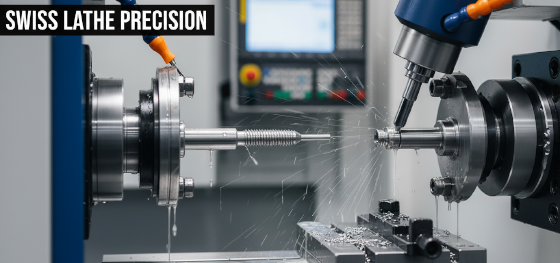
The material properties of 1215 make it the perfect candidate for Swiss-style CNC turning. Swiss machines are designed to produce small, complex, and high-precision parts by supporting the workpiece very close to the cutting tool. This eliminates vibration and deflection, which is critical for long, slender parts.
When we combine the high-speed capability of 1215 with the simultaneous multi-axis movements of a Swiss lathe, the efficiency is staggering. We can perform turning, milling, cross-drilling, and threading all in a single operation. For 1215 parts, we can often complete a complex part cycle in under 30 seconds. This synergy between material and machine is why JUCHENG can deliver extremely tight tolerances (+/- 0.005mm) on 1215 components at prices that are difficult for traditional lathes to match.
Typical Applications: From Fasteners to Fluid Power

Where do all these millions of 1215 parts go? Look around you. 1215 is the invisible glue of modern industry. While it shouldn't be used for high-stress aerospace wings or heavy-duty axles, it is the standard for virtually everything else.
In the fluid power industry, 1215 is used for countless hydraulic fittings and pneumatic valves. Its smooth surface finish ensures a perfect seal. In the electronics sector, you will find it in miniature motor shafts, printer dowels, and complex mounting pins. The automotive world uses 1215 for dashboard components, seat adjustment mechanisms, and various non-structural fasteners. If a part needs to be precise, shiny, and produced in large quantities, 1215 is almost certainly the right choice. It also takes various platings—like zinc or nickel—extremely well, providing the necessary corrosion resistance for everyday environments.
JUCHENG's Cost Strategy: Maximizing ROI for High Volumes
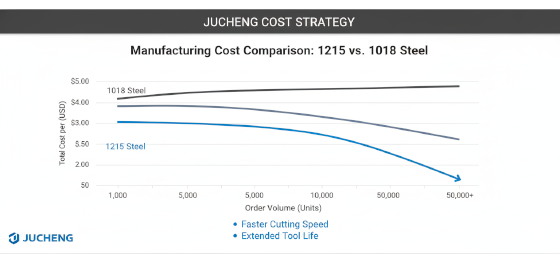
At Jucheng Precision, our engineering team doesn't just quote what's on the drawing; we offer DFM (Design for Manufacturability) advice that saves you money. We often encounter clients who specify 1018 or even 1045 for simple, high-volume pins or screws. Our first question is usually: "Can we switch this to 1215?"
The ROI calculation for 1215 carbon steel machining is compelling. While 1215 raw material might carry a small premium over 1018, the reduction in machine time is massive. If we can run a machine 40% faster and reduce tool changes by half, the total cost per part drops significantly. For a 100,000-piece order, this switch can save a client tens of thousands of dollars. When you partner with Jucheng, you are getting more than just a machinist; you are getting a production consultant who understands how to leverage free-machining alloys to give your business a competitive edge. Upload your drawings today, and let us show you the power of high-speed steel production.

