


Selecting the optimal metallurgical state for food processing chambers, biochemical reactors, or high-vacuum scientific chambers is a critical phase in custom sheet metal fabrication. Specifying polished stainless steel sheet metal provides your components with an exceptionally smooth, non-porous outer surface that resists chemical corrosion while ensuring strict sanitization compliance. This mechanical abrasive process removes micro-imperfections, replacing raw oxide scales with reflective finishes that prevent contaminant adhesion.
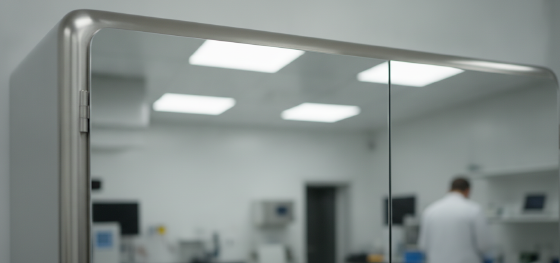
Wasting resources on standard mill-finish sheets that collect dust, harbor bio-films, or rust at welded seams is a major setback for high-purity industrial hardware. If your manufacturer skips precision grit-buffing or chemical de-ironing, micro-cracks will trap organic residues and initiate rapid crevice corrosion. Transitioning to a high-precision polished sheet entirely eliminates these sanitary risks.
Let's explore the official industrial grading of polished metal sheets, analyze why sanitary industries mandate ultra-low surface roughness, and review why chemical de-ironing is essential after mechanical buffing.
The Grading of Stainless Finishes
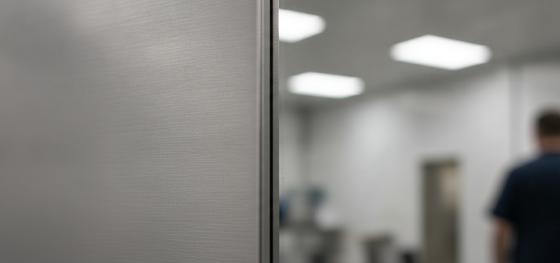
What do standard finish codes like No.4 and No.8 represent?
These industry-standard codes define the abrasive grain size and polishing steps used, ranging from a directional satin grain (No.4) to a flawless, non-directional mirror reflection (No.8).
To achieve consistent visual and physical properties, our finishing department classifies raw plates according to international grading scales. A standard No.4 finish represents a directional, linear grain obtained by progressive polishing with 120 to 180 grit abrasives, ideal for hiding fingerprint marks in high-traffic commercial environments. Conversely, a No.8 finish is a flawless, highly reflective mirror surface produced by polishing with progressively finer compounds, followed by intensive buffing with organic sisal wheels.
The progressive abrasive polishing sequence must be executed carefully to reach a true mirror luster without distorting flat panels:
Rough Grinding: Initial grinding with 80-grit belt blocks to level weld seams and remove mill oxides.
Intermediate Buffing: Grinding with 120, 180, and 240-grit belts to gradually minimize the scratch depth.
Fine Polishing: Polishing with 320 to 400-grit belts to establish a highly consistent satin base.
Mirror Buffing: High-speed buffing wheels with green chromium oxide compounds to polish out all scratch lines.
Why Medical and Food Industries Require Polished Surfaces
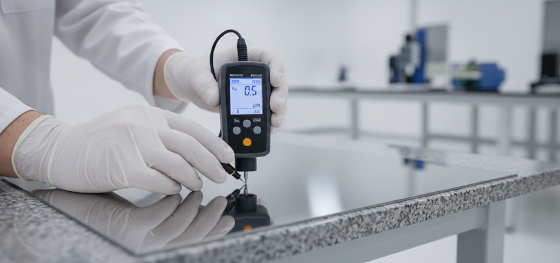
Why do food and biochemical processing standards forbid rough mill surfaces?
Microscopic valleys on rough surfaces act as shelters that trap bio-films and bacteria, shielding them from chemical CIP washes.
In sanitary engineering, managing the micro-topography of the steel plate is a life-or-death requirement. We measure this micro-geometry using the surface roughness (Ra) parameter, representing the arithmetic average of profile deviations. Standard US DA and bio-pharmaceutical guidelines mandate an Ra of 0.8 microns (32 micro-inches) or less for food contact, and an Ra of 0.4 microns (16 micro-inches) or less for surgical equipment. Polishing the plate flat eliminates microscopic crevices, allowing clean-in-place (CIP) chemicals to wash away all organic films during sanitization.
| Standard Finish Code | Average Roughness (Ra) | Visual Appearance | Best Application |
|---|---|---|---|
| No.2B (Mill Finish) | 0.8 to 1.5 µm (32 to 60 µin) | Dull, slightly reflective grey | Industrial framing, internal structural parts |
| No.4 (Satin / Brushed) | 0.4 to 0.8 µm (16 to 32 µin) | Linear, directional brushed grain | Food processing covers, appliance panels |
| No.8 (Mirror Finish) | 0.02 to 0.1 µm (0.8 to 4 µin) | Flawless, reflective mirror surface | Surgical enclosures, pharmaceutical chambers |
The Importance of Passivation After Polishing
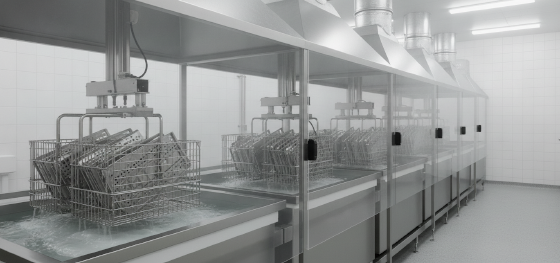
Why is chemical de-ironing mandatory after mechanical buffing has finished?
Mechanical buffing wheels wear down and embed microscopic carbon iron particles into the stainless surface, destroying the passive chromium oxide layer.
To restore the full anti-corrosion properties of your components, incorporating this chemical sheet metal surface treatment into your turnkey sheet metal fabrication cycle is critical. The high friction of abrasive wheels deplates the localized chromium molecules from the outer surface, leaving behind traces of non-passive free iron. If exposed to moisture, this free iron will rust immediately.
To prevent this, we execute chemical passivation according to ASTM A967 standards, using nitric or citric acid baths to selectively dissolve the free iron and restore the self-healing chromium oxide barrier. Jucheng Precision manages both mechanical buffing and chemical acid washing under one roof, ensuring that your parts are cut, folded, and completely passivated with zero cross-contamination.
Jucheng Precision's High-Precision Stainless Fabrication

How does Jucheng Precision ensure consistent tolerances and finishes on polished custom panels?
We operate high-power fiber laser cutters, high-tonnage press brakes, and automated polishing lines managed by certified operators, checking all alignments before assembly.
Integrating this highly cosmetic, reflective finishing into your turnkey fabrication flow is the single most effective way to eliminate logistical bottlenecks and double-handling shipping bills. Jucheng Precision houses these advanced polishing and passivation lines inside our 8000-square-meter facility, ensuring that your parts are cut, folded, and completely finished under one roof with extreme quality control.
We process a wide range of materials, including lightweight aluminum, high-yield stainless steel, and easily formable carbon steel during high-precision sheet metal fabrication cycles. Our technical department provides a 24-hour free DFM analysis to check your CAD models, checking tolerances and hinge clearances before production. Supported by our no MOQ policy and rapid delivery guarantee, we manage your project from initial flat pattern cutting to final, high-durability powder coating and assembly.
FAQ: Critical Questions About Sheet Metal Welding
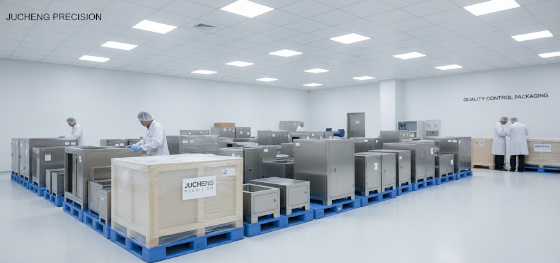
Our engineering team has compiled professional solutions to the most common quality challenges faced during stainless steel polishing runs:
Why is a welded joint highly prone to corrosion even on polished stainless steel?
Welding heats the steel past its sensitization temperature, causing chromium to react with carbon and form chromium carbides along grain boundaries. This depletes the local chromium content, destroying the self-healing passive oxide barrier and making weld seams highly vulnerable to localized rust. We resolve this by performing electro-chemical weld cleaning and full passivation post-weld.Does mechanical polishing remove deep scratches and tooling marks completely?
Yes, but it requires progressive, multi-stage grinding. Attempting to buff out a deep scratch using a fine buffing wheel directly will only distort the local surface flatness. We remove deep tool marks by starting with an aggressive 80-grit abrasive wheel to level the metal, then transitioning down through 120, 240, and 400-grit steps to establish a uniform surface.How do you protect the polished mirror finish during press brake bending?
Stainless steel has high yield strength and requires high bending forces, making its polished surface highly vulnerable to tooling marks from steel press dies. To prevent scratches, our press benders utilize specialized polyurethane die liners or apply high-density protective vinyl masking films to the polished sheet before forming.How does Jucheng Precision prevent surface contamination during stainless steel sheet metal fabrication?
We keep our stainless steel fabrication area strictly segregated from our carbon steel processing bays to prevent airborne metal dust cross-contamination. Our finishing team utilizes certified iron-free grinding discs, performs electro-chemical weld cleaning, and runs automated passivation treatments to ensure that every finished component maintains its flawless corrosion resistance.

