


Biological hostility destroys inadequate hardware before a procedure even begins. In the uncompromising environment of the modern operating theater, reusable surgical instruments are subjected to a brutal cycle of bodily fluids, high-pressure steam, and aggressive chloride-based cleaning agents. When an engineer specifies a material for a robotic fluidic manifold or a laparoscopic grasper, traditional carbon steel or generic 304 stainless will rapidly succumb to "Pitting Corrosion," creating microscopic rust caverns that harbor lethal bacteria. Navigating this demand for indestructible, sterile longevity requires the strategic deployment of 316L stainless steel medical machining. This specific alloy—often dubbed "Surgical Steel"—is the undisputed workhorse of the healthcare sector, engineered with unique chemical additives to resist the assault of the autoclave. Jucheng Precision operates as an ISO 13485-certified metallurgical sanctuary in the Shenzhen precision manufacturing hub, providing the elite CNC capabilities required to conquer this notoriously "sticky" and heat-retaining metal. Within the broader framework of Medical Robotics Manufacturing, we bridge the gap between "industrial metal" and "clinical instrument," ensuring your effectors and housings maintain their bio-inert perfection through thousands of surgical cycles.

Establishing a resilient clinical supply chain demands the rejection of standard machining protocols. Amateurs often approach a billet of 316L with the same feeds and speeds used for aluminum, unaware that the material will actively "Work-Harden" ahead of the cutter, snapping carbide end-mills and destroying tight tolerances. Jucheng Precision eliminates these "Mechanical Drifts" by enforcing a strict "Heavy-Chip" machining philosophy across our fleet of advanced Swiss-style turning centers and 5-axis mills. Whether you are developing ultra-thin needle drivers or robust structural hubs for a surgical arm, our facility provides the material science and metrological rigor required for 2026 FDA and CE Mark approval. This guide deconstructs the chemistry of Molybdenum defense, the physics of surface roughness (Ra), and why JUCHENG’s "Passivation Protocol" is the mandatory foundation for anyone launching reusable medical hardware.
Chemical Armor: The Molybdenum Advantage in 316L
Mechanical Rebellion: Conquering the Work-Hardening Effect
Microscopic Hygiene: Why Ra 0.4 is the Clinical Baseline
Surface Sovereignty: The Necessity of Chemical Passivation
JUCHENG Protocol: Swiss CNC and Heat Lot Traceability
Frequently Asked Questions: 316L Surgical Hardware
Chemical Armor: The Molybdenum Advantage in 316L

Metallurgical survival in a saline environment is dictated by a 2% chemical addition. The "L" in 316L stands for "Low Carbon" (max 0.03%), which prevents carbide precipitation during high-heat processes like welding, reducing the risk of intergranular corrosion. However, the true superpower of 316L stainless steel medical machining is the inclusion of 2% to 3% Molybdenum. Standard 304 stainless steel relies solely on Chromium to form a protective oxide layer. When 304 is exposed to the chlorides present in human blood or hospital disinfectants, those chlorides attack the oxide layer, causing deep, localized "Pitting" rust. Molybdenum acts as a chemical reinforcement to the chromium-oxide shield, making it vastly more resilient to chloride assault. Jucheng Precision engineers mandate 316L for any robotic component that will enter the sterile field or handle bodily fluids. We don't just "cut parts"; we provide the chemical sovereignty required to ensure your fluidic valves and trocar ports remain permanently bio-inert, preventing the heavy metal leaching that causes patient tissue rejection.
Mechanical Rebellion: Conquering the Work-Hardening Effect
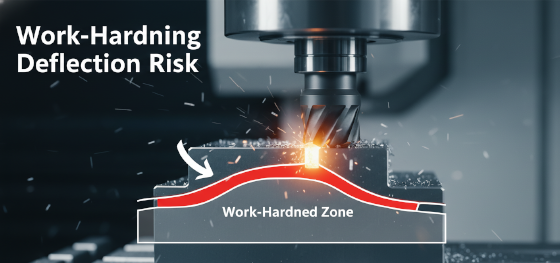
Thermal accumulation destroys dimensional accuracy when cutting austenitic stainless steels. 316L is notorious for a phenomenon known as "Work-Hardening." As a CNC cutting tool strikes the metal, the localized pressure and heat instantly alter the crystal structure of the steel directly beneath the cut, making it significantly harder than the surrounding material. If the tool "rubs" or dwells in one spot, the next pass will hit a surface that is twice as hard, deflecting the cutter and destroying the part's tolerance. Jucheng Precision combats this by utilizing rigid, high-torque machine setups and specialized positive-rake carbide tooling. We program our toolpaths to maintain a constant, heavy "Chip Load"—ensuring the cutter physically bites *underneath* the work-hardened zone generated by the previous pass. We couple this with high-pressure, through-spindle coolant to aggressively evacuate the heat. This "Violent but Controlled" machining strategy ensures your surgical shafts and robotic gear housings maintain sub-micron concentricity without suffering from stress-induced warping after they leave the machine.
Microscopic Hygiene: Why Ra 0.4 is the Clinical Baseline

Surface topography dictates the biological safety of a reusable instrument. A part fresh off a CNC mill may look shiny, but under a microscope, the surface resembles a plowed field of peaks and valleys. In the medical sector, these valleys act as microscopic sanctuaries for bacteria and proteins (bioburden) that standard autoclaves cannot reach, leading to Hospital-Acquired Infections (HAIs). A professional 316L stainless steel medical machining protocol mandates a Surface Roughness Average (Ra) of 0.4 µm (16 µin) or better for all tissue-contacting surfaces. Jucheng Precision achieves this clinical baseline through a multi-stage finishing process. After the precision CNC cut, we utilize centrifugal barrel tumbling with specialized ceramic media to knock down the microscopic peaks without altering the tight geometric tolerances of the part. We don't just "make it shiny"; we engineer a surface so mathematically flat that pathogens cannot find a physical foothold, ensuring your robotic instruments pass the most rigorous swab and culture tests in the industry.
Surface Sovereignty: The Necessity of Chemical Passivation

Machining inherently compromises the natural rust-defense of stainless steel. As the carbide tool cuts the 316L billet, it inevitably deposits microscopic particles of "free iron" onto the surface of the part. If left untreated, this free iron will oxidize rapidly when exposed to moisture, causing the "Surgical Steel" to rust. Jucheng Precision restores the material's chemical integrity through an in-house Passivation Protocol, compliant with ASTM A967 standards. We submerge the finished components in a controlled bath of heated nitric or citric acid. This acid attacks and dissolves the free iron without harming the base metal, while simultaneously accelerating the formation of a thick, impenetrable chromium-oxide passive layer. For complex robotic end-effectors with intricate hinge pins and internal lumens, we often upgrade to "Electropolishing." This electrochemical process acts as a reverse-plating bath, stripping away the outermost skin of the metal, removing micro-burrs, and leaving a mirror-like, ultra-passive finish. We deliver components that are surgically sterile and chemically invincible.
JUCHENG Protocol: Swiss CNC and Heat Lot Traceability
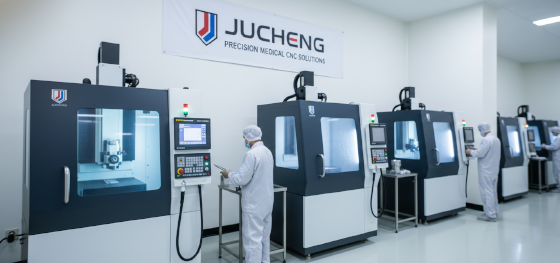
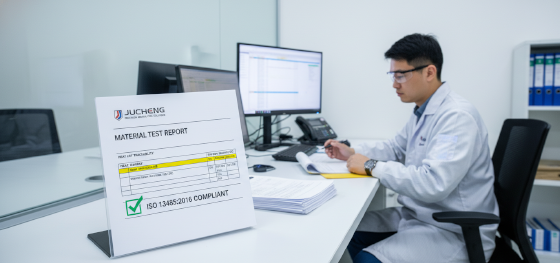
Manufacturing excellence at Jucheng Precision is built on the foundation of the documented pedigree. We recognize that producing long, slender surgical shafts (often 300mm long by 5mm wide) requires specialized equipment. Our facility houses an elite fleet of Swiss-style CNC turning centers. The guide-bushing technology of the Swiss machine supports the 316L rod mere millimeters from the cutting tool, eliminating the deflection that ruins standard lathe operations. Furthermore, our ISO 13485 certified workflow guarantees absolute "Heat Lot Traceability." When you receive a batch of surgical jaws or robotic flanges, it is accompanied by a Material Test Report (MTR) linking those parts to the specific smelting batch of the steel mill. Stop gambling your FDA 510(k) submission on uncertified machine shops. Leverage our decade of medical metallurgy mastery to validate rapidly and launch profitably. Contact our technical team today for a free DFM review and see how we can turn your digital intent into a rust-proof, clinical reality.
Frequently Asked Questions: 316L Surgical Hardware
Question: Why use 316L instead of 17-4PH stainless steel for surgical robots?
Answer: 17-4PH can be heat-treated to a much higher hardness (HRC 40+), making it ideal for cutting blades and sharp jaws. However, 316L offers vastly superior corrosion resistance against hospital chemicals, making it the preferred choice for fluidic housings, handles, and structural components.
Question: What is the tightest tolerance JUCHENG can hold on a 316L robotic shaft?
Answer: Utilizing our advanced Swiss CNC lathes, we routinely maintain concentricity and diameter tolerances within +/- 0.005mm (0.0002") even on parts with extreme length-to-diameter (L/D) ratios.
Question: Can JUCHENG provide laser marking on 316L surgical instruments?
Answer: Yes. We provide high-contrast, permanent laser etching for Unique Device Identification (UDI) codes and serial numbers. The parts are passivated *after* laser marking to ensure the etched area does not become a rust initiation point.

