


Orthopedic navigation demands absolute optical clarity in the surgical field. When a robotic assistant guides a surgeon during a spinal fusion or a complex joint replacement, the physical hardware cannot obstruct the critical X-ray or MRI telemetry required to verify screw placement. Standard surgical tools and implants forged from stainless steel or titanium—while incredibly strong—create dense, bright white artifacts on a fluoroscopy screen, completely masking the biological structures beneath them. Navigating this clinical "Blind Spot" requires the strategic deployment of Machining medical grade PEEK. Polyetheretherketone (PEEK) is the undisputed king of high-performance thermoplastics, possessing a flexural modulus that closely mimics human cortical bone while remaining entirely transparent to radiological imaging. Jucheng Precision operates as a high-fidelity polymer sanctuary in the Shenzhen precision manufacturing hub, providing the sub-micron accuracy needed to process this brutally difficult material. Within the broader framework of Medical Robotics Manufacturing, we transform raw, expensive PEEK billets into life-saving spinal cages and radiolucent targeting guides that survive thousands of high-temperature sterilization cycles.
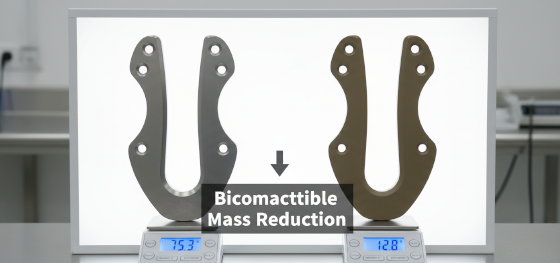
Establishing a resilient launch for PEEK hardware demands the rejection of "General Purpose" machining logic. Amateurs often treat a $500 block of implant-grade PEEK like a piece of cheap Delrin, ignoring the massive internal residual stresses generated during the extrusion process. Attempting to CNC mill a complex surgical instrument without a meticulous thermal annealing protocol guarantees that the part will warp, crack, or drift out of tolerance the moment it hits the operating room. Jucheng Precision eliminates these "Catastrophic Failures" by enforcing a strict thermodynamic management system. We bake the tension out of the polymer before a single 5-axis spindle engages the material. This guide deconstructs the physics of radiolucency, the absolute necessity of multi-stage annealing, and why JUCHENG’s "Zero-Contamination" protocol is the mandatory foundation for anyone developing Class II and Class III medical devices for 2026 market entry.
Visual Independence: The Radiolucent Advantage Over Titanium
Thermodynamic Pathology: The Dangers of Internal Residual Stress
The Annealing Mandate: Eradicating Dimensional Drift
Microscopic Integrity: Speeds, Feeds, and Burr-Free Execution
JUCHENG Protocol: USP Class VI Traceability and Medical Purity
Frequently Asked Questions: PEEK Surgical Hardware
Visual Independence: The Radiolucent Advantage Over Titanium
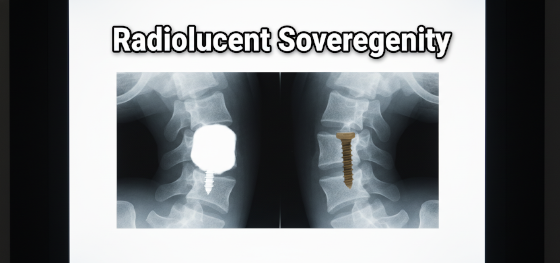
Diagnostic visibility dictates the success of image-guided robotic surgery. The primary reason engineers pivot from Titanium Grade 5 to PEEK is its inherent radiolucency. Because PEEK is a low-density organic polymer (approx. 1.3 g/cm³), X-rays pass through it without scattering. This "Visual Sovereignty" allows the surgeon to monitor bone growth, fusion progress, and tool alignment in real-time without the "Starburst" glare associated with metal implants. Furthermore, PEEK eliminates the risk of "Galvanic Corrosion" that occurs when dissimilar metals interact inside the human body. By utilizing 5-axis CNC machining, we deliver complex orthopedic targeting guides and implantable cages that possess the mechanical spine of an alloy without the optical interference, ensuring your robotic assistant operates with unobstructed "Vision."
Thermodynamic Pathology: The Dangers of Internal Residual Stress
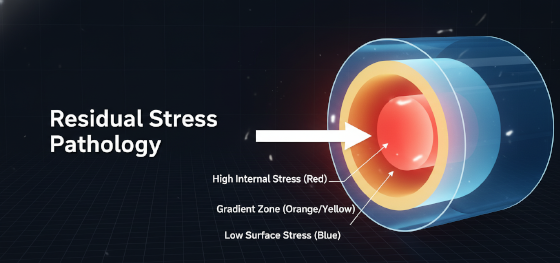
Geometric rebellion occurs when a highly crystalline polymer is violently relieved of its constraints. Extruded PEEK rods and plates are "frozen" in a state of high internal tension as they cool rapidly during production. When a CNC cutter removes the outer skin of this material to form a delicate surgical tool, the internal stresses are suddenly unleashed. If unmanaged, the part will literally bend, twist, or split in half while still clamped in the vise. This "Thermodynamic Pathology" is the primary cause of scrap when inexperienced shops attempt to process PEEK. The material fights the tool, leading to unpredictable dimensional drift that ruins the tight tolerances required for robotic end-effectors. We treat every raw billet of PEEK as a "loaded spring," requiring careful thermal disarmament before the machining sequence begins.
The Annealing Mandate: Eradicating Dimensional Drift
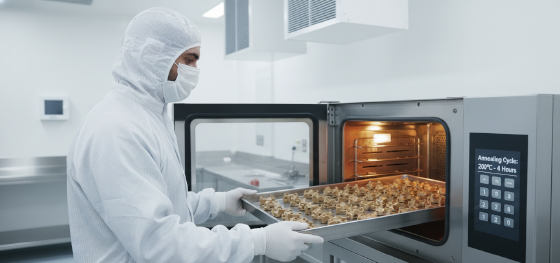
Thermal stabilization is the secret to sub-micron accuracy in high-performance thermoplastics. Jucheng Precision implements a mandatory, multi-stage "Annealing Protocol" for all PEEK components. Before rough machining, the raw stock is placed in programmable convection ovens and slowly heated to 200°C (392°F), held for several hours based on thickness, and then cooled at an agonizingly slow rate of 10°C per hour. This allows the polymer chains to relax and achieve maximum crystallinity. After the rough CNC pass removes the bulk of the material, the part undergoes a *second* annealing cycle to relieve the new stresses introduced by the cutter. Only then is the part subjected to the final, high-precision finishing pass. This rigorous thermal engineering ensures your PEEK components remain perfectly stable during the 134°C steam sterilization of a hospital autoclave, preventing the warping that would otherwise bind a robotic joint mechanism.
Microscopic Integrity: Speeds, Feeds, and Burr-Free Execution
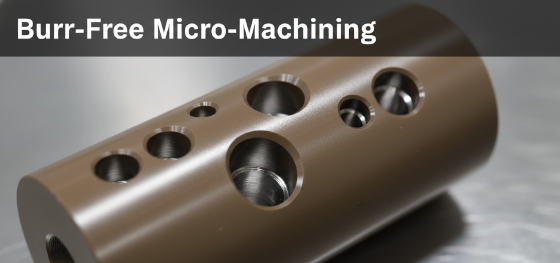
Cutting mechanics must respect the heat-sensitive nature of the polymer. PEEK is notoriously abrasive and a poor conductor of heat. If a CNC spindle runs too fast or feeds too slowly, the friction generates immense localized heat. Instead of cleanly shearing a chip, the tool begins to "melt and smear" the plastic, resulting in "Galling" and microscopic "Burrs." In the context of a surgical instrument, a plastic burr that detaches inside a patient is a catastrophic biological risk. Jucheng Precision eliminates this "Thermal Fuzz" by utilizing specialized, razor-sharp solid carbide tooling with polished flutes. We program highly aggressive feed rates combined with massive volumes of synthetic, medical-safe coolant to evacuate the heat instantly. This "Cold-Cut" philosophy produces surgical-grade edges and smooth bearing bores that require zero manual deburring, ensuring your instruments are clinically ready the moment they leave the machine.
JUCHENG Protocol: USP Class VI Traceability and Medical Purity
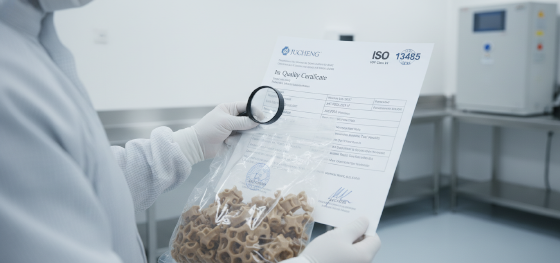
Manufacturing excellence at Jucheng Precision is built on the foundation of the documented pedigree. We recognize that "Implant-Grade" or "Surgical-Grade" PEEK (such as Invibio or Solvay) is an investment of hundreds of dollars per kilogram. Our facility operates under a strict ISO 13485 quality management system, ensuring that every billet is accompanied by a Certificate of Analysis (COA) proving its USP Class VI and ISO 10993 biocompatibility. We maintain dedicated "Plastic-Only" CNC machines to ensure zero cross-contamination from metal shavings or non-medical cutting fluids. We provide the "Paper Trail of Quality" required for FDA and CE Mark submissions, ensuring your hardware journey is lean, predictable, and audit-ready. Stop gambling your high-stakes medical launch on machine shops that treat PEEK like a hobby plastic. Leverage our decade of thermal and subtractive mastery to validate rapidly and scale profitably.
Frequently Asked Questions: PEEK Surgical Hardware
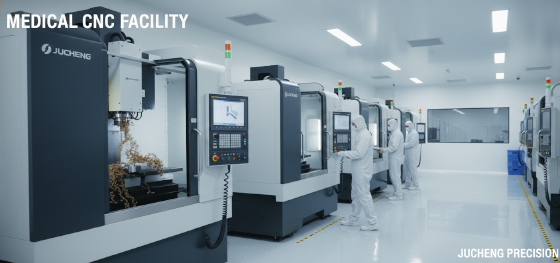
Question: What is the tightest tolerance JUCHENG can hold on a PEEK surgical component?
Answer: By utilizing strict double-annealing processes and 5-axis CNC technology, we routinely hold tolerances of +/- 0.01mm (0.0004") on critical bores and mating surfaces, ensuring zero-backlash assembly.
Question: How many times can a machined PEEK component be autoclaved?
Answer: PEEK is virtually immune to hydrolytic degradation. A properly annealed and machined PEEK instrument can survive over 1,000 cycles of high-pressure steam sterilization (134°C) without losing its mechanical strength or dimensional accuracy.
Question: Does JUCHENG provide carbon-fiber filled PEEK (CF-PEEK)?
Answer: Yes. For robotic arms that require extreme stiffness and radiolucency, we machine 30% Carbon-Filled PEEK, which effectively doubles the flexural modulus compared to unfilled grades.

