


Mobility in the clinical environment is a brutal test of structural physics. When a nursing team maneuvers a 150-kilogram diagnostic robot down a hospital corridor, the kinetic energy transferred through the caster wheels into the base is immense. If the structural spine of that machine flexes, vibrates, or succumbs to rust after repeated chemical washdowns, the highly calibrated internal electronics will fail. Navigating this requirement for indestructible, heavy-duty mobility requires the strategic deployment of Medical cart and chassis fabrication. This foundational discipline within Medical Robotics Manufacturing rejects the fragility of plastic in favor of the unyielding modulus of formed metal. Jucheng Precision operates as a high-fidelity metallurgical sanctuary in the Shenzhen precision manufacturing hub. We possess the heavy-tonnage press brakes and robotic welding cells needed to construct load-bearing architectures that survive the chaos of 24/7 healthcare logistics. We don't just "bend metal"; we engineer a low-center-of-gravity fortress that ensures your medical fleet remains stable, sterile, and sovereign in the field.
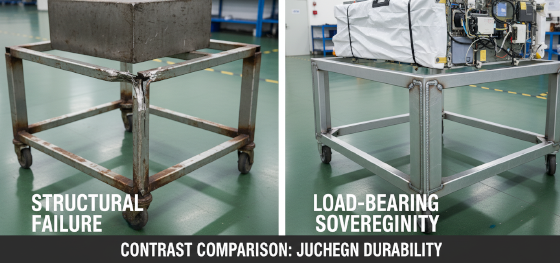
Establishing a failure-proof mobile platform demands the absolute rejection of "Office-Grade" sheet metal logic. Amateurs often design medical carts using thin-gauge aluminum bolted together with standard fasteners, unaware that the constant vibration of hospital elevator thresholds will rattle those bolts loose within months. Jucheng Precision eliminates these "Structural Disasters" by enforcing a strict "Welded-Core" protocol. We utilize heavy-gauge carbon steel or 316L Stainless Steel, fused together via Tungsten Inert Gas (TIG) welding, to create a monolithic base that absolutely refuses to twist. Whether you are developing a specialized tele-presence robot or a massive surgical equipment tower, our facility provides the material science and ISO 13485 rigor required for 2026 market entry. This guide deconstructs the mechanics of laser-cut precision, the chemistry of antimicrobial coatings, and why JUCHENG’s "Integrated Fabrication" is the mandatory foundation for your next medical rollout.
Subtractive Violence: Laser Cutting Heavy-Gauge Steel
Hygienic Fusion: The Mandate for TIG Welded Joints
Chemical Defense: Antimicrobial Powder Coating Armor
Kinetic Stability: Center of Gravity and FEA Audits
JUCHENG Protocol: Marrying Sheet Metal with RIM Plastic
Frequently Asked Questions: Medical Carts and Chassis
Subtractive Violence: Laser Cutting Heavy-Gauge Steel
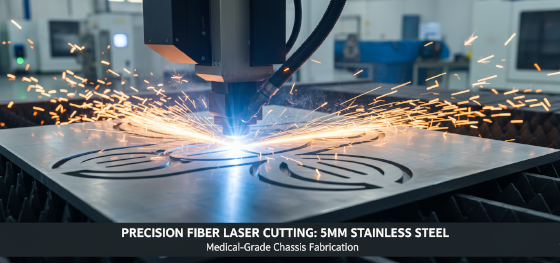
Geometric complexity in heavy metal relies on the precision of light. The foundation of any robust Medical cart and chassis fabrication project begins with the blanking of raw steel plates. Stamping presses are inefficient and prohibitively expensive for the low-to-mid volume runs typical of the medical sector. Jucheng Precision bypasses this tooling debt by deploying a fleet of high-wattage Fiber Lasers. These machines slice through 5mm or 10mm thick plates of 304/316L stainless steel with surgical accuracy (+/- 0.05mm). This "Digital Subtraction" allows us to cut intricate mounting patterns, weight-reduction honeycombs, and complex cable-routing ports directly into the chassis base plate without a single custom punch tool. Unlike plasma or waterjet cutting, fiber lasers produce a negligible Heat-Affected Zone (HAZ), meaning the edges remain metallurgically stable and ready for high-precision CNC bending. We turn "raw slabs" into highly engineered structural puzzle pieces in minutes.
Hygienic Fusion: The Mandate for TIG Welded Joints

Fasteners vibrate; welds endure. The structural spine of a medical robot must survive years of kinetic trauma without loosening. While bolts and rivets are acceptable for internal mounting brackets, the primary load-bearing frame must be a monolithic entity. Jucheng Precision enforces a strict Tungsten Inert Gas (TIG) welding protocol for all critical joints in our Medical Robotics Manufacturing lines. TIG welding provides the deepest, strongest penetration for stainless steel and aluminum, creating a joint that is often stronger than the base metal itself. More importantly, TIG produces a "Clean Bead" without the massive spatter and slag associated with MIG welding. In a clinical environment, a messy weld joint acts as a microscopic cavern where bacteria and pathogens can hide and colonize. Our master welders produce "Stack-of-Dimes" seams that are subsequently ground flush and polished. This ensures the chassis is not only structurally indestructible but possesses the smooth, hygienic surface required to pass rigorous hospital infection-control audits.
Chemical Defense: Antimicrobial Powder Coating Armor
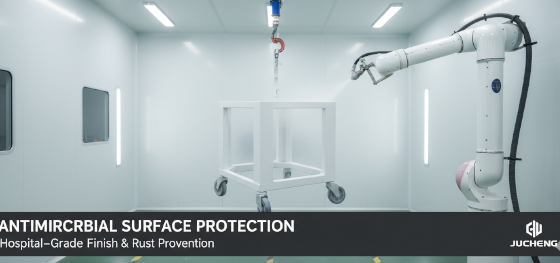
Rust is the silent assassin of medical hardware. A carbon steel chassis provides excellent stiffness and weight, but it will oxidize rapidly when exposed to the harsh bleach and hydrogen peroxide solutions used for daily hospital wipe-downs. Medical cart and chassis fabrication requires a chemical shield. Jucheng Precision eliminates the corrosion crisis by utilizing advanced electrostatic Powder Coating. Unlike liquid paint, which can crack or chip upon impact, powder coating is baked into the metal at 200°C, creating a highly cross-linked, impact-resistant polymer shell. For high-stakes clinical environments, we utilize specialized "Antimicrobial Powders." These coatings are infused with silver-ion technology that actively inhibits the growth of microbes and bacteria on the surface of the cart. This value-added finish transforms a raw metal frame into an active participant in hospital infection control, delivering the visual authority and chemical defense your brand requires to dominate the market.
Kinetic Stability: Center of Gravity and FEA Audits
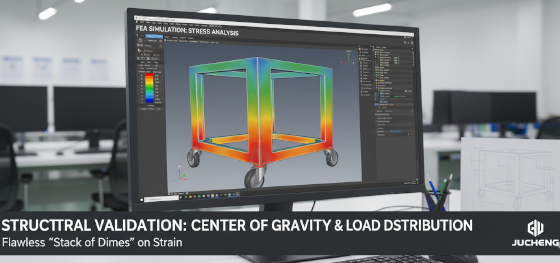
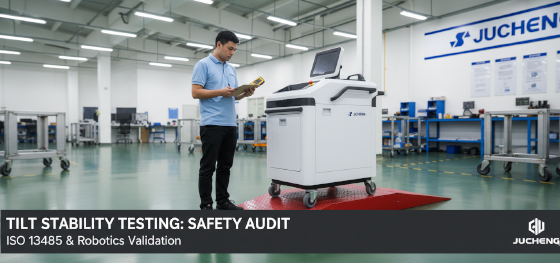
A top-heavy robot is a lawsuit waiting to happen. The most critical, yet frequently overlooked, aspect of a mobile chassis is its Center of Gravity (CoG). Medical carts are often loaded with heavy monitors and articulated arms at the top, creating a massive "Tip-Over" risk when pushed over a bump or parked on a 10-degree ramp. Jucheng Precision engineers act as your "Kinetic Navigators." We utilize Finite Element Analysis (FEA) during the DFM phase to simulate the stress distribution across the wheelbase. We often recommend adding specific "Ballast Plates"—heavy gauge steel sheets bolted to the absolute lowest point of the chassis—to forcibly lower the CoG and lock the machine to the floor. We also calculate the "Torsional Twist" of the frame under asymmetrical loads, ensuring that the heavy-duty caster wheels remain perfectly aligned. We don't just "build boxes"; we engineer dynamic stability to ensure your medical robot meets the strict tilt-safety requirements of IEC 60601-1.
JUCHENG Protocol: Marrying Sheet Metal with RIM Plastic
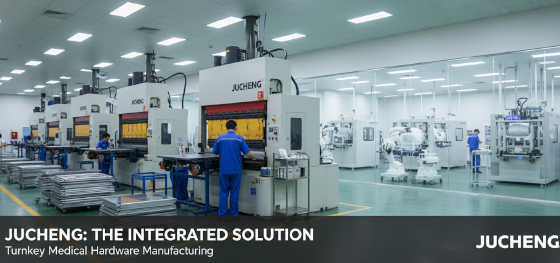
Manufacturing excellence at Jucheng Precision is built on the foundation of the "Turnkey Assembly" mandate. We recognize that Medical cart and chassis fabrication is only half the battle; the bare metal frame must ultimately be clad in beautiful, ergonomic plastic enclosures. The friction of vendor-hopping—having one shop weld the frame and another mold the covers—inevitably leads to "Tolerance Clashes" where the plastic simply won't fit the metal. JUCHENG eliminates this risk by housing our heavy sheet metal fabrication wing and our Reaction Injection Molding (RIM) bays under a single ISO 13485 certified roof. We test-fit the oversized plastic shrouds directly onto your welded chassis before the batch ever leaves our facility. Stop gambling your venture funding on fragmented suppliers who "hope" their parts will mate. Leverage our decade of integrated manufacturing mastery to validate rapidly, scale responsibly, and maintain a zero-defect supply chain. Contact our technical team today for a free DFM review and see how we can turn your digital robotic intent into a structurally sovereign, fully assembled physical reality.
Frequently Asked Questions: Medical Carts and Chassis
Question: What is the best material for a medical robot chassis?
Answer: For structural bases requiring extreme weight to lower the center of gravity, we recommend Powder-Coated Carbon Steel. For parts requiring ultimate hygiene and rust prevention (like IV poles), 316L Stainless Steel is mandatory.
Question: Can JUCHENG handle the assembly of casters and internal hardware?
Answer: Yes. Our facility provides full mechanical assembly services, including the installation of heavy-duty medical casters, internal power supplies, and cabling harnesses into the fabricated chassis.
Question: How do you ensure the welded frame meets ISO 13485 standards?
Answer: We enforce strict weld-procedure specifications (WPS) and provide full material lot traceability for the steel. Every chassis undergoes a rigid dimensional CMM audit to ensure the mounting points are perfectly aligned.

