


Kinetic inertia remains the primary architect of robotic inefficiency. In the hyper-agile landscape of 2026, the success of a high-speed pick-and-place line is not decided by the arm's motor torque, but by the weight of the tool attached to its wrist. If the End-of-Arm Tooling (EOAT) is over-engineered and heavy, it forces the robot to move at slower velocities to prevent vibration and motor overheating. Navigating this requirement for extreme lightweighting requires the strategic deployment of 3D printed end of arm tooling. Jucheng Precision operates as a high-fidelity manufacturing sanctuary in the Shenzhen precision manufacturing hub, providing the additive depth to transform heavy metal assemblies into featherweight polymer structures. Within the broader framework of custom robotic end-of-arm tooling, we bridge the gap between "prototype grip" and "production velocity," ensuring your robot operates at its maximum potential with zero-compromise structural integrity.
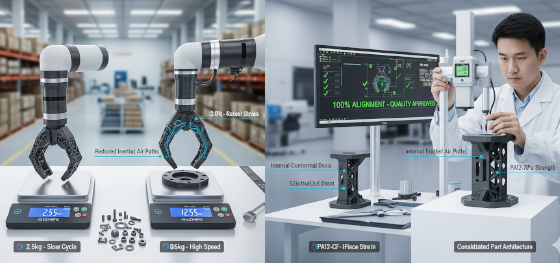
Establishing a resilient autonomous supply chain demands the rejection of traditional "subtractive-only" thinking. Amateurs often default to heavy machined aluminum for grippers, unaware that 3D printed end of arm tooling can reduce effector mass by up to 70%. Jucheng Precision eliminates this "Inertia Penalty" by utilizing industrial Multi Jet Fusion (MJF) and specialized carbon-fiber filaments. Whether you are developing a soft-robotic grasper for a food processing line or a complex vacuum manifold for an automotive cell, our facility provides the material science and metrological rigor required for 2026 market entry. This guide deconstructs the necessity of mass reduction, the physics of conformal pneumatic channels, and why JUCHENG’s "Consolidation Protocol" is the mandatory foundation for anyone developing 3D printed end of arm tooling for global fulfillment.
Maximizing Payload via Mass Reduction
Designing Conformal Internal Air Channels
Nylon-CF: The Modulus of Carbon Fiber
JUCHENG Protocol: Consolidating Metal Assemblies
Frequently Asked Questions: 3D Printed Grippers
Maximizing Payload via Mass Reduction
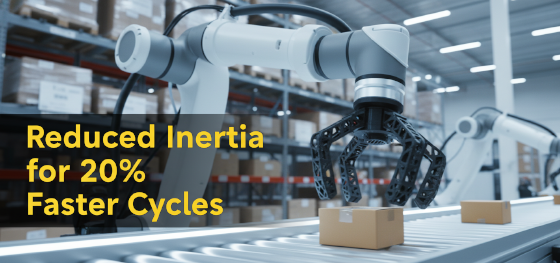
Mechanical leverage dictates the energy efficiency of every autonomous cycle. Every gram removed from the end of a six-axis arm translates directly into increased "Allowable Payload"—the weight of the actual product the robot can carry. 3D printed end of arm tooling allows designers to utilize generative design to create hollow, rib-reinforced grippers that possess the flexural modulus of metal at a fraction of the mass. At Jucheng Precision, we routinely help clients slash effector weight from 2kg down to 600g. This reduction lowers the load on the arm’s harmonic drives, reducing maintenance intervals and allowing for 20% faster directional changes. We turn "heavy anchors" into "agile effectors," ensuring your robotic cell maximizes its units-per-hour (UPH) through pure physical optimization.
Designing Conformal Internal Air Channels
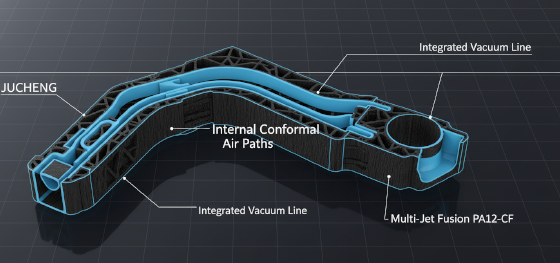
Pneumatic logistics reach a new level of elegance through additive manufacturing. Traditional robotic grippers are often plagued by a "nest" of external pneumatic hoses that can get caught during rapid movements, leading to catastrophic downtime. 3D printed end of arm tooling solves this by integrating conformal air channels directly into the structural walls of the gripper. Jucheng Precision engineers utilize high-resolution MJF technology to "print" these internal pipes, which can snake through 3D space with zero radius limitations. This "Self-Contained Pneumatics" eliminates the need for external fittings and heavy manifolds. We turn a chaotic assembly into a monolithic, airtight component, ensuring your vacuum suction cups and air-powered fingers operate with surgical reliability and zero hose-interference risk.
Nylon-CF: The Modulus of Carbon Fiber

Material sovereignty defines the structural limits of 3D printed end of arm tooling. Amateurs often settle for fragile SLA resins that shatter under the impact forces of high-speed industrial use. Jucheng Precision exclusively utilizes high-performance composites like Carbon-Fiber Filled Polyamide 12 (Nylon-CF). The addition of microscopic carbon fibers into the Nylon matrix increases the tensile strength to over 70 MPa and provides a flexural modulus that rivals some cast aluminum alloys. This "Composite Backbone" ensures your grippers can withstand the torque of a 10kg payload without flexing or losing their grip position. We provide the material lot traceability and mechanical data audits needed to ensure your 3D-printed hardware is armored for the most abusive factory environments, documented for 24/7 industrial survival.
JUCHENG Protocol: Consolidating Metal Assemblies

Manufacturing excellence at Jucheng Precision is built on the foundation of part consolidation. We don't just "print a bracket"; we replace entire sub-assemblies. A traditional metal gripper might consist of 15 separate components—plates, standoffs, screws, and seals. Utilizing 3D printed end of arm tooling, JUCHENG collapses these 15 parts into a single, monolithic Carbon-Fiber part. This radical reduction in the Bill of Materials (BOM) count eliminates assembly labor, removes potential failure points from loose screws, and slashes your NRE (Non-Recurring Engineering) fees. Our industrial 3D printing farm, combined with our 5-axis CNC finishing bays, delivers retail-quality, high-strength hardware in days. Stop managing a fragmented supply chain of a dozen vendors. Leverage our decade of custom robotic end-of-arm tooling mastery to validate rapidly and launch profitably.
Frequently Asked Questions: 3D Printed Grippers
Question: Is 3D printed end of arm tooling durable enough for heavy industrial use?
Answer: Yes, when utilizing industrial MJF Nylon-CF. These parts achieve 99% density and possess the impact resistance needed to survive thousands of hours on an automotive assembly line.
Question: How much weight can I save by switching from aluminum to 3D printed EOAT?
Answer: On average, our clients see a 40% to 65% reduction in mass, which often allows for the use of a smaller, more affordable robot arm for the same payload task.
Question: Can JUCHENG handle the assembly of sensors into 3D printed grippers?
Answer: Absolutely. We provide integrated assembly services, including the installation of threaded brass inserts, vacuum sensors, and proximity switches directly into your 3D printed end of arm tooling.

