


Mechanical versatility dictates the ROI of modern automated manufacturing lines. In the hyper-agile environment of 2026, a robotic cell is no longer dedicated to a single task; it must switch from high-torque bolt-driving to delicate vacuum picking in seconds. The most critical component in this transition is the tool changer—the precision interface that bridges the robot's wrist to its diverse arsenal of effectors. If the "Handshake" between the master plate and the tool plate exhibits even ten microns of positional drift, the entire system loses its calibration, leading to bent pins, crashed grippers, and thousands of dollars in downtime. Navigating this requirement for extreme structural rigidity and sub-micron repeatability requires the strategic deployment of Robot tool changer machining. Jucheng Precision operates as a high-fidelity subtractive sanctuary in the Shenzhen precision manufacturing hub, providing the exotic grinding and hard-turning depth needed to ensure your interfaces remain perfectly aligned through millions of cycles. Within the broader framework of custom robotic end-of-arm tooling, we deliver the structural backbone that enables true manufacturing autonomy, ensuring your robot switches tools with absolute dimensional sovereignty.
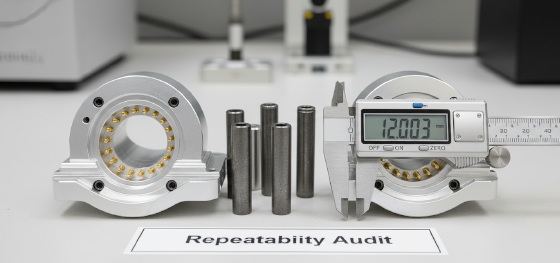
Establishing a resilient robotic supply chain in 2026 demands the absolute rejection of "general-purpose" machine shops. Amateurs often treat a tool changer plate like a standard mounting flange, unaware that the repetitive "Galling" and "Pitting" of the locking mechanism will ruin the interface within months of 24/7 service. Jucheng Precision eliminates these "Kinematic Failures" by enforcing a strict "High-Hardness" protocol across our 150+ CNC machine campus. We don't just "cut metal"; we manage the molecular fatigue of the interface. Whether you are developing a surgical robot changer requiring autoclave-stable 17-4PH or a heavy-duty automotive changer using hardened H13 tool steel, our facility provides the material science and metrological rigor required for global market entry. This guide deconstructs the necessity of sub-micron lock-up, the physics of abrasive-resistant materials, and why JUCHENG’s "Coupling Protocol" is the mandatory foundation for anyone developing robot tool changer machining projects for the autonomous era.
Why is repeatability the ultimate metric for tool changers?
Which materials survive millions of robotic locking cycles?
How to achieve sub-micron tolerances for locking pins?
JUCHENG Protocol: Integrated Turn-Mill and Metrology
FAQ
Why is repeatability the ultimate metric for tool changers?
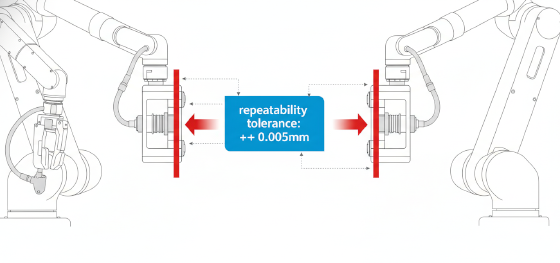
Kinetic precision is won or lost in the "Lock-up" phase. Repeatability in robot tool changer machining refers to the ability of the master and tool plates to return to the exact same 3D coordinate after every swap. For high-precision electronics assembly, the required threshold is often +/- 0.01mm or better. Achieving this requires the elimination of mechanical "Slop" within the locking cams and pins. Jucheng Precision utilizes 5-axis CNC machining followed by precision jig-grinding to ensure the mating tapered surfaces are perfectly matched. We understand that as the robot accelerates at 5G, the centrifugal forces attempt to pry the plates apart. Our engineering team prioritizes "High-Engagement Geometry," where the locking pins are slightly pre-loaded against the tool plate. This ensures a rock-solid mechanical link that effectively transforms the tool changer into a monolithic part of the robot arm, preventing the vibration-induced sensor errors that plague lower-quality interfaces.
Which materials survive millions of robotic locking cycles?
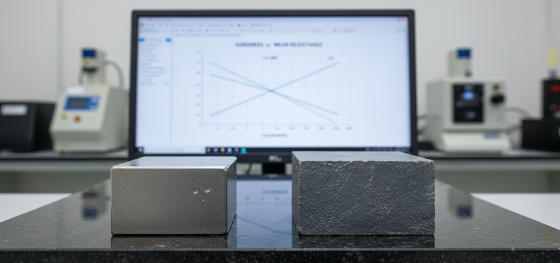
Molecular hardness dictates the "Wear Horizon" of a robotic interface. Because tool changers involve metal-on-metal sliding contact under intense pneumatic clamping force, they are prime targets for "Galling"—where microscopic pieces of metal weld together and tear the surface. Jucheng Precision eliminates this crisis through strategic metallurgical selection. For the primary plates, we utilize 17-4PH Stainless Steel heat-treated to H900 condition (approx. 40-44 HRC). This provides a spectacular balance of corrosion resistance and surface hardness. For the mission-critical locking pins and bushings, we pivot to H13 or D2 Tool Steel hardened to 58-62 HRC. We often apply specialized PVD (Physical Vapor Deposition) coatings such as Titanium Nitride (TiN) to these surfaces to reduce the coefficient of friction to below 0.15. This "Sapphire-Hard" exterior ensures that after a million tool changes, the tolerances remain as tight as the day the parts left our facility.
How to achieve sub-micron tolerances for locking pins?
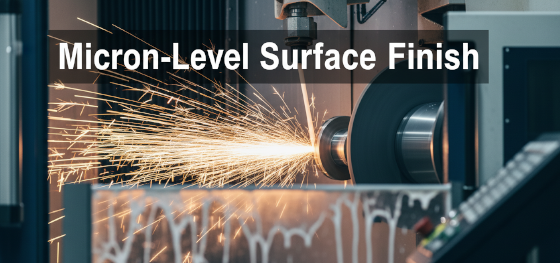
Subtractive perfection reaches its limit when the goal is sub-micron cylindricity. A standard CNC lathe can achieve +/- 0.01mm, but robot tool changer machining for the 2026 market demands +/- 0.002mm for the locking pins. Jucheng Precision resolves this paradox through "Precision Cylindrical Grinding." After the parts are rough-machined and hardened, we move them to our climate-controlled grinding bay. Using vitrified diamond wheels and real-time laser gauging, we remove material in increments of 0.001mm. This process eradicates the "Lobing" and "Taper" inherent in traditional turning, delivering a surface finish of Ra 0.2 µm. This mirror-smooth finish is vital for the pneumatic seals; if the pin surface is rough, it will shred the O-rings inside the tool plate, causing "Air Bleed" that leads to tool-drop sensors triggering erroneously. We turn "metal rods" into "optical-grade mechanical anchors," documented for sub-micron accuracy.
JUCHENG Protocol: Integrated Turn-Mill and Metrology
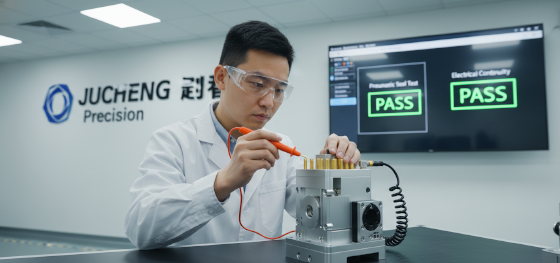
Manufacturing excellence at Jucheng Precision is built on the foundation of the integrated supply chain. We don't just machine the plates; we engineer the "Coupling Sovereignty." Our facility combines elite Turn-Mill centers to cut the complex internal air-galleries and electrical porting with high-precision metrology labs to verify the assembly. We understand that a tool changer is a hybrid system: it requires perfectly parallel metal faces and airtight pneumatic manifolds. When you upload a CAD file to our facility, our veteran engineers perform a comprehensive "Repeatability DFM Audit." We suggest material switch-outs to prevent "Bimetallic Corrosion" and propose tolerances that maximize your robot's UPH. We provide full material lot traceability and CMM inspection reports for every batch, providing the "Paper Trail of Quality" required for automotive and med-tech industries. Stop gambling your robot's uptime on vendors who only see a "simple plate." Leverage our decade of robot tool changer machining mastery to validate rapidly and launch profitably.
FAQ
Q: What is the lead time for a custom set of tool changer plates?
A: Utilizing our expedited 5-axis CNC and grinding workflow, Jucheng Precision can deliver fully machined and tested tool changer kits in as fast as 12 to 15 business days.
Q: Can JUCHENG handle the machining of high-payload (100kg+) tool changers?
A: Yes. Our facility is equipped with heavy-duty CNC centers designed to machine oversized tool plates from high-strength tool steels, ensuring the mechanical lock survives extreme dynamic forces.
Q: Do you offer assembly for the electrical spring-pin connectors?
A: Absolutely. We provide integrated assembly services, including the installation of gold-plated pogo-pins, pneumatic seals, and sensor housings directly into the robot tool changer machining plates.
Q: How do you verify the repeatability of the tool changer before shipping?
A: We utilize a custom test rig and a high-precision laser tracker to measure the 3D coordinate delta over 100 mating cycles, providing you with a certified "Repeatability Report" for each unit.

