


Pneumatic latency and mechanical interference remain the primary executioners of robotic units-per-hour (UPH). In the high-velocity environment of autonomous pick-and-place lines, the robot's ability to manipulate parts is entirely dependent on the integrity of its vacuum supply. If the robot arm is draped in a "spaghetti" of external plastic hoses, it creates a dangerous kinetic friction. These hoses snag on structural frames, rub against sharp edges, and eventually develop microscopic leaks that ruin the vacuum seal. Navigating this requirement for high-reliability, streamlined air distribution requires the strategic deployment of Custom vacuum suction manifolds. Jucheng Precision operates as a high-fidelity manufacturing sanctuary in the Shenzhen precision manufacturing hub, providing the technical depth to transform chaotic external plumbing into an integrated structural asset. Within the broader framework of custom robotic end-of-arm tooling, we bridge the gap between "clunky prototype hoses" and "integrated industrial sovereignty," ensuring your robot moves with 100% agility and zero pneumatic downtime.
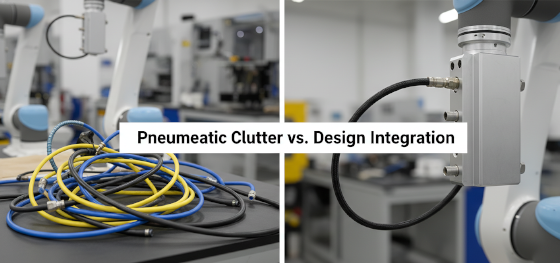
Establishing a resilient autonomous supply chain in 2026 demands the absolute rejection of "exposed air lines." Amateurs often neglect the inertia penalty and snag-risk of external hoses, unaware that every extra gram of plastic and every millimeter of hose-drag forces the robot to move at a slower velocity to prevent motor overloading. Jucheng Precision eliminates these "Mechanical Drags" by providing an integrated ecosystem of 5-axis CNC machining and Direct Metal Laser Sintering (DMLS). Whether you are developing a multi-cup array for solar panel handling or a hyper-compact camera mount requiring a prototype robot vacuum seal, our facility provides the material science and metrological rigor required for global market entry. This guide deconstructs the necessity of integrated manifold logic, the physics of deep-hole drilling, and why JUCHENG’s "Airtight Protocol" is the mandatory foundation for anyone developing next-generation effectors.
Interference Risks: Why external hoses sabotage robot uptime?
Integrated Solutions: Streamlining EOAT with internal air routing
Subtractive Precision: Deep hole drilling and internal porting
Additive Innovation: Metal 3D printing for conformal air paths
JUCHENG Protocol: Zero-Leak Metrology for Vacuum EOAT
FAQ
Interference Risks: Why external hoses sabotage robot uptime?
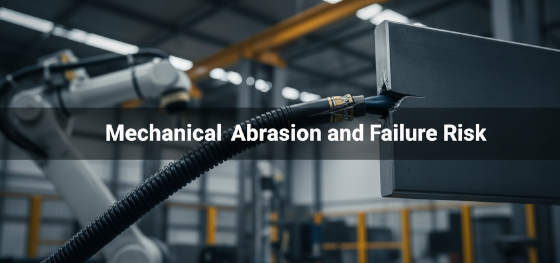
Kinetic reliability is a byproduct of geometric isolation. In a traditional robotic cell, external pneumatic hoses are subjected to millions of violent "Whip-Actions" per year. This constant flexing work-hardens the plastic, eventually leading to fatigue cracking near the fittings. Furthermore, as the robot arm executes complex 6-axis rotations, these hoses often interfere with the robot’s own skeletal frame, restricting the "Safe Motion Window" and potentially snagging on nearby safety guarding. Custom vacuum suction manifolds eliminate this risk by routing the air through the internal structure of the effector. By removing the hoses from the exterior, Jucheng Precision allows your robot to utilize its full range of motion at maximum speed, preventing the expensive downtime associated with burst lines and sensor-calibration errors caused by hose-drag. We turn "vulnerable plumbing" into "structural conduits," ensuring your robot’s UPH is limited only by its motor torque, not its air supply.
Integrated Solutions: Streamlining EOAT with internal air routing
Organizational mastery at the robot wrist dictates the success of high-density assembly cells. A Custom vacuum suction manifolds assembly functions as a high-precision pneumatic hub, consolidating multiple suction cup lines into a single industrial input. At Jucheng Precision, we advocate for the "Single-Point Connection" mandate. Instead of running five separate hoses down the length of the arm, our engineers design a manifold that distributes vacuum through internal galleries. This consolidation significantly reduces the "Wrist Payload," allowing the robot to carry 15% more product or move with 20% higher acceleration. We utilize Aerospace-Grade 6061-T6 Aluminum or high-modulus Delrin for these hubs, ensuring the manifold acts as both a pneumatic distributor and a rigid structural mounting plate. We don't just "organize hoses"; we optimize the kinetic energy of your entire automation cell, documented for survival in 24/7 high-cadence production.
Subtractive Precision: Deep hole drilling and internal porting
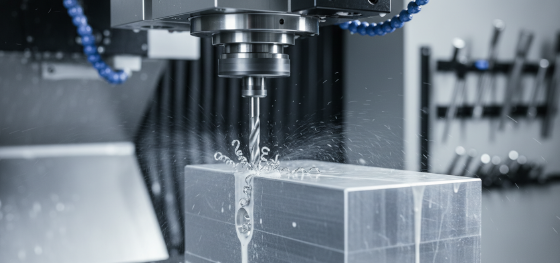
Hermetic integrity in a manifold is achieved through sub-micron subtractive control. The traditional method for creating a Custom vacuum suction manifolds involves 5-axis CNC machining of solid aluminum billets. Jucheng Precision utilizes specialized "Gun-Drilling" and deep-hole milling techniques to create internal air paths that can traverse the entire length of the part. Once the primary galleries are cut, we utilize precision-tapped "Plug Ports" to seal the access holes, creating a series of hidden internal crossroads. Our machining bay ensures that every O-ring seat and NPT thread is verified with a go/no-go gauge, preventing the "Vacuum Bleed" that causes parts to drop during high-speed moves. We turn "raw metal blocks" into "hermetically sealed air highways," providing the pneumatic sovereignty needed for precision handling of electronics and automotive sub-assemblies.
Additive Innovation: Metal 3D printing for conformal air paths
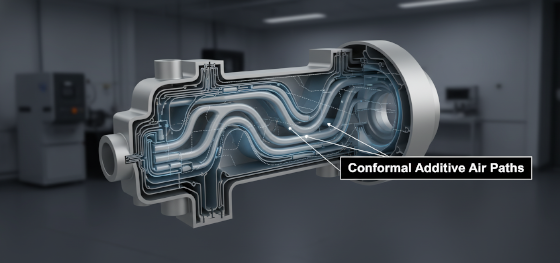
Fluid dynamics reached their absolute peak through the power of additive manufacturing. When a robotic effector requires complex, non-linear air routing—such as curving around an internal sensor or distributing air to a circular array of 20 suction cups—traditional drilling is physically impossible. Jucheng Precision utilizes Direct Metal Laser Sintering (DMLS) to "grow" Custom vacuum suction manifolds from titanium or aluminum powder. This technology allows for "Conformal Air Channels" with optimized internal radii that minimize air turbulence and maximize vacuum flow. By utilizing DMLS, we can consolidate a manifold that would traditionally require five CNC parts and ten seals into a single, monolithic, 3D-printed asset. This radical reduction in seal-count eliminates 90% of your potential leak paths, ensuring your high-performance hardware maintains its grip in the most demanding industrial environments.
JUCHENG Protocol: Zero-Leak Metrology for Vacuum EOAT
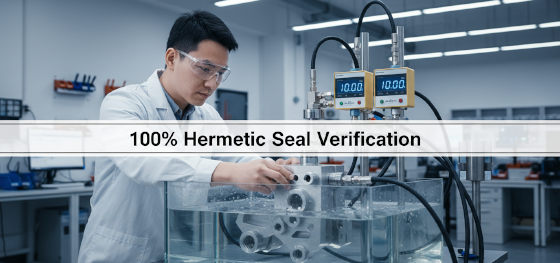
Manufacturing excellence at Jucheng Precision is built on the foundation of the hydrostatic and pneumatic audit. We don't just "mold and machine"; we prove airtightness with documented data. Our facility subjects every Custom vacuum suction manifolds batch to a rigorous "Pressure-Decay Test." We charge the internal galleries with 10 bar of dry air and monitor the pressure loss over a fixed duration using digital transducers. If we detect a leak of even 0.01 bar, the part is scrapped and investigated. We provide full material lot traceability and CMM dimensional inspection reports for every batch, ensuring your project meets the strict requirements of the aerospace and medical industries. Stop gambling your robot's UPH on uncertified vendors who use manual hose-clamps. Leverage our decade of high-performance replication mastery to validate rapidly and launch profitably. Contact our technical team today for a free DFM review.
FAQ
Q: Why is aluminum better than plastic for Custom vacuum suction manifolds?
A: Aluminum offers superior airtightness over long durations and provides a rigid mounting surface that won't warp under vacuum pressure, ensuring your suction cup alignment remains perfect.
Q: Can JUCHENG handle manifolds for high-speed "Spider" robots?
A: Yes. We specialize in ultra-lightweight, 5-axis machined aluminum manifolds designed specifically for the extreme accelerations (up to 15G) of high-speed delta and SCARA robots.
Q: How do you prevent internal air paths from being blocked in 3D printed manifolds?
A: Our DFM engineers design "Powder Escape Ports" and utilize multi-stage ultrasonic cleaning and vibration protocols to ensure 100% of the unfused material is removed from the internal air channels.
Q: What is the lead time for a custom 5-axis machined aluminum manifold?
A: Utilizing our integrated facility and expedited robotics workflow, JUCHENG delivers fully tested and anodized custom manifolds in as fast as 5 to 7 business days.

