


Shaping the strongest metal in the world used to be a battle of attrition. Titanium is legendary for its refusal to cooperate on a machine bed; it eats carbide tools, work-hardens instantly, and traps heat with a persistence that challenges every traditional machinist. But the arrival of 3d printed titanium has fundamentally shifted the balance of power. We are no longer restricted by the line-of-sight of a milling cutter or the massive costs of specialized forged tooling. Instead, we use high-power fiber lasers to weld metallic atoms into a solid, monolithic block, one 30-micron layer at a time. This is the ultimate evolution of metal 3d printing—a technology that allows us to build skeletal aerospace frames and patient-specific medical implants that are physically impossible to create via any other manufacturing method.
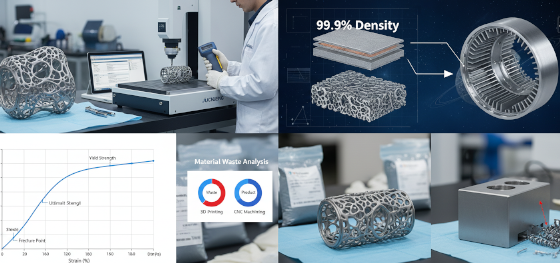
At JUCHENG, we recognize that titanium additive manufacturing is not just about the machine—it is about metallurgical sovereignty. When an aerospace component must survive a launch or a spinal cage must fuse with a human body, the structural integrity of the part is non-negotiable. Operating from our ISO 13485 certified facility, we manage the entire lifecycle of the titanium powder, from the initial XRF verification to the final vacuum stress-relief cycle. We understand that success in DMLS is found in the management of the melt pool and the mitigation of residual thermal stress. This guide moves past the basic tutorials to explore the thermodynamics of laser powder bed fusion, the biological logic of porous bone-mimicry, and why JUCHENG’s integrated approach to high-performance alloys ensures your most ambitious designs thrive in the field.
Precision in metal additive manufacturing is a struggle against heat distribution. You aren't just melting powder; you are conducting a high-speed metallurgical event that must result in 99.9% density. Whether you are building an ultra-lightweight drone bracket or a high-fidelity surgical tool, the logic of the fusion is your greatest engineering asset. Let us examine the technical pillars of 3D printed titanium and see how JUCHENG locks the integrity of your next-generation designs into physical reality.
The DMLS Advantage: Forging Without the Hammer
Medical Frontiers: Osseointegration and ISO 13485
Aerospace Integrity: Mastering Thin Walls and Lattices
Additive vs. Subtractive: The Titanium Standoff
Technical Baseline: Mechanical Property Chart
JUCHENG’s Quality Standard: From Powder to Validation
The DMLS Advantage: Forging Without the Hammer
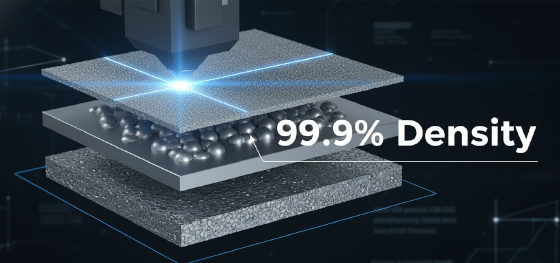
To understand the value of 3d printed titanium, one must move past the concept of "stacking layers" and look at the physics of the melt pool. We utilize Direct Metal Laser Sintering (DMLS), which uses a high-power 400W fiber laser to micro-weld spherical metal particles together. The process occurs within an inert argon environment where the oxygen level is kept below 0.1%, preventing any oxidation that would embrittle the part. The speed and intensity of this thermal event result in a highly refined grain structure that mimics—and often exceeds—the properties of a forged metal.
The primary technical advantage here is "Structural Homogeneity." Unlike traditional casting, which can suffer from internal blowholes or cooling voids, a JUCHENG DMLS part achieves a theoretical density of over 99.9%. By managing the laser’s power density and hatch-spacing, we ensure that each layer is fused at a molecular level with the one below it. This creates a monolithic part with high tensile strength and incredible fatigue resistance. For our clients in the defense and aerospace industries, this means they can design complex high-pressure valve bodies and hydraulic manifolds that are lighter than standard parts but possess the raw toughness to survive explosive pressure spikes. We don't just print shapes; we forge the future of high-stress alloys with the precision of a laser beam.
Medical Frontiers: Osseointegration and ISO 13485
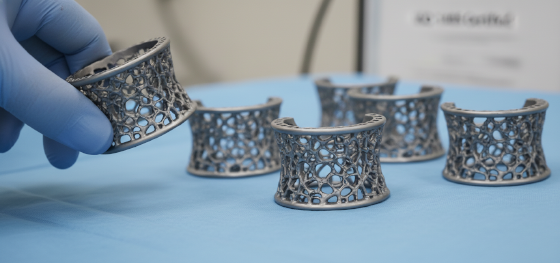
Titanium is the undisputed king of biocompatibility, but 3D printing has added a new functional dimension to its medical use: Osseointegration. In a traditional machined spinal cage, the smooth surface of the metal relies purely on mechanical friction to stay in place. With 3D printing, JUCHENG engineers can create "Trabecular" surface textures—complex, porous lattices that mimic the microscopic structure of human bone. This allows the patient's own bone cells to grow directly into the metal implant, creating a permanent biological bond that is far more secure than any screw or adhesive.
Managing this level of complexity requires a certified manufacturing partner. Jucheng Precision operates under the rigorous ISO 13485:2016 quality system, ensuring that every medical-grade titanium part—usually made from Grade 23 (ELI)—is handled with absolute purity. We manage the "Thermal History" of every implant, utilizing vacuum-annealing ovens to remove the internal stresses caused by the laser build. This ensures that the part doesn't warp or become brittle after sterilization. By combining patient-specific CAD models with our validated medical production protocols, we provide surgeons with custom cranial plates and orthopedic devices that are as anatomically precise as they are biologically safe. We bridge the gap between digital surgery and physical healing.
Aerospace Integrity: Mastering Thin Walls and Lattices
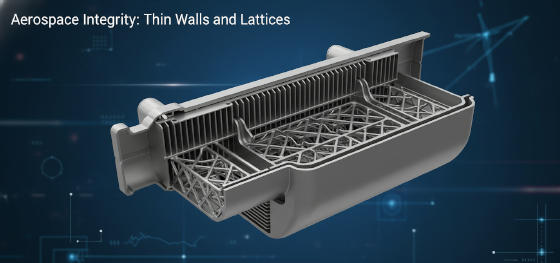
In the sky, weight is the ultimate tax on performance. Aerospace designers use 3D printing to achieve "Topology Optimization"—removing every gram of material that isn't carrying a load. This results in skeletal, organic designs with paper-thin walls and complex internal lattice structures. Machining these shapes from a solid billet would be a nightmare of tool vibration and material waste. But in the powder bed, these features are born naturally.
Successful execution in the metal 3d printing field requires a mastery of "Support Strategy." Because titanium generates massive thermal gradients during the build, thin walls want to warp. JUCHENG’s engineers utilize advanced simulation software to design sacrificial support structures that act as both mechanical anchors and thermal heat sinks. These supports pull heat away from the part and into the build plate, ensuring that even a 0.5mm wall remains straight and true. We also utilize lattices to provide "Internal Cooling"—creating complex fluid channels inside engine brackets that can never be reached by a drill. This ability to integrate thermal management and structural support into a single monolithic part is why JUCHENG is a trusted partner for the next generation of satellite and drone technology.
Additive vs. Subtractive: The Titanium Standoff
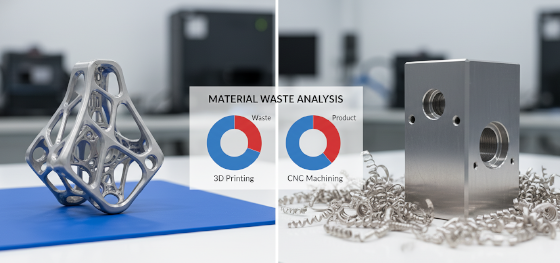
Choosing between 3D printing and CNC machining for titanium is a move of strategic pragmatism. At Jucheng Precision, we offer both, providing an unbiased DFM perspective. 3D printing is the champion of complexity and material conservation. For a complex aerospace bracket, a 3D printer might use only 500g of powder to create a 400g part. A CNC mill would have to start with a 5kg billet and grind 90% of it into expensive, unrecyclable waste chips. When material costs reach hundreds of dollars per kilogram, 3d printed titanium becomes the obvious economic choice for complex geometries.
However, subtractive manufacturing still wins on surface finish and absolute tolerance. A DMLS part has a surface roughness similar to a fine-grit casting (Ra 5-10 µm). If your design requires an H7 bearing seat or a mirror-finish seal surface, you need the mill. This is why JUCHENG employs a "Hybrid Solution." We 3D print the bulk of the complex geometry and then use our 5-axis CNC centers to perform a final precision finish on the critical mating surfaces. This integration ensures you get the lightweight benefits of additive and the surgical accuracy of subtractive in a single delivery. We don't just choose a technology; we engineer a manufacturing flow that satisfies both your performance goals and your budget.
Technical Baseline: Mechanical Property Chart
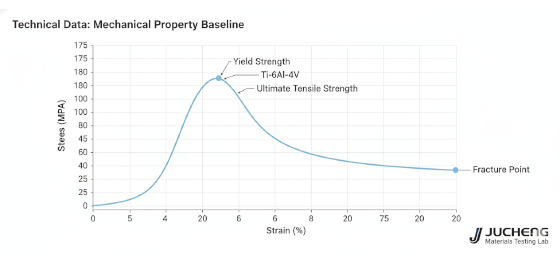
To finalize your material audit, Jucheng Precision provides the following mechanical baseline for our DMLS titanium. These values are representative of parts produced within our inert gas chambers and subjected to standardized stress-relief protocols.
| Mechanical Property | DMLS Titanium (Ti-6Al-4V) | Comparative Cast Ti64 |
|---|---|---|
| Tensile Strength | ~1000 - 1100 MPa | ~895 MPa |
| Yield Strength | ~900 - 950 MPa | ~825 MPa |
| Elongation at Break | ~10 - 15% | ~10% |
| Density | ~4.43 g/cm³ (99.9%+) | ~4.43 g/cm³ |
| Thermal Conductivity | 6.7 W/m-K | 6.7 W/m-K |
JUCHENG’s Quality Standard: From Powder to Validation
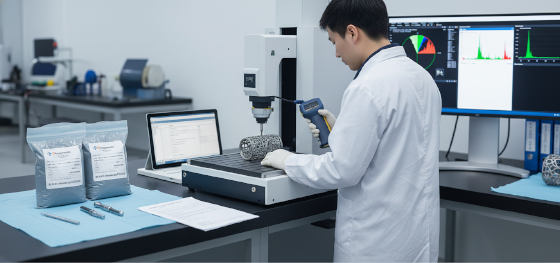
The final hallmark of a high-end manufacturing partner is the ability to prove the integrity of the part. In the metal 3d printing world, you can't see internal defects with the naked eye. Jucheng Precision has built a quality sanctuary to protect your reputation. We perform mandatory powder analysis, checking for particle size distribution and oxygen content before every build. We utilize in-process laser monitoring to detect any melt-pool anomalies that could indicate a hidden void.
Once the build is complete, every part undergoes a "Thermal Stabilization" cycle in our vacuum furnaces. We verify the final dimensions using high-resolution CMM probes and video measuring systems. For mission-critical aerospace parts, we provide full material traceability and documented process validation. When you receive a titanium component from JUCHENG, you aren't just getting metal; you are getting a verified engineering solution that has been audited for survival. Whether you are building an innovative heart pump or a high-performance jet engine bracket, our expertise in 3d printed titanium ensures your vision is delivered with absolute precision. Contact our engineering team today for a comprehensive DFM review and let our titanium protocols armor your next industrial breakthrough.

