


Atomic fusion has replaced traditional casting as the ultimate frontier for complex metal components. In the modern landscape of 3D printing materials, the ability to transform microscopic metallic dust into solid, high-integrity hardware is a feat of pure thermodynamics. This is the industrial domain of metal 3d printing. Unlike plastic printing, which focuses on rapid mockups, metal additive manufacturing operates at the mission-critical level—building the structural nodes of fighter jets and the life-saving implants used in orthopedic surgery. It is a process where high-power fiber lasers weld particles of titanium and steel into a monolithic block that is as dense as a forging but more complex than any machine could ever carve.
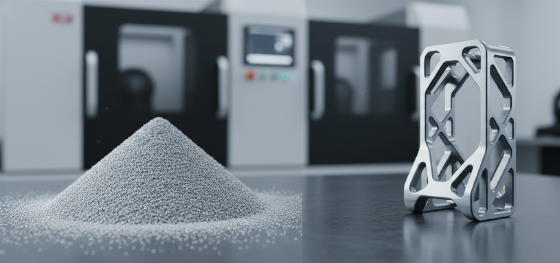
At JUCHENG, we recognize that metal additive manufacturing is not just about the printer; it is about the metallurgical integrity of the powder bed. A part is only as strong as the purity of the alloy it was born from. We operate an advanced DMLS (Direct Metal Laser Sintering) facility that bridges the gap between digital design and physical survival. By mastering the chemical nuances of titanium, aluminum, and nickel-based superalloys, we provide our global partners with a technical sanctuary for their most ambitious designs. This guide explores the diverse palette of metal powders, the physics of laser fusion, and the rigorous quality standards JUCHENG employs to ensure every part is structurally invincible and dimensionally perfect.
Efficiency in high-performance metalwork starts with the selection of the correct powder morphology. Success is found in the management of the melt pool and the mitigation of residual thermal stress. Whether you are building an ultra-lightweight satellite bracket or a high-pressure valve manifold, understanding the material logic is your greatest asset. Let us examine the technical pillars of metal additive manufacturing and see how it redefines the integrity of your next-generation hardware.
Titanium Alloys: Forging Biocompatible Strength
Aluminum Alloys: Achieving Aerospace Lightweighting
Stainless and Tool Steels: Industrial Durability at Scale
Superalloys and Specialized Powders: Survival in the Heat
JUCHENG’s Quality Standard: Powder Purity and Validation
Titanium Alloys: Forging Biocompatible Strength
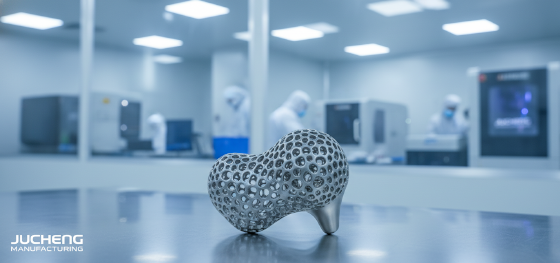
In the hierarchy of metal 3d printing, Titanium is the undisputed king of performance. We primarily utilize Grade 5 (Ti-6Al-4V) and Grade 23 (ELI) powders to produce components that demand an extreme strength-to-weight ratio. Titanium's molecular behavior during laser sintering is unique; the rapid cooling rates of the DMLS process result in a highly refined grain structure that offers superior mechanical properties compared to traditional castings. For aerospace engineers, this means the ability to manufacture skeletal brackets that can withstand massive G-forces while remaining exceptionally light.
Beyond flight, Titanium dominates the medical sector due to its absolute biocompatibility. JUCHENG operates under strict ISO 13485 protocols to produce patient-specific implants—spinal cages, cranial plates, and hip joints—that the human body accepts as its own. We leverage the additive process to create "trabecular" surface textures—complex, porous lattices that mimic the structure of natural bone. This encourages osseointegration, where the patient's bone actually grows into the titanium part, creating a permanent mechanical bond. By managing the oxygen levels in our build chambers to less than 100 parts per million, we ensure that the titanium remains pure and ductile, providing surgeons with the reliable hardware they need to rebuild human lives.
Aluminum Alloys: Achieving Aerospace Lightweighting
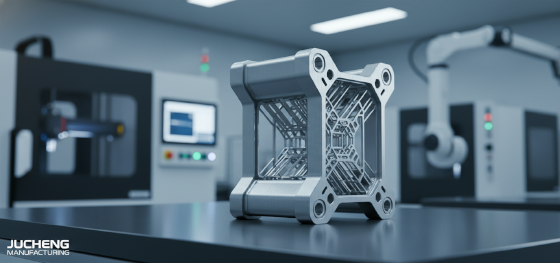
Lightweighting is a struggle against the relentless force of gravity. For the aerospace and automotive sectors, Aluminum alloys are the primary weapons in this battle. We primarily utilize AlSi10Mg—a high-strength aluminum powder combined with silicon and magnesium. This specific alloy was engineered for the fast-cooling cycles of laser powder bed fusion. It provides excellent castability and weldability, allowing JUCHENG to print thin-walled structures and complex internal housings that would be impossible to manufacture via traditional milling.
The value for the designer is found in "Topology Optimization." Since the laser can build material only where the stress dictates, we can remove as much as 60% of the mass from a solid bracket while maintaining its structural rigidity. These lightweight aluminum parts are essential for drones, satellites, and electric vehicle battery housings where every gram saved translates into increased range or payload capacity. At Jucheng Precision, we use high-speed spindles to perform secondary CNC finishing on critical mating faces, ensuring that your topologically optimized parts meet the tight +/- 0.02mm tolerances required for precision assembly. We don't just print aluminum; we engineer skeletal efficiency that survives the launch pad.
Stainless and Tool Steels: Industrial Durability at Scale

Steel remains the backbone of the industrial world. In our additive facility, we focus on high-performance grades like 316L Stainless Steel and MS1 Maraging Steel. 316L is favored for its extreme corrosion resistance and high ductility, making it the standard for chemical processing components and medical instruments. The additive process allows us to create 316L parts with intricate internal cooling channels that significantly improve the thermal efficiency of industrial valves and heat exchangers.
Maraging Steel (MS1) is the "heavy artillery" of our material palette. It can be heat-treated to achieve a hardness of HRC 54 or higher while maintaining exceptional toughness. This makes it the ideal material for high-stress tooling, such as die-casting inserts and injection mold cavities. By utilizing metal 3D printing, JUCHENG can integrate "Conformal Cooling" into these tool steel components. Unlike traditional straight-drilled holes, conformal channels follow the exact contour of the mold cavity, reducing cooling times by up to 30% and eliminating "hot spots" that lead to part warping. This technical synergy between 3D printing and tool engineering allows our clients to increase their production throughput and reduce scrap rates in their own molding facilities.
Superalloys and Specialized Powders: Survival in the Heat
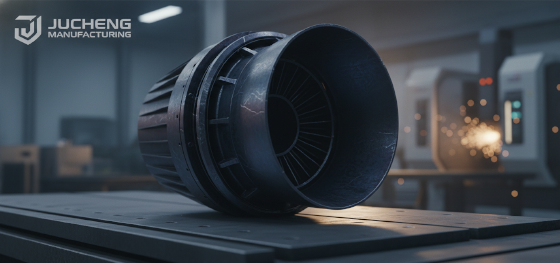
There is a class of components that must survive in the "warm zone" where standard metals would simply melt or deform. This is the domain of Superalloys like Inconel 718 and Cobalt-Chrome. Inconel 718 is a nickel-chromium based alloy designed to maintain its high tensile, creep, and rupture strength at temperatures up to 700°C (1300°F). It is notoriously difficult to machine via traditional CNC milling because it work-hardens instantly and eats cutting tools for breakfast. Additive manufacturing solves this "Machinability Barrier."
At Jucheng Precision, we use Inconel 718 to produce complex exhaust components, turbine blades, and high-pressure subsea equipment. Because we are growing the part from powder, the hardness of the material is no longer an obstacle to complexity. We also specialize in Copper 3D printing for high-conductivity applications. Pure copper is notoriously difficult to print because it reflects the laser energy; JUCHENG utilizes high-power lasers and specialized green-laser technology in some cases to overcome this reflection, delivering induction coils and heat sinks with 100% density and thermal performance that matches raw copper stock. By providing access to these "difficult" materials, we empower our clients to design for the most hostile environments on Earth and beyond.
JUCHENG’s Quality Standard: Powder Purity and Validation
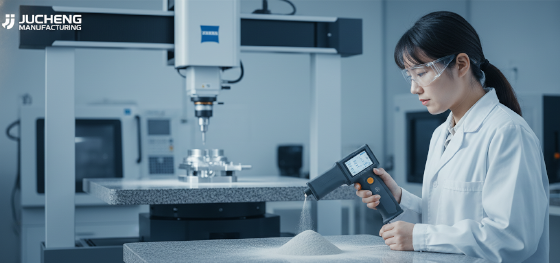
Choosing a partner for metal additive manufacturing is a move of technical trust. You are trusting that the "Titanium" in the machine is truly the alloy you specified. Jucheng Precision eliminates this uncertainty through a rigorous "Atomic Audit." We verify every batch of incoming powder using in-house X-Ray fluorescence (XRF) and particle size analysis. This ensure that the sphericity of the powder is perfect, allowing it to flow smoothly across the build plate for a defect-free part.
Our facility is an integrated ecosystem of additive and subtractive mastery. We don't just "print and ship." Every critical component undergoes a multi-stage post-processing cycle, including vacuum stress-relief annealing to prevent warping and 5-axis CNC machining to lock in final dimensions. We provide full material traceability and detailed CMM inspection reports with every order, ensuring that the structural soul of your design is verified at every level. Whether you are building an innovative surgical robot or a high-performance jet engine component, JUCHENG has the metallurgical rigor and the manufacturing capacity to deliver. We don't just make metal parts; we forge the future of precision engineering. Contact our engineering team today for a technical DFM review and see how our metal additive protocols can clarify and armor your next project.

