


Weight is a silent tax on every moving mechanism. In the high-velocity sectors of aerospace, robotics, and electric vehicle development, the struggle to shed kilograms without compromising structural stiffness is an eternal engineering battle. Traditional aluminum casting, while effective for bulk shapes, often reaches a geometric ceiling where internal voids and wall-thickness limitations prevent further optimization. This is where 3d printed aluminum has effectively liberated the design envelope. By utilizing Direct Metal Laser Sintering (DMLS), we can now grow complex, high-strength aluminum structures that are lighter than a casting and more intricate than anything a traditional 5-axis mill could carve from a solid block. This is the new era of metal 3d printing, where the material is no longer a constraint, but an active participant in performance optimization.
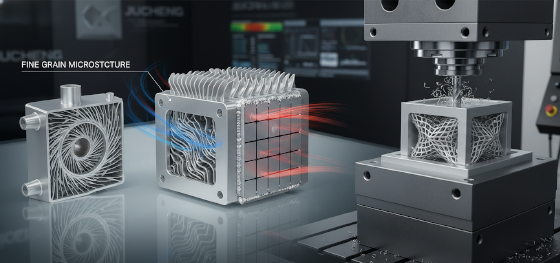
At JUCHENG, we don't treat aluminum additive manufacturing as a mere prototyping tool; we treat it as an industrial-grade production platform. We understand that for a high-performance heat sink or a lightweight robotic end-effector, the integrity of the part is defined by the purity of the AlSi10Mg powder and the precision of the laser's thermal footprint. If the cooling rate is poorly managed, the aluminum will develop internal micro-stresses that lead to long-term fatigue failure. We have engineered our facility to balance this rapid solidification with rigorous post-process stabilization. This guide moves past the basic definitions to explore the metallurgy of fine-grain alloys, the rise of digital lattice engineering, and why JUCHENG’s integrated approach to hybrid manufacturing ensures your lightweight designs survive the extreme vibrations of the real world.
Efficiency in modern metalwork is found in the removal of wasted mass. When you can consolidate a twenty-piece assembly into a single, topologically optimized aluminum print, you aren't just saving weight—you are eliminating twenty potential points of failure. Let us examine the technical pillars of 3D printed aluminum and see how JUCHENG locks the integrity of your most ambitious designs into physical reality.
Metallurgical Foundations: Why AlSi10Mg Rules the Bed
Thermal Sovereignty: Engineering Next-Gen Heat Sinks
Lattice Logic: Redefining Strength-to-Weight Ratios
Rapid Tooling: Accelerating Mold and Jig Development
Technical Data: AlSi10Mg Mechanical Property Chart
JUCHENG’s Hybrid Protocol: Closing the Tolerance Gap
Metallurgical Foundations: Why AlSi10Mg Rules the Bed
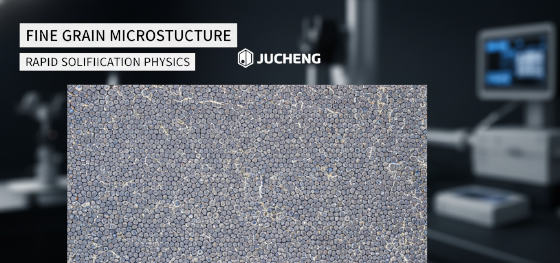
In the hierarchy of metal additive manufacturing, AlSi10Mg has emerged as the workhorse for a specific reason: its near-perfect weldability. This alloy, which combines aluminum with roughly 10% silicon and a fraction of magnesium, was originally designed for high-pressure die casting. However, the physics of 3D printing—specifically the rapid heating and cooling cycles of the laser—transform this familiar material into a high-performance solid with a significantly finer grain structure than its cast counterparts. The silicon content improves the melt-pool stability, preventing the "cracking" that occurs when other high-strength aluminum alloys are subjected to laser fusion.
At JUCHENG, we leverage this metallurgical balance to produce parts with excellent cast-like properties but with a 99.9% theoretical density. The rapid solidification process of DMLS results in a material with higher tensile strength and hardness than traditional T6-tempered castings. This makes 3D printed aluminum suitable for functional structural components, not just visual prototypes. Furthermore, AlSi10Mg exhibits excellent corrosion resistance, making it an ideal choice for outdoor housings and marine-adjacent sensors. By controlling the laser’s energy density and hatch-spacing, we ensure that the silicon particles are uniformly dispersed, creating a consistent structural matrix that can survive the brutal vibrational loads of an aerospace launch or a racing track. We don't just melt powder; we orchestrate a metallurgical event that locks in performance at the micron level.
Thermal Sovereignty: Engineering Next-Gen Heat Sinks
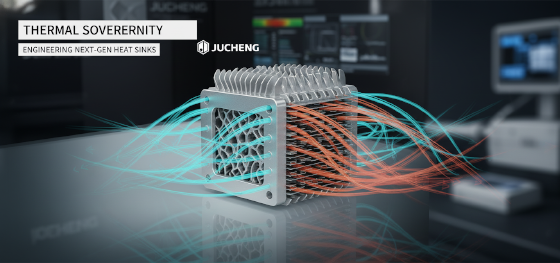
The primary functional superpower of aluminum is its thermal conductivity. In the electronics and EV industries, moving heat away from sensitive chips is a constant struggle. Traditional heat sinks are limited by the extrusion process, which can only produce straight, parallel fins. 3D printing removes these shackles, allowing for the creation of "Conformal Heat Management" systems. We can design heat sinks with curved fins, varying surface areas, and internal liquid cooling channels that follow the exact geometry of the heat source.
Jucheng Precision utilizes AlSi10Mg to produce these high-fidelity thermal solutions. The material’s thermal conductivity (approximately 110 W/m-K in the as-printed state) ensures that energy is moved rapidly from the source. Because we can print "monolithic" cooling assemblies—where the fins, the base plate, and the fluid connectors are all a single piece—we eliminate the thermal resistance caused by seams and thermal paste. This results in a system that is 30% to 50% more efficient than a traditional assembled heat sink. For our clients building high-power LED arrays or drone flight controllers, this thermal sovereignty allows them to pack more power into smaller packages without the fear of thermal throttling. We bridge the gap between abstract design and real-world cooling performance, providing the complex geometry needed to keep your electronics alive in high-stress environments.
Lattice Logic: Redefining Strength-to-Weight Ratios
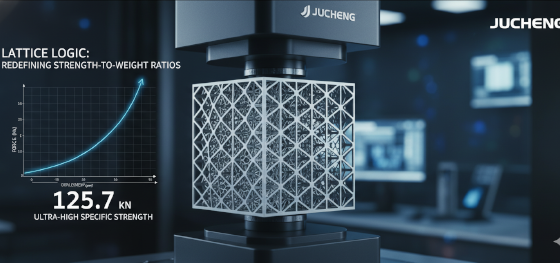
In the world of 3D printed aluminum, mass is a choice, not a requirement. One of the most powerful DFM tools JUCHENG provides is "Lattice Engineering." By filling the internal volume of a part with a skeletal lattice structure rather than solid metal, we can reduce the weight of a component by up to 70% while maintaining its structural rigidity. This is essentially "Digital Honeycomb," allowing for parts that are incredibly stiff but light enough to be used in satellite deployments or handheld robotic tools.
We utilize various lattice geometries, such as Gyroid or Diamond cells, to provide "Tailored Stiffness." We can make a part more flexible in one axis and more rigid in another by simply varying the lattice density. This level of mechanical control is impossible with traditional casting or CNC milling. Aluminum is particularly suited for lattice design because its low density and high ductility allow the lattice beams to absorb energy during impact without snapping. For automotive designers, this means the ability to create "crumple-friendly" brackets that absorb shock while protecting sensitive sensors. At JUCHENG, we help our clients perform the necessary simulation and DFM reviews to ensure these delicate internal structures don't collapse during the build, delivering a part that is mathematically optimized for its specific load case. We don't just print metal; we engineer the void to maximize performance.
Rapid Tooling: Accelerating Mold and Jig Development
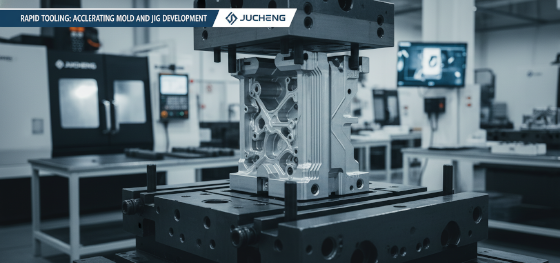
Time is the most expensive consumable on the production floor. When a manufacturer needs a custom assembly jig or a prototype injection mold insert, waiting eight weeks for a traditional tool steel part is a project-killer. 3D printed aluminum offers a "Fast-Track" solution for industrial tooling. By printing mold inserts with integrated conformal cooling channels, we can reduce injection molding cycle times by up to 40%, paying for the 3D printed part in just a few days of production.
At Jucheng Precision, we use AlSi10Mg to produce high-durability assembly fixtures and rapid tooling. Aluminum is easy to post-machine, allowing us to add precision features or surface textures after the print is complete. For our robotics clients, we print customized end-of-arm tooling (EOAT) that is lighter than steel, allowing the robot to move faster and handle more payload. Because 3D printed aluminum is naturally wear-resistant and can be anodized for additional hardness, these tools survive for thousands of cycles on the factory floor. By digitizing the tooling process, we enable our clients to iterate on their assembly lines with the same speed they iterate on their CAD files. We turn the slow world of heavy hardware into an agile, rapid-response manufacturing ecosystem.
Technical Data: AlSi10Mg Mechanical Property Chart
To finalize your material selection, Jucheng Precision provides the following technical baseline for our DMLS aluminum. These values are representative of parts produced in our inert atmosphere and subjected to standard stress-relief protocols.
| Mechanical Property | DMLS Aluminum (AlSi10Mg) | Comparative Cast A360 |
|---|---|---|
| Tensile Strength | ~400 - 450 MPa | ~315 MPa |
| Yield Strength | ~250 - 280 MPa | ~170 MPa |
| Elongation at Break | ~5 - 10% | ~3.5% |
| Thermal Conductivity | ~110 W/m-K | ~113 W/m-K |
| Density | 2.68 g/cm³ (99.9%+) | 2.68 g/cm³ |
JUCHENG’s Hybrid Protocol: Closing the Tolerance Gap
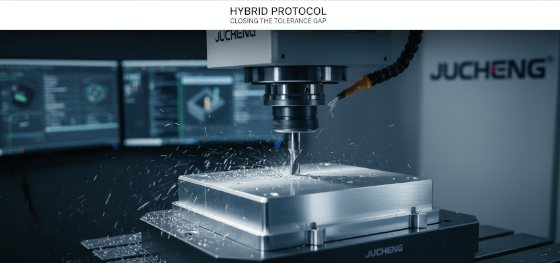
A raw 3D print is a starting point, not a destination. For any part requiring a precision fit—like a bearing seat or a sealed gasket face—the surface finish of a 3D print (typically Ra 6.3-10 µm) is insufficient. Jucheng Precision eliminates this "Accuracy Gap" through our hybrid manufacturing workflow. We don't just "print and ship"; we utilize our internal 5-axis CNC fleet to perform secondary finishing on all critical mating features.
By performing the "Heavy Lifting" with 3D printing and the "Final Precision" with CNC milling, we deliver parts that combine the geometric freedom of additive with the micron-level certainty of subtractive manufacturing. This integrated approach ensures that your complex aluminum components arrive with verified H7 tolerances and mirror-like finishes where it matters most. We manage the entire lifecycle, providing full material certification and CMM inspection reports to ensure your design intent is fully realized. Whether you are building an innovative electric powertrain or a high-efficiency drone chassis, JUCHENG’s expertise in 3d printed aluminum ensures your vision is delivered with absolute structural and dimensional integrity. Contact our engineering team today for a technical DFM review and let our aluminum additive protocols armor your next project.

