


Gravity is the most expensive variable in flight. Every gram of excess mass on an aircraft or satellite represents a permanent tax on fuel efficiency, range, and payload capacity. In the high-stakes world of 3D printing industry applications, the aerospace sector serves as the ultimate laboratory for structural perfection. Traditional manufacturing—the forging, casting, and multi-part assembly logic of the 20th century—has reached a physical ceiling. These methods require thick walls for tool access and heavy fasteners for assembly, adding unnecessary weight to every airframe. This is where 3d printing aerospace transitions from an R&D curiosity into the primary engine of flight performance. By growing metal and high-performance polymers layer-by-layer, engineers can finally match the complexity of the digital model with the reality of the physical part, building skeletal structures that are functionally invincible but mathematically lean.
At JUCHENG, we recognize that an aerospace component is not just a part; it is a liability-heavy asset that must survive supersonic vibration and extreme thermal shock. Success in the stratosphere is found in the management of the "Digital Thread"—the unbroken chain of data from the initial topological optimization to the final CMM verification. We have integrated our high-precision 5-axis centers with industrial-tier DMLS and FDM systems to deliver monolithic flight hardware that meets the most demanding regulatory standards. This guide moves past the basic brochures to explore the thermodynamics of titanium fusion, the safety physics of FST-certified polymers, and why JUCHENG’s integrated approach to hybrid manufacturing is the mandatory final step in ensuring your aerospace designs reach orbit without compromise.
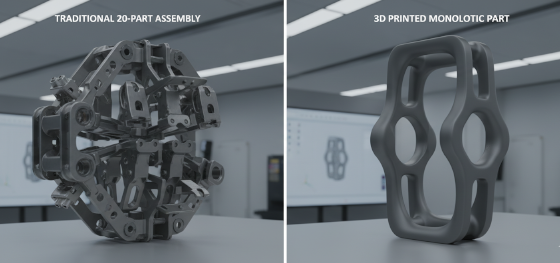
Efficiency in the air is won through the removal of structural doubt. When you can consolidate a fifteen-part assembly into a single 3D printed structure, you aren't just saving weight; you are eliminating fifteen potential points of failure. Whether you are building a complex fuel swirler for a jet engine or a lightweight interior panel for a commercial cabin, the logic of the layer is your greatest competitive shield. Let us break down the technical pillars of aerospace additive solutions and see how technical foresight can lock the integrity of your next flight design into physical reality.
Structural Skeletons: Generative Design and Titanium Lattices
FST Sovereignty: Why Ultem 9085 Owns the Cabin
Aerodynamic Fidelity: High-Detail SLA for Wind Tunnel Testing
The Hybrid Metamorphosis: CNC Finishing for Critical Datums
The Audit Trail: Traceability in Mission-Critical Systems
Structural Skeletons: Generative Design and Titanium Lattices
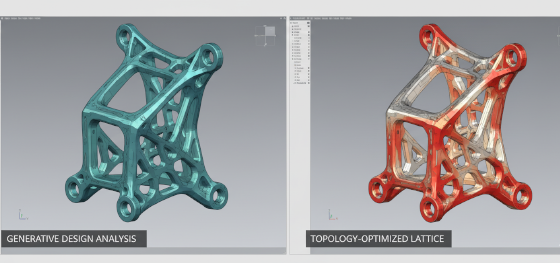
The most powerful move in aerospace lightweighting is the move away from solid volume. Traditional CNC milling is a slave to the "Block Logic"—you can only hollow out what a tool can reach. 3d printing aerospace hardware via DMLS (Direct Metal Laser Sintering) allows for the creation of "Digital Bone." We utilize generative design algorithms to identify the exact load paths within a bracket or housing, removing every gram of metal that doesn't contribute to structural stability. This results in complex lattice structures—internal honeycombs of titanium or aluminum that offer a strength-to-weight ratio that feels physically impossible.
At Jucheng Precision, we specialize in these skeletal metal components. For a satellite structural node, we can reduce the mass by 60% while maintaining the rigidity of a solid forged block. The secret lies in the 30-micron layer resolution, allowing us to build struts thinner than a human hair that act as microscopic I-beams. We primarily utilize Titanium Grade 5 (Ti-6Al-4V) for these structural missions because it offers the ultimate balance of fatigue resistance and chemical immunity. By engineering the internal void, we allow aerospace designers to pack more sensors and more fuel into their vehicles, turning the "Gravity Tax" into a performance dividend. We don't just print metal; we weave strength into the void, ensuring your mission-critical hardware survives the violent G-forces of launch and atmospheric re-entry.
FST Sovereignty: Why Ultem 9085 Owns the Cabin
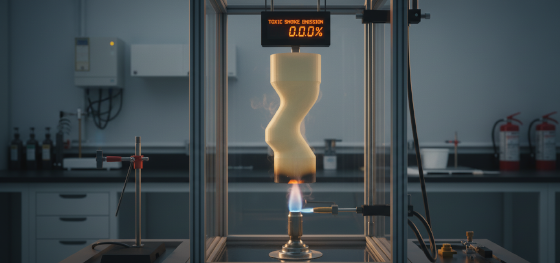
Inside a pressurized aircraft cabin, "performance" is secondary to "compliance." The ultimate gatekeeper for aerospace polymers is the FST protocol: Flame, Smoke, and Toxicity. Most 3D printing materials are essentially fuel; they burn rapidly and emit toxic gases that could incapacitate a crew in minutes. This is why 3d printing aerospace interiors relies almost exclusively on one material: Ultem 9085. This high-performance Polyetherimide (PEI) resin is inherently flame-retardant, meeting the strictest FAA and EASA standards for cabin safety.
JUCHENG utilizes industrial-grade FDM systems with actively heated chambers (reaching 180°C) to process Ultem 9085 for functional ducting, cockpit panels, and electrical junction boxes. The material’s high strength-to-weight ratio allows us to replace heavy aluminum conduits with complex, one-piece plastic assemblies. But the real value is the "Chemical Immunity." Ultem is resistant to jet fuel, hydraulic fluids, and commercial cleaning agents, ensuring it won't soften or crack over a twenty-year service life. We manage the entire documentation trail for these parts, providing the burn-test certificates and material lot tracking required for flight certification. By choosing Ultem, you are designing for the worst-case scenario, ensuring that even in an emergency, your hardware remains a stable and non-toxic part of the safety system.
Aerodynamic Fidelity: High-Detail SLA for Wind Tunnel Testing
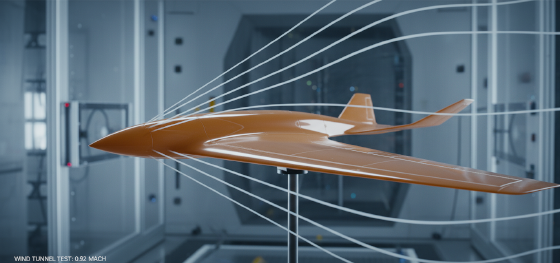
Before a new aircraft geometry is ever validated in the sky, it must survive the wind tunnel. This is an environment where surface roughness is more than a cosmetic issue; it is a source of aerodynamic noise and parasitic drag. For high-fidelity aerodynamic prototypes, JUCHENG utilizes large-format SLA (Stereolithography). When 3d printing aerospace wing profiles or fuselage sections for fluid dynamics testing, the surface must be as smooth as a mirror to ensure the airflow data is honest.
Our SLA process delivers a surface finish that rivals injection molding, achieving layer heights as thin as 25 microns. This resolution allows us to replicate the microscopic "vortex generators" and fine trailing edges found in modern stealth and high-efficiency designs. For high-velocity testing, we utilize ceramic-filled resins that offer the extreme stiffness needed to prevent the model from deforming under the force of the air. These models allow aerospace engineers to verify their CFD (Computational Fluid Dynamics) simulations in a matter of days, accelerating the development cycle of next-generation UAVs and commercial airframes. We bridge the gap between digital airflow and physical drag, providing the visual and tactile fidelity required to master the invisible currents of flight.
The Hybrid Metamorphosis: CNC Finishing for Critical Datums
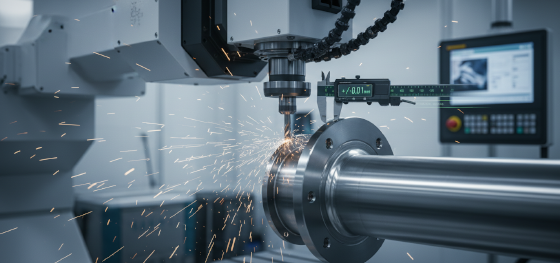
A raw 3D print is a technical preform, not a finished aerospace component. Straight off the build plate, a metal additive part has the surface texture of a fine-grit casting. For a bearing seat, a high-pressure seal, or a critical mounting flange, this is insufficient. Jucheng Precision has mastered the "Hybrid Metamorphosis"—the integration of 3d printing aerospace complexity with the surgical accuracy of 5-axis CNC machining. We don't just "print" your design; we engineer its final tolerances.
We utilize a "Double-Datum" strategy. We print the complex structural body with an extra 1.5mm of "machining stock" on critical faces. Once the part is vacuum-annealed to release thermal stresses, it moves to our CNC department. Using our high-speed mills, we carve away the near-net texture to achieve +/- 0.01mm tolerances and Ra 0.4 finishes on mating interfaces. This hybrid workflow ensures that your complex titanium manifold or Inconel turbine shroud fits perfectly into the final assembly. It eliminates the accountability gap between additive bureaus and machine shops. When you partner with JUCHENG, you are accessing a unified ecosystem that understands that "complexity" is only valuable if it is backed by "certainty." We deliver parts that possess the geometric freedom of additive and the documented accuracy of the mill.
The Audit Trail: Traceability in Mission-Critical Systems
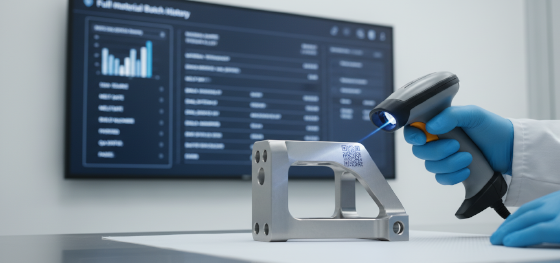
The final hallmark of a professional aerospace manufacturer is not the machine; it is the data. In the world of defense and flight, a part without a history is a dangerous liability. Jucheng Precision recognizes that every 3d printing aerospace project must be backed by an absolute audit trail. If a structural fastener fails at 30,000 feet, the manufacturer must be able to trace that failure back to the specific batch of metal powder or resin resin used in the build.
We implement a "Digital Birth Certificate" for every part. This includes Heat Number traceability from the raw material mill certificate, laser-etched UDI (Unique Device Identification) codes, and 100% CMM dimensional reports. Our facility is ISO 9001 and ISO 13485 certified, with a quality ecosystem that satisfies the technical rigor of the AS9100 standard. We don't just give you a part; we give you the verified certainty that your hardware is mission-ready. Whether you are building an innovative heart-lung machine for emergency transport or a structural node for a hypersonic test vehicle, our expertise ensures your vision is delivered with absolute integrity. We bridge the gap between design theory and real-world survival, providing the technical clarity needed to succeed in the most aggressive environments known to man. Contact Jucheng Precision today for a technical DFM review and see how our aerospace additive protocols can armor your next flight breakthrough.

