


A six-month wait for a die-cast engine block or an injection-molded headlight housing is a death sentence in the modern vehicle launch cycle. In the hyper-competitive arena of 3D printing industry applications, the gap between a digital sketch and a road-tested prototype has become the primary metric of success. Automotive engineering is no longer a slow crawl of clay models and expensive hard-tooling; it is a rapid-fire sequence of iteration. This is where 3d printing automotive parts transitions from a "cool technology" to a strategic necessity. Whether you are building a one-off racing manifold that must survive 200°C temperatures or a complex interior bezel that needs to feel like production-grade plastic, additive manufacturing provides the flexural freedom and speed that the traditional assembly line simply cannot match.
JUCHENG operates at the intersection of high-fidelity prototyping and IATF 16949-compliant production. We understand that an automotive part isn't just a shape—it is a functional component that must withstand vibration, chemical exposure, and intense thermal cycling. Our facility integrates 5-axis CNC precision with advanced MJF and SLA systems to deliver components that are functionally identical to their mass-produced successors. This guide moves past the basic visual mockups to explore the thermodynamic grit of functional testing, the optical physics of clear lighting prototypes, and why JUCHENG’s commitment to a zero-defect culture ensures your automotive designs reach the track or the showroom with absolute integrity.
Profitability in the automotive sector is won in the first ninety days of R&D. If you can validate your airflow dynamics or your ergonomic tactile response in a week, you eliminate months of capital risk. Let us break down the mechanical pillars of automotive additive solutions and see how technical foresight can lock the soul of your next vehicle design into physical reality.
Prototyping Aesthetics: SLA and the Concept Grille
Thermal Survival: MJF Nylon for Functional Engine Testing
Optical Precision: JUCHENG’s Specialization in Lighting
Line Efficiency: High-Accuracy Jigs and Assembly Aids
The IATF 16949 Standard: Engineering a Zero-Defect Culture
Prototyping Aesthetics: SLA and the Concept Grille

Visual drama is the primary currency of concept car development. Before a vehicle ever touches rubber to asphalt, its exterior must pass the scrutiny of the boardroom and the wind tunnel. This is where SLA (Stereolithography) defines the state of the art. When 3d printing automotive parts for exterior mockups, the surface finish must be flawless—ready for high-end paint or chrome-plating directly off the build plate. JUCHENG utilizes large-format SLA machines to print monolithic front grilles and complex aerodynamic spoilers in a single piece, eliminating the structural weak points of assembled sections.
The technical advantage of resin-based printing is the ability to resolve sub-millimeter features. We can produce intricate mesh patterns and sharp interior radii that are physically impossible to achieve via traditional CNC milling. For interior trim mockups, we utilize specialized "Tough" resins that mimic the snap-fit behavior of production ABS. This allow designers to test the "hand-feel" and tactile feedback of dashboard vents and door handles with 100% confidence. By delivering prototypes that possess the visual fidelity of a final product, we allow our automotive partners to conduct consumer focus groups and aerodynamic audits months ahead of schedule, turning visual intent into a tangible marketing asset.
Thermal Survival: MJF Nylon for Functional Engine Testing

Looking pretty is fine for the auto show, but looking functional is what wins the race. The engine bay is a hostile environment of heat, oil, and vibration. To perform functional testing on air intakes, cooling manifolds, or cable clips, you need a material that refuses to creep under load. Multi Jet Fusion (MJF) technology has become the industrial standard for these functional 3d printing automotive parts. By fusing Nylon 12 powder with infrared lamps, JUCHENG produces parts that are nearly 100% dense and possess isotropic mechanical properties.
The high heat-deflection temperature of MJF Nylon (~175°C) ensures that an intake manifold prototype won't warp or soften when the engine reaches operating temperature. This allow engineers to perform real-world dyno testing and fluid dynamics validation with a 3D printed part that costs 90% less than a cast aluminum prototype. Furthermore, MJF parts are naturally chemical-resistant, surviving exposure to fuel and coolant without degradation. JUCHENG’s expertise in high-density sintering ensures that your functional engine components are airtight and structurally sound, providing the high-fidelity data needed to finalize designs before moving to expensive injection molding or die casting.
Optical Precision: JUCHENG’s Specialization in Lighting

Modern vehicle lighting has moved beyond the simple bulb to complex arrays of LEDs, light pipes, and thick-walled lenses. These components are the most difficult to prototype because any internal haze or surface ripple ruins the beam pattern. Jucheng Precision has mastered the specialized workflow of 3d printing automotive parts for the lighting sector. We utilize ultra-clear SLA resins specifically formulated for minimal yellowing and maximum light transmission.
Achieving optical clarity is a two-stage battle. First, we print with ultra-thin layers (25 microns) to minimize the stair-stepping effect. Second, the part moves to our finishing lab for proprietary Vapor Polishing and manual multi-stage buffing. This process melts the microscopic tool marks, resulting in a lens that is as clear as glass. Our lighting prototypes allow Tier 1 suppliers to verify the "Light Signature" of a new vehicle on a photometric bench, ensuring the LED signals meet road safety regulations across the globe. We don't just print light; we control its path, ensuring your brand's nocturnal identity is perfectly realized long before the first production car rolls off the line.
Line Efficiency: High-Accuracy Jigs and Assembly Aids
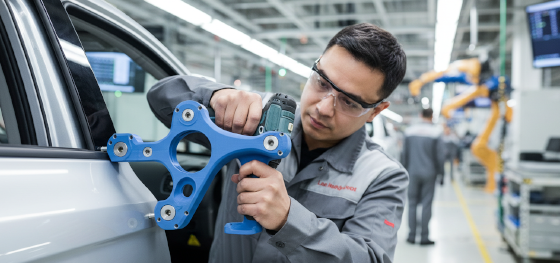
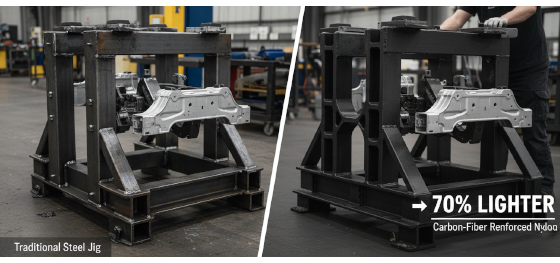
The final bottleneck in vehicle production is often the human hand. Assembly lines rely on thousands of custom jigs, drill guides, and fixtures to maintain speed and quality. Traditionally, these were milled from aluminum, making them heavy, expensive, and slow to replace if a design changed. 3D printing has revolutionized this "Unsung Hero" of the automotive industry. JUCHENG produces high-performance 3d printed jigs and fixtures that are designed for the worker, not just the machine.
By using Carbon-Fiber reinforced nylon, we create assembly aids that have the rigidity of metal but are light enough to be used all day without operator fatigue. These custom-contoured fixtures wrap around the vehicle’s organic curves, ensuring that every badge is placed perfectly and every sensor is aligned to within 0.1mm. If a vehicle's trim changes on a Friday, JUCHENG can print a new set of inspection gauges over the weekend, ensuring the line never stops. This agility is a cornerstone of lean automotive manufacturing, reducing the "Time to Efficiency" for new models and allowing for a more responsive and ergonomic factory floor.
The IATF 16949 Standard: Engineering a Zero-Defect Culture
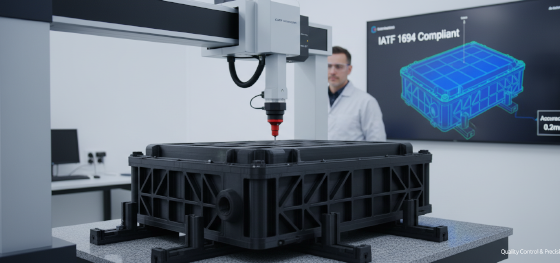
Choosing a partner for automotive additive is a decision of technical trust. Most bureaus treat 3D printing as a fast commodity; JUCHENG treats it as a regulated engineering discipline. We operate under the IATF 16949 quality framework, which is the gold standard for automotive production. For our clients, this means that every batch of 3d printing automotive parts is backed by a documented "Zero-Defect" mindset.
We implement APQP (Advanced Product Quality Planning) and provide full PPAP (Production Part Approval Process) documentation for high-volume orders. Our facility is equipped with in-house XRF spectrometers to verify material purity and CMM centers to provide 100% dimensional heatmaps of complex components. We manage the risk so you don't have to. When you partner with JUCHENG, you aren't just buying 3D prints; you are buying a verified manufacturing solution that stabilizes your supply chain and accelerates your market entry. Whether you are launching a new EV startup or managing a legacy OEM platform, our automotive protocols clarify and elevate your most ambitious projects. Contact Jucheng Precision today for a technical DFM review and see how our integrated additive and subtractive expertise can armor your next vehicle breakthrough.

