


Surviving the interior of the human body is the ultimate material audit. In the rapidly evolving landscape of 3D printing industry applications, the stakes shift from simple mechanical performance to biological safety and regulatory accountability. A single microscopic impurity in an implant or a misalignment in a surgical guide can have catastrophic clinical consequences. This is the uncompromising arena of 3d printing medical devices. It is a world where additive manufacturing is no longer used just for visual mockups; it has become the primary technology for producing patient-specific orthopedic implants, biocompatible surgical tools, and high-fidelity anatomical models that allow surgeons to "practice" a life-saving procedure before the first incision is ever made.

At JUCHENG, we recognize that a medical device engineer is looking for a technical sanctuary—a partner capable of bridging the gap between an anatomical STEP file and a validated, sterile-ready component. We don't just "print" parts; we validate biological environments. By integrating our ISO 13485 quality system with advanced DMLS titanium and light-cured PEEK capabilities, we provide the technical rigor required for the most sensitive healthcare innovations. This guide ignores the surface-level tutorials to explore the molecular mechanics of osseointegration, the physical necessity of zero-burr finishes, and why JUCHENG’s commitment to absolute material traceability is the final link in the chain of patient safety.
Reliability in medicine is born from the control of risk. Every layer of resin or metal dust must be documented, verified, and locked into a validated process. Whether you are building a revolutionary cardiovascular housing or a series of custom dental abutments, the logic of compliance is your greatest engineering ally. Let us break down the technical pillars of medical additive manufacturing and see how JUCHENG transforms digital data into clinical certainty.
Biological Neutrality: Navigating ISO 10993 Compliance
Anatomical Replicas: Pre-Operative Haptic Validation
Osseointegration Mechanics: Sintering Porous Titanium Implants
Microscopic Purity: Eliminating Burrs in Surgical Tools
Regulatory Sovereignty: The Role of ISO 13485 Certification
Biological Neutrality: Navigating ISO 10993 Compliance
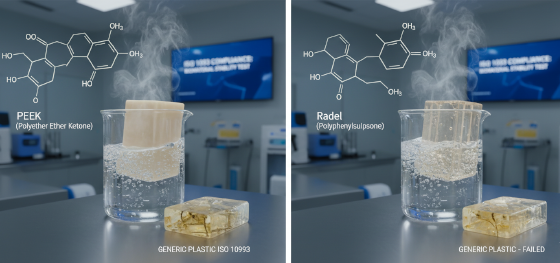
Material selection in healthcare is not a visual choice—it is a chemical contract. When we engage in 3d printing medical devices, the primary technical governor is the ISO 10993 standard for biocompatibility. A part that sits against human skin or is permanently implanted into a bone must be molecularly inert. It cannot leach toxic monomers, trigger inflammatory responses, or harbor cytotoxic residues. JUCHENG utilizes a specialized palette of high-purity photopolymers and thermoplastics that are pre-certified for medical use. This includes PEEK (Polyetheretherketone), which offers a mechanical modulus that closely mimics natural bone, and Radel (PPSU), a material capable of surviving hundreds of sterilization cycles without losing its structural toughness.
The engineering challenge here is the prevention of cross-contamination. Our facility implements strict material isolation protocols; a machine used for medical-grade PEEK never sees industrial carbon fiber. We utilize dedicated cleaning stations where parts are subjected to multi-stage ultrasonic baths using medical-grade solvents. This ensuring that the "biocompatible" status of the raw resin is preserved throughout the build cycle. By managing the surface energy and chemical purity of the part, we deliver components that provide the "Biological Neutrality" required for surgical safety. We don't just print shapes; we ensure those shapes are safe for the humans who will carry them.
Anatomical Replicas: Pre-Operative Haptic Validation
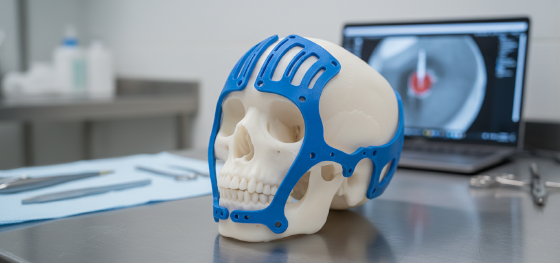
Surgeons operate in a world of high-velocity tactile data. The ability to touch a patient's unique bone structure or vascular anatomy before entering the operating room has transformed the speed of complex surgeries. JUCHENG’s medical prototyping service utilizes high-resolution SLA and Material Jetting to create 1:1 anatomical models from CT and MRI scans. These models are not just visual aids; they provide "Haptic Validation." By using multi-material printing, we can replicate the hard feel of bone alongside the soft, flexible texture of a tumor or blood vessel.
These models allow surgical teams to pre-bend titanium plates, test the fit of custom implants, and identify potential anatomical obstructions in a risk-free environment. This reduces time-under-anesthesia for the patient and significantly lowers the chance of intraoperative surprises. We also produce patient-specific surgical guides that snap onto a patient's bone with absolute certainty, directing the path of a drill or a saw with the precision of a CNC machine. By digitizing the patient's unique anatomy and translating it into a physical tool, we bridge the gap between digital planning and physical execution, providing the healthcare sector with a tactical level of foresight that was physically impossible a decade ago.
Osseointegration Mechanics: Sintering Porous Titanium Implants
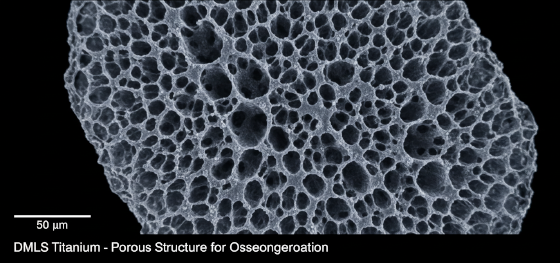
The most advanced move in 3d printing medical devices is the creation of permanent metal implants. Traditional forged titanium implants are smooth, which forces them to rely on mechanical friction or cement to stay in place. DMLS (Direct Metal Laser Sintering) technology has rewritten this script. At Jucheng Precision, we use high-power fiber lasers to sinter Grade 23 (ELI) titanium powder into "Trabecular" structures. These are intricate, porous lattices that mimic the microscopic architecture of natural bone tissue.
These porous features trigger a biological event known as osseointegration. The patient's bone cells actually grow into the pores of the 3D printed titanium, creating a permanent mechanical and biological bond that is far superior to any external adhesive. Designing these lattices requires an understanding of "Unit Cell" physics—the pores must be large enough (typically 300-600 microns) to allow for fluid transport and cellular attachment, but small enough to maintain structural integrity. We manage this thermal-mechanical balance by utilizing specialized build strategies that prevent the lattice from becoming brittle. By growing implants rather than carving them, we provide the orthopedic industry with components that aren't just "parts"—they are integrated extensions of the human skeletal system, verified for both strength and biological performance.
Microscopic Purity: Eliminating Burrs in Surgical Tools
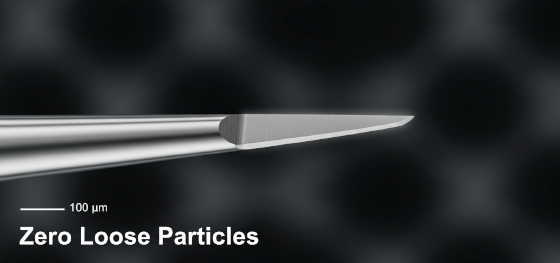
In an industrial gearbox, a small metallic burr is a maintenance issue. In a surgical tool, a burr is a life-threatening risk. A microscopic fragment that detaches inside a patient can lead to localized inflammation, thrombosis, or sepsis. This is why "Zero-Burr" is the absolute mandate of JUCHENG’s medical finishing line. 3D printed metal and plastic parts are inherently rough straight from the build; they are covered in "witness marks" where supports were attached. Removing these marks without compromising the part’s geometry is a test of surgical craftsmanship.
Our 3d printing medical devices protocol includes multi-stage deburring using high-magnification scopes. We utilize thermal deburring and electropolishing to round off the peaks of the layer lines at the molecular level. This results in a surface that is not only smooth to the touch but also fundamentally hostile to bacterial adhesion. A smooth surface has no "nooks" where proteins can bind or where biofilm can grow. For our clients building custom laparoscopic tools or diagnostic manifolds, this "Microscopic Purity" ensures the device is as easy to sanitize as it is to use. We don't just ship prints; we ship verified, "sterile-ready" components that meet the highest standards of the clinical environment.
Regulatory Sovereignty: The Role of ISO 13485 Certification
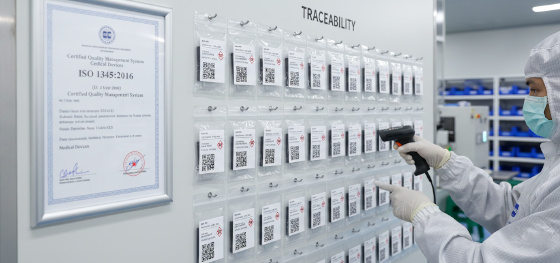
Choosing a partner for medical manufacturing is a move of technical liability. If your supplier doesn't understand the "Process Validation" logic of the FDA or CE MDR, they are a threat to your business. Jucheng Precision operates as an ISO 13485:2016 certified facility. This certification is our "Regulatory Sovereignty"—it is a documented proof that our manufacturing is built on risk-management. It means that every medical batch we produce is backed by a full "Device History Record" (DHR).
We implement absolute traceability. We can trace a single spinal screw back to the specific hour it was printed and the specific bag of powder used. We provide our clients with full CMM inspection reports, material mill certificates, and validated sterilization-test data. This transparency is the cornerstone of our service to the global robotics and med-tech sectors. When you receive a shipment from JUCHENG, you aren't just getting metal and plastic; you are getting the peace of mind that comes with a verified audit trail. Whether you are building an innovative heart-lung machine or a high-volume series of orthopedic screws, our expertise ensures your vision is delivered with absolute integrity. Contact Jucheng Precision today for a technical DFM review and see how our medical additive protocols can clarify and secure your next healthcare breakthrough.

