


What is an "honest" design? It is a design that is in perfect harmony with its material and its manufacturing process. A wooden chair that celebrates the grain. A forged steel knife that shows the marks of the hammer.
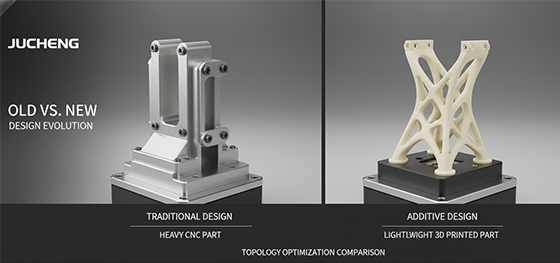
For decades, we designed plastic and metal parts based on the rules of an old world. The world of cutting, milling, and molding. But Industrial 3D Printing is a new world. It does not cut or mold. It grows.
To create a truly great part with this technology, you need a new philosophy. A new set of rules. This is the world of Design for Additive Manufacturing (DfAM). This is the guide to a new kind of design honesty.
content:
Embracing the Layered World
Thinking Light: Hollowing and Lattices
Consolidating Parts: The Power of One
Designing for the Final Finish
Your Partner in Smart Design
Embracing the Layered World
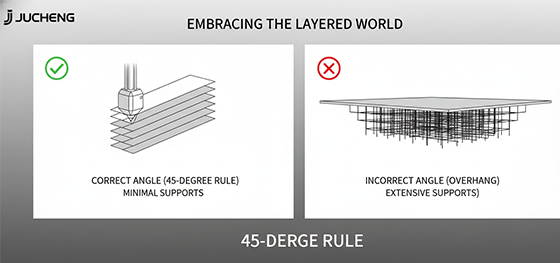
The first step in a good 3D printing design is to accept a fundamental truth: your part will be built in layers. This is both a limitation and a superpower.
The limitation is overhangs. A 3D printer cannot print in mid-air. Any feature that juts out horizontally will need support structures underneath it. These supports waste material, add time, and leave marks on the surface when they are removed.
A smart designer knows how to "speak the language" of the printer. They know the "45-degree rule": most industrial printers can build overhangs up to 45 degrees without any supports. By designing steep chamfers instead of flat overhangs, you can eliminate the need for supports entirely. This is an honest design. It works with the process, not against it.
Thinking Light: Hollowing and Lattices
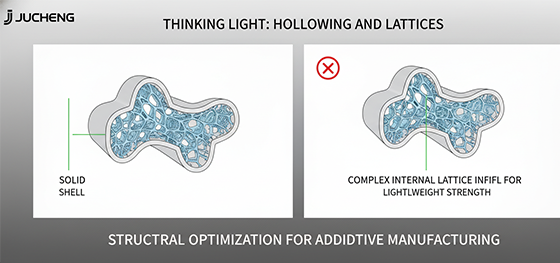
In traditional manufacturing, a solid part is a strong part. In additive manufacturing, a solid part is a wasteful part.
The cost of a 3D print is directly tied to the amount of material used and the time it takes to print. A big, solid cube is the most expensive thing you can print.
A core principle of DfAM is to remove any material that is not doing a structural job. This is where hollowing comes in. A smart designer will design their part as a hollow shell with a thick enough wall for strength.
To add back stiffness without adding weight, they can fill this hollow space with an internal lattice structure. This is a complex, web-like geometry that looks like bone. It is incredibly strong for its weight. This is something that only a 3D printer can create. It is a design that is truly native to the additive process.
Consolidating Parts: The Power of One
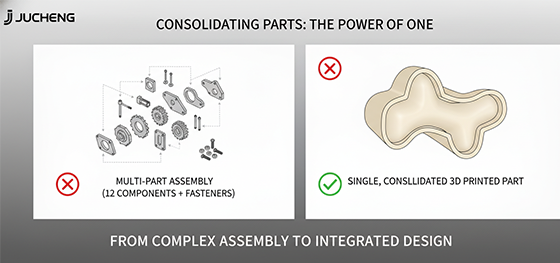
Traditional design is full of assemblies. A bracket might be made of five different bent and welded pieces.
3D printing gives you the power of consolidation. You can ask a different question: "How can I redesign this so all five functions are performed by one single, elegant part?"
Because 3D printing can create almost any geometry, you can combine brackets, mounts, and channels into one complex, organic shape. This has huge benefits. It reduces the number of parts in your assembly. It eliminates the time and cost of welding or screwing things together. And it often results in a final part that is stronger and lighter than the original assembly. This is one of the most powerful economic arguments for the Industrial 3D Printing workflow.
Designing for the Final Finish
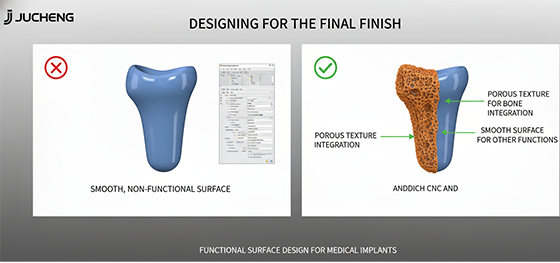
A smart 3D printing design also considers the very last step: post-processing.
If you know your part needs a beautiful, painted finish, you should orient it in the printer so that the most important cosmetic surfaces are facing up. This will give them the best possible raw finish and make them easier to sand and paint.
You can even design functional textures directly into the model. For a medical implant, a designer can create a porous, rough surface on the areas that need to bond with bone, while keeping the other surfaces perfectly smooth.
This level of control, designing not just the shape but the very texture of the final part, is a unique feature of additive manufacturing.
Your Partner in Smart Design
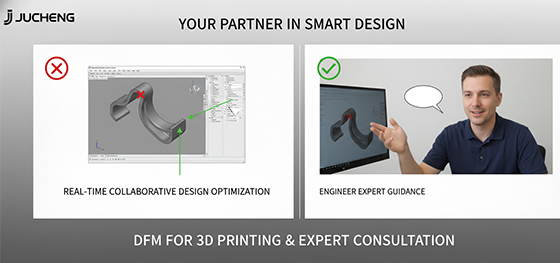
Learning how to design 3d print models effectively is a journey. It requires a new way of thinking. This is where a manufacturing partner is invaluable.
At JUCHENG, our DFM (Design for Manufacturability) service is a core part of our process. When we receive your design, our engineers do not just check if it can be printed. We look for opportunities to make it better.
We might suggest orienting the part differently to improve its strength. We might recommend hollowing a section to save you money. We might suggest adding a fillet to a weak point.
This collaborative partnership is the key to unlocking the full potential of this incredible technology. We are here to help you learn the new language of additive design and create a product that is truly honest to its innovative creation process.

