


Dismiss the notion that extrusion-based additive manufacturing is limited to visual mockups and trinkets. While the broader 3D printing materials market is saturated with low-grade PLA, the industrial tier operates under a different set of physical laws. This is the sophisticated world of 3d printing filament engineering. It is a sector defined by materials that can replace die-cast aluminum in an engine bay or survive the corrosive acids of a chemical processing plant. We are moving beyond the "hobbyist bench" and into the realm of high-performance thermoplastics like PEEK and Ultem—polymers that require thermal management strategies as precise as those used in aerospace alloy fabrication.
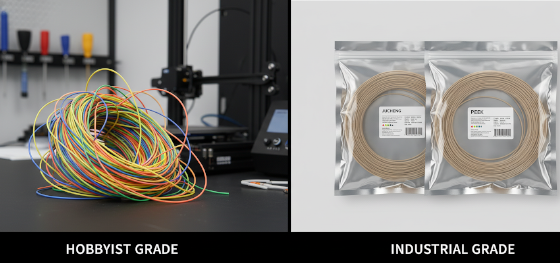
At Jucheng Precision, we recognize that the success of an FDM component is not determined by the printer's brand, but by the moisture content and molecular integrity of the filament. If the resin is not dried to a specific dew point or if the extrusion temperature fluctuates by even five degrees, the result is a part with weak layer adhesion and compromised structural safety. We have centered our manufacturing facility around the technical demands of high-requirement sectors, providing functional prototypes that endure real-world stress. This guide moves past the basic definitions to explore the thermodynamics of high-heat extrusion, the science of composite reinforcement, and why JUCHENG’s commitment to industrial-grade filament management ensures your designs bridge the gap from CAD to functional survivor.
Precision in filament-based manufacturing is a struggle against gravity and thermal shock. You aren't just melting a string of plastic; you are managing a phase-change event that must result in a monolithic, dense solid. Whether you are building an ergonomic surgical tool handle or a high-voltage electrical insulator, the logic of the extrudate is your primary engineering governor. Let us examine the technical pillars of industrial-grade filaments and see how they lock the performance of your next design into physical reality.
Thermal Sovereignty: Why Standard Printers Fail at High-Performance Extrusion
Environmental Survival: Navigating ASA and Polyamide Resilience
Composite Fortification: The Era of Carbon-Fiber and Glass Infusion
The Peak of Polymers: Engineering with PEEK and Ultem 9085
Moisture Management: The Invisible Enemy of Layer Adhesion
JUCHENG’s Standard: Beyond Prototyping into Industrial Utility
Thermal Sovereignty: Why Standard Printers Fail at High-Performance Extrusion

The primary differentiator of industrial 3d printing filament processing is the control of the ambient environment. On a standard desktop machine, the plastic is extruded into room-temperature air. This creates a massive thermal gradient; the bottom of the part is cold while the new layer is molten. This results in "warping"—the internal stresses of the plastic pulling the edges away from the build plate. For engineering materials like ABS or Nylon, this failure rate is nearly 50% on open-frame machines.
Jucheng Precision utilizes industrial-tier FDM systems with actively heated build chambers. These chambers maintain a stabilized environment—often up to 180°C—ensuring that the entire part remains at a uniform temperature throughout the build. By preventing the part from cooling too rapidly, we allow the polymer chains to relax, effectively eliminating the internal stresses that cause warping or delamination. This thermal sovereignty is what allows us to produce large-format enclosures and structural frames that maintain +/- 0.15mm tolerances over significant distances. We don't fight the thermodynamics of the plastic; we engineer a sanctuary where those thermodynamics work in our favor, delivering parts that are dimensionally true and structurally homogeneous.
Environmental Survival: Navigating ASA and Polyamide Resilience
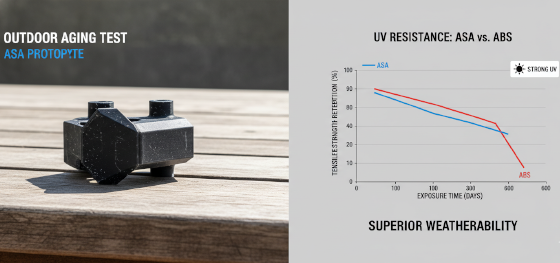
Choosing a filament for a functional part is an exercise in environmental foresight. Standard ABS is a fantastic all-rounder, but it is notorious for yellowing and becoming brittle when exposed to sunlight. This is why JUCHENG often directs our automotive and agricultural clients toward ASA (Acrylonitrile Styrene Acrylate). ASA is the UV-stable brother of ABS. Its chemical makeup is specifically designed to resist the radiation of the sun, making it the premier choice for outdoor sensor housings and agricultural vehicle controls.
When the requirement shifts from UV stability to raw toughness and chemical resistance, we pivot toward Polyamides (Nylon). As detailed in our Machining Nylon guides, this material is incredibly ductile. However, printing nylon filament is a technical high-wire act due to its extreme hygroscopy. At JUCHENG, we utilize specialized high-temperature nozzles and precision feed-mechanisms to deliver functional nylon parts that can withstand the vibration of a robotic arm or the impact of an industrial fall. We help you navigate these material choices based on the part's intended "theater of war," ensuring your design isn't just a mock-up, but a functional survivor.
Composite Fortification: The Era of Carbon-Fiber and Glass Infusion
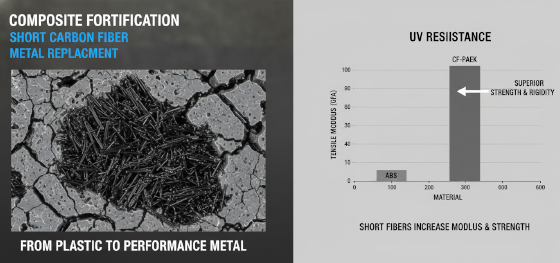
Sometimes, raw polymers lack the necessary stiffness to replace metal. This is where "Composite Filaments" redefine the boundaries of FDM. JUCHENG utilizes Carbon-Fiber Reinforced Nylon and Glass-Filled PETG to provide a massive boost in structural rigidity. By infusing the plastic matrix with short-strand fibers, we create a part that offers a high strength-to-weight ratio, rivaling some aluminum alloys. These materials are the primary choice for end-of-arm tooling in automated factories and lightweight brackets in the racing sector.
However, machining or extruding these composites requires a deep understanding of tool abrasion. Carbon fibers are essentially microscopic needles that wear away standard brass nozzles in hours. Jucheng Precision uses hardened steel and ruby-tipped nozzles for all composite runs, ensuring that the extrusion diameter remains consistent from the first layer to the last. We also pay close attention to the "Fiber Alignment." Because the fibers align along the extrusion path, the part is significantly stronger in the direction of the print lines. Our engineers provide DFM advice on part orientation to ensure that your highest load-bearing requirements are aligned with the material's maximum strength. We don't just print composite shapes; we engineer structural systems.
The Peak of Polymers: Engineering with PEEK and Ultem 9085
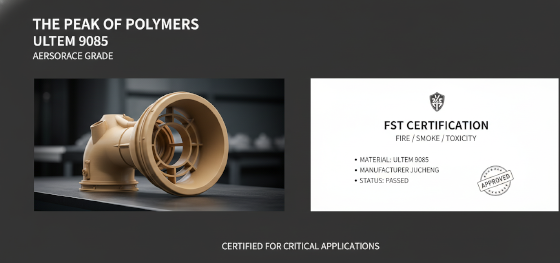
At the absolute summit of 3D printing materials are the high-performance polyaryletherketones (PAEK). This includes PEEK and Ultem 9085 (PEI). These filaments are not just "plastics"—they are industrial-grade resins that can survive in the most hostile environments known to engineering. Ultem 9085 is the standard for aerospace interiors because it meets strict FST (Flame, Smoke, and Toxicity) requirements. If a fire breaks out in a cabin, an Ultem part will not burn or emit toxic fumes. PEEK takes performance even further, offering extreme chemical resistance and the ability to maintain its mechanical modulus at temperatures exceeding 250°C.
Processing these materials via FDM requires a machine that can sustain a nozzle temperature of 400°C and a bed temperature of 160°C. At Jucheng Precision, we operate a dedicated high-performance extrusion cell specifically for these materials. We use these filaments to produce lightweight air ducts for satellites, surgical instrument handles for the medical sector, and downhole tools for the energy industry. Because these materials are so expensive, the cost of a failed print is massive. JUCHENG’s "Zero-Failure" protocol for PEEK and Ultem includes real-time monitoring of extrusion pressure and filament diameter, providing our clients with the confidence that their high-value components are built with absolute crystalline integrity.
Moisture Management: The Invisible Enemy of Layer Adhesion
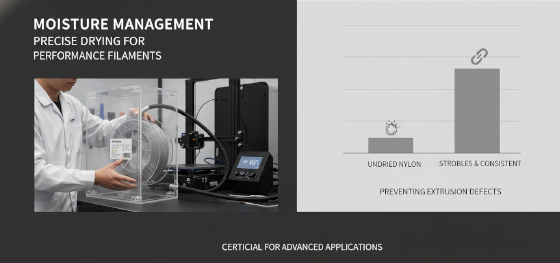
The quality of a 3D print is often decided long before the file is uploaded. Most engineering-grade filaments are hygroscopic—they pull moisture from the air at a rapid rate. If a spool of Nylon or Polycarbonate is left on a shelf for just twelve hours, it will absorb enough water to ruin the part. During extrusion, that trapped moisture turns to steam, creating microscopic voids (bubbles) inside the part. This results in a "crackling" sound at the nozzle and a part that is brittle, porous, and cosmetically ugly.
Jucheng Precision treats moisture management as a mandatory manufacturing pillar. We utilize industrial desiccant dryers to "pre-condition" every spool of filament. During the build, the filament is kept inside a climate-controlled "Dry Box" connected directly to the machine's intake. This ensures that the resin enters the nozzle with near-zero moisture content. This level of technical oversight is why our parts exhibit such superior layer-to-layer adhesion. By eliminating internal voids, we maximize the tensile strength of the part, ensuring it performs exactly as the material's datasheet promises. We don't just "print and hope"; we control the chemical state of the material from the spool to the finished part.
JUCHENG’s Standard: Beyond Prototyping into Industrial Utility
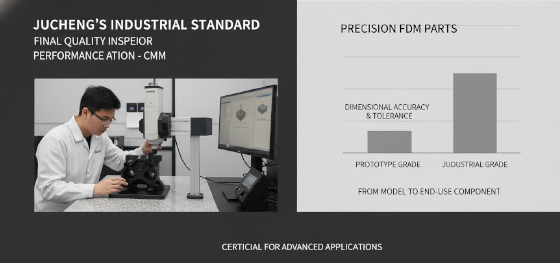
The transition from a "3D print" to an "industrial component" is defined by the quality of the post-processing. A raw FDM part straight off the bed is often covered in support scars and layer lines. At Jucheng Precision, we operate an integrated finishing hub to transform these raw extrusions into finished engineered solutions. We provide automated bead-blasting to homogenize the surface and specialized chemical smoothing for parts that require liquid-tight seals or aesthetic perfection.
Our quality assurance framework includes full CMM verification and material lot traceability. We understand that in high-volume industrial orders, consistency across a batch of 500 parts is as important as the precision of a single prototype. Whether you are building a custom drone chassis or a production run of thousand-unit aerospace clips, JUCHENG has the technical depth and the machine capacity to deliver. We don't just make plastic shapes; we engineer functional reliability through the science of industrial polymers. Contact our engineering team today for a technical DFM review and see how our industrial filament protocols can stabilize and elevate your next structural breakthrough.

