


Innovation is a race against obsolescence. In the volatile landscape of 3D printing industry applications, the distance between a digital hypothesis and a physical, functional component is where market share is won or lost. For decades, engineers were trapped in a sluggish cycle of waiting weeks for expensive hard-tooling or relying on crude wooden mockups that lacked the mechanical soul of the final design. This bottleneck has been permanently dismantled by 3d printing for rapid prototyping. It is no longer just a method for making "parts that look like parts"; it is a strategic technical sanctuary where you can fail fast, fix faster, and validate complex engineering assumptions for a fraction of the traditional cost. Additive manufacturing provides the flexural freedom to ignore the constraints of the drill bit, allowing your R&D team to touch, test, and break their ideas in a matter of days.
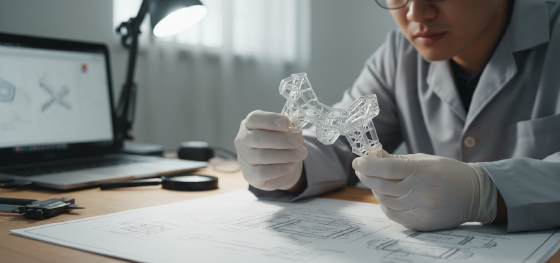
At JUCHENG, we treat every prototype as a critical question about your product's future survival. We understand that a medical device engineer or an automotive designer doesn't just need a shape—they need a functional surrogate that possesses the heat resistance of PEEK or the impact strength of Nylon 12. By integrating our high-resolution SLA resin systems with the industrial ruggedness of MJF and 5-axis CNC finishing, we provide a unified technical roadmap for rapid iteration. We recognize that the "First Part Cost" is the ultimate barrier to entry, and we have engineered our facility to eliminate the setup debt associated with traditional manufacturing. This guide moves past the basic visual checks to explore the thermodynamic grit of real-world testing, the economic logic of zero-tooling production, and why JUCHENG’s agile ecosystem ensures your hardware reaches the field without a single manufacturing compromise.
Profitability in hardware development is won by those who can compress the time-to-certainty. You aren't just buying a 3D print; you are buying the right to be wrong early, when changes cost pennies instead of thousands. Whether you are building a complex aerospace manifold or a sleek ergonomic grip for a consumer wearable, the logic of the prototype is your greatest competitive shield. Let us break down the technical pillars of rapid additive solutions and see how JUCHENG transforms digital vision into verified physical reality.
Compressing the Feedback Loop: Why Speed Defines Market Entry
Zero-Tooling Logic: Eliminating the Financial Barrier to Failure
Material Fidelity: Testing Real-World Physics Early
Iterative Sovereignty: Solving Geometric Errors in Real-Time
JUCHENG’s Agile Protocol: From Rapid Print to Final Mill
Compressing the Feedback Loop: Why Speed Defines Market Entry
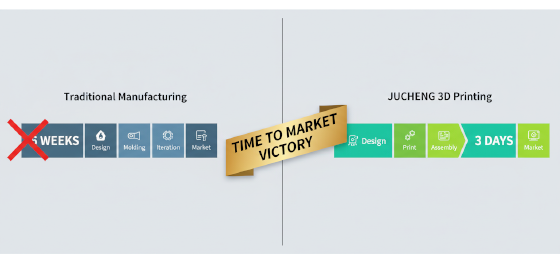
In the hyper-accelerated world of tech development, "Wait" is a terminal word. When you engage in 3d printing for rapid prototyping, you are essentially buying the one asset money usually cannot buy: time. Traditional subtractive methods, while precise, require a massive "Preparation Lead Time." You must wait for a programmer to write CAM code, for a toolroom to build fixtures, and for raw stock to arrive. This can turn a simple design change into a two-week delay. JUCHENG eliminates this temporal friction by utilizing a "Direct-to-Machine" workflow. Our SLA and MJF systems can begin building your Revision 1 file within hours of quote approval.
This speed allows for "Simultaneous Iteration." While your competitors are waiting for their first batch of parts, your team has already held the physical prototype, discovered a clearance error, modified the CAD, and received a Revision 2 part. This compressed loop reduces the total R&D timeline by up to 70%. We provide our clients with a dedicated "Rapid Pass" lane, ensuring that your most urgent engineering queries are answered with functional hardware in 48 to 72 hours. Speed in this context is not just about moving fast; it is about reducing the "Time to Certainty," giving your engineers the confidence to commit to expensive production tooling only after the design has been physically proven in the field.
Zero-Tooling Logic: Eliminating the Financial Barrier to Failure
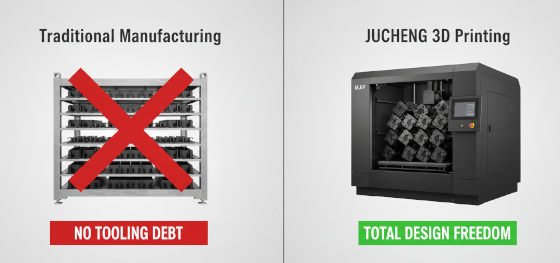
Fear of failure is the greatest obstacle to radical innovation. If every design change costs ten thousand dollars in mold modifications, the engineering team will naturally become conservative, choosing the "safe" path over the "optimal" one. 3d printing for rapid prototyping shatters this economic fear by introducing "Zero-Tooling Logic." Because the machine builds from a digital file without physical guides or dies, the cost of a design change is virtually zero. You can change a radius, hollow out a cavity, or move a mounting boss on a Monday and have the new part on Tuesday for the same unit price as the old version.
At JUCHENG, we help our clients leverage this financial agility to manage their "Development ROI." We encourage aggressive experimentation during the early phases of 3D printing industry applications development. By removing the front-loaded costs of CNC fixturing or injection molding, we allow your budget to be spent on high-value testing and user-feedback cycles. This economic shift allows for "Massive Parallel Prototyping," where we can print five different versions of a handle simultaneously for ergonomic A/B testing. This data-driven selection process ensures that your final product is optimized for the end-user, not for the limitations of your manufacturing budget. We turn "failure" into a low-cost educational tool, ensuring your eventual production run is born from a series of fast, cheap, and successful physical iterations.
Material Fidelity: Testing Real-World Physics Early
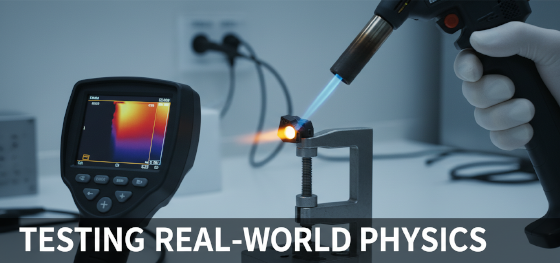
Visual mockups are for boardrooms; functional prototypes are for the lab. The greatest danger in rapid development is a "Fidelity Gap"—the difference between the properties of the prototype and the properties of the final part. If you test a high-pressure manifold using a brittle, non-industrial resin, your results are meaningless. JUCHENG solves this through our extensive library of high-performance 3D printing materials. We offer functional simulants that mimic the mechanical soul of production-grade plastics and metals.
Whether you require the heat resistance of Ultem 3D Printing for an aerospace interior or the chemical immunity of Polypropylene for a laboratory device, our prototyping service provides the "Material Fidelity" needed for real physics. We utilize MJF Nylon 12 to provide parts that have the same tensile modulus and impact strength as injection-molded polyamide. This allows you to perform real-world vibration audits, drop tests, and thermal cycling with 100% confidence in the data. We bridge the gap between "look-and-feel" and "work-and-survive," ensuring your rapid prototypes are not just visual surrogates, but technical benchmarks that accurately predict the performance of your mass-production hardware.
Iterative Sovereignty: Solving Geometric Errors in Real-Time
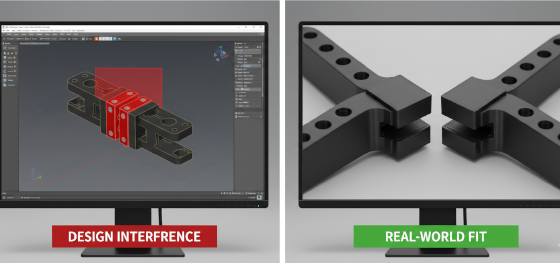
Geometric perfection is difficult to achieve in the first draft of a complex assembly. A 0.1mm interference between a sensor housing and its mounting bracket can halt a production line for weeks. 3d printing for rapid prototyping provides the "Geometric Sovereignty" needed to identify these errors before they become catastrophes. Because we can resolve intricate internal features and undercuts without tool-access constraints, we allow you to build prototypes that are as geometrically complex as your final vision.
At Jucheng Precision, we use our additive fleet to perform "Assembly Validation" on your behalf. We can print the entire internal mechanism of a device to verify that gears don't bind and that cables have the correct clearance paths. If a design flaw is found, we don't just send a rejection notice; we work with your engineers to suggest a fix and print the new version immediately. This real-time troubleshooting is essential for industries like medical robotics and EV components where the assemblies are dense and unforgiving. By verifying the "Physical Gaps" of your design in a matter of days, we ensure that your final production run is a smooth, high-yield event, protecting your brand from the embarrassment of a late-stage redesign or a non-functional product launch.
JUCHENG’s Agile Protocol: From Rapid Print to Final Mill
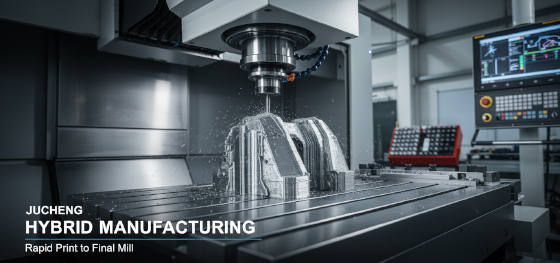
The final hallmark of JUCHENG’s prototyping service is the integration of additive speed with subtractive precision. Many service bureaus can print a part, but they cannot verify its tolerances. Jucheng Precision operates a "Hybrid Prototyping" facility where our 3D printers and 5-axis CNC machines work in harmony. We don't just give you a "rough" print; we give you a verified component.
For prototypes requiring critical assembly fits—like an H7 bearing bore or a high-pressure seal surface—we utilize a "Print-and-Refine" protocol. We print the part slightly oversized and then use our precision mills to finish the critical features to sub-micron accuracy. This integrated approach ensures that your rapid prototypes are functionally identical to the production parts, allowing you to test the actual fitment of the final assembly. We also provide full CMM inspection reports for our prototypes, ensuring your R&D data is backed by the same technical rigor as our aerospace production contracts. When you partner with JUCHENG, you aren't just getting a fast part; you are getting the benefit of a synchronized manufacturing ecosystem that clarifies and elevates your vision. Contact our engineering team today for a rapid DFM review and see how our prototyping protocols can armor and accelerate your next industrial breakthrough.

