


Momentum is the invisible tax on industrial automation. Every millisecond a robotic arm spends decelerating or waiting for vibrations to settle is a leak in the factory's profitability. In the highly demanding landscape of 3D printing industry applications, the focus has shifted from making parts that look like robots to engineering parts that make robots faster. This is the strategic core of 3d printing robotics. By utilizing advanced additive manufacturing, engineers can finally solve the "Inertia Crisis"—the physical burden of heavy, over-engineered metal grippers that stress motors and limit cycle speeds. We are no longer carving boxes to hold parts; we are growing skeletal, high-strength systems that integrate structural integrity with functional voids.
JUCHENG operates as a technical sanctuary for the world’s leading automation firms. We understand that a robotic component is not a static bracket; it is a high-acceleration athlete that must survive millions of cycles without fatigue or dimensional drift. By merging the raw strength of carbon-fiber reinforced polyamides with the geometric freedom of MJF and 5-axis CNC refinement, we provide a unified roadmap for high-fidelity robotics. This guide moves past the standard visual mockups to explore the physics of moving mass, the logic of integrated pneumatic circuitry, and why JUCHENG’s commitment to high-durability materials ensure your automated systems operate at the absolute peak of their theoretical performance.
Efficiency in the automated world is won by those who can increase payload without increasing power consumption. You aren't just buying a plastic gripper; you are buying the ability to move faster with less mechanical wear. Whether you are building an innovative warehouse sorter or a sub-micron surgical robot, the logic of the print is your greatest competitive shield. Let us break down the technical pillars of robotic additive solutions and see how technical foresight can lock the integrity of your next automated breakthrough into physical reality.
Kinetic Weight: Battling the Moment of Inertia
Integrated Labyrinths: Designing Internal Air Passages
Rapid EOAT: Custom Grippers for Every Geometry
Structural Fortification: Navigating the Composite Shift
The JUCHENG Lifecycle: Validation and Operational Uptime
Kinetic Weight: Battling the Moment of Inertia

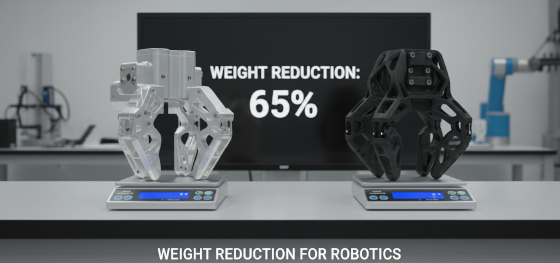
Physics dictates that the force required to move an object is proportional to its mass, but the force required to stop that object is a function of its leverage. In 3d printing robotics, we focus on reducing the "Moment of Inertia" at the mechanical extremities. Every unnecessary gram at the end of a robotic arm acts as a lever against the internal gears and servo-motors of the primary joints. This lead to increased vibration during high-speed moves and requires longer "settling times" before the robot can perform its next task. A traditional aluminum gripper, while strong, carries too much dead weight.
JUCHENG solves this through "Lattice Consolidation." We don't print solid plastic blocks; we engineer skeletal frames that utilize internal Gyroid or Diamond lattices to provide rigid support with 60% less material mass. This reduction in kinetic weight allows the robot to accelerate faster and stop with surgical precision. For our clients in the semiconductor handling and automotive assembly sectors, this means a 15% to 20% increase in total throughput. We don't just reduce weight; we increase the "Dynamic Bandwidth" of the entire system. By making the robot's hand lighter, we enable the motors to operate within their efficiency sweet spot, reducing thermal heat-soak and extending the service life of expensive industrial actuators by years.
Integrated Labyrinths: Designing Internal Air Passages
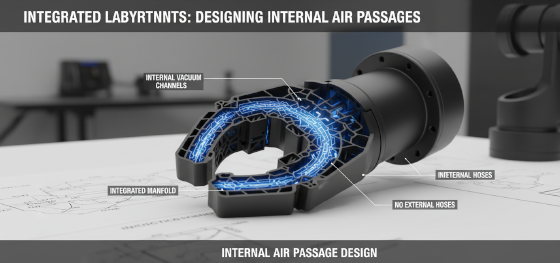
The messiest part of traditional robotics is the "Umbilical Cord"—the cluster of external pneumatic hoses and electrical wires that snake along the arm. These hoses are prone to snagging, wear, and eventual failure, often leading to production downtime. Modern 3d printing robotics protocols allow JUCHENG to "hide the plumbing." We utilize the geometric freedom of MJF and SLS to design manifolds with integrated internal air channels. These are complex labyrinths carved into the very walls of the structural part.
By eliminating external hoses and heavy brass connectors, we further reduce the moving mass and simplify the overall assembly. These internal channels are designed using smooth, organic curves that optimize airflow and reduce pressure drops, allowing for faster vacuum engagement at the suction cups. At Jucheng Precision, we use high-density Nylon 12 and specialized vapor smoothing to ensure these internal voids are perfectly airtight. This level of functional integration is technically impossible for a standard CNC drill to reach. We transform a collection of separate parts into a single, monolithic "Smart Tool," reducing your part count and ensuring that the most complex internal fluid logic is locked into a compact, durable structure that survives millions of cycles.
Rapid EOAT: Custom Grippers for Every Geometry
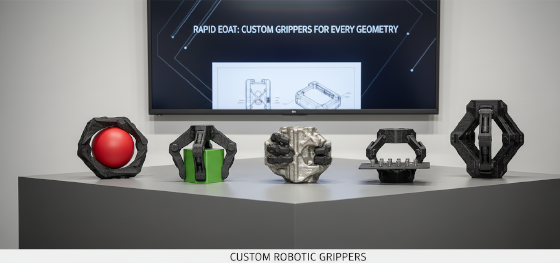
Standard grippers are a compromise. They use flat contact pads that struggle to secure organic or complex 3D shapes, often leading to part slippage or surface damage. 3D printing robotics shatters this geometric ceiling through "Conformal End-of-Arm Tooling" (EOAT). At JUCHENG, we can print robotic fingers that are the exact negative of your part's complex surface. This allows for a perfect "wraparound" grip that distributes clamping force evenly, protecting delicate high-polish automotive trim or fragile medical glass.
The real value of our rapid EOAT service is the speed of iteration. In an agile factory, the parts being moved change every few months. If you rely on traditional tooling, you face an eight-week lead time for every design shift. JUCHENG can design, print, and ship a set of custom-contoured grippers in 48 hours. We often utilize multi-material strategies—printing a rigid nylon frame for strength and overmolding a soft TPU (Thermoplastic Polyurethane) contact surface to increase friction and prevent scratching. This hybrid approach allows the robot to handle a variety of hardware with the same hand, reducing the need for expensive tool-changers. We bridge the gap between "concept" and "clamping," providing the tactical flexibility needed for high-mix, low-volume automated production.
Structural Fortification: Navigating the Composite Shift

Robotics is a brutal environment for plastics. Components are subjected to constant chemical exposure from coolants, high temperatures near welding cells, and the abrasive reality of industrial dust. Standard resins often reach their fatigue limit here, resulting in cracks and downtime. JUCHENG addresses this through "Material Fortification." For structural robotic frames and high-stress sensor brackets, we utilize Carbon-Fiber reinforced polyamides (Nylon-CF). These composites offer a tensile modulus that rivals soft aluminum but with the vibration-damping characteristics of a high-end polymer.
The addition of microscopic carbon fibers prevents "creep"—the slow deformation of plastic under a constant load. This ensures that a camera mount stays perfectly calibrated to its datum even after years of high-speed vibration. We also utilize high-temp materials like Ultem 3D Printing for robotic components that must operate in sterilized medical labs or near heat-intensive processes. By selecting materials with the correct "Mechanical Spine," we ensure that your 3D printed robotic hardware isn't a temporary prototype—it is a production-ready asset. Our DFM team audits your specific environmental load-case, matching the polymer’s chemical soul to the robot’s physical mission.
The JUCHENG Lifecycle: Validation and Operational Uptime
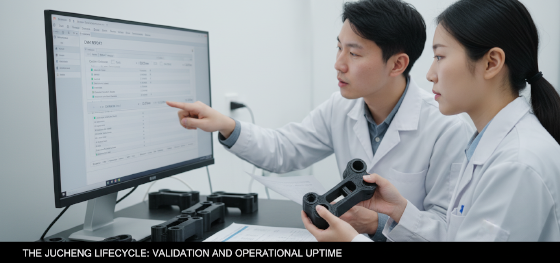
Choosing a manufacturer for high-performance robotics is a decision of operational trust. Most shops can follow a drawing; few can guarantee uptime. Jucheng Precision operates a facility where additive manufacturing is a documented engineering discipline, not a visual craft. Our 3D printing robotics protocol includes full CMM (Coordinate Measuring Machine) verification of critical features. We provide our clients with digital inspection reports that prove every mounting hole and sensor seat is perfectly positioned relative to your master CAD data.
We also manage the "Digital Spares" economy. For our global automation partners, we maintain a secure library of their tooling designs. If a gripper fails in a factory in Michigan, JUCHENG can print a certified replacement and ship it immediately, ensuring the line is back up in days rather than weeks. This transparency and scalability is why JUCHENG is the preferred partner for the world's most innovative robotics brands. We don't just ship parts; we provide the engineered certainty that your automation systems remain agile, precise, and durable. Contact Jucheng Precision today for a comprehensive technical review and see how our robotic additive protocols can armor and accelerate your next automated breakthrough.

