


Martensitic stainless steels occupy a unique niche in the material hierarchy, bridging the gap between the corrosion resistance of standard stainless grades and the extreme hardness of high-carbon tool steels. Among these, 440C Stainless Steel reigns supreme as the hardest variant available to industrial engineers. With a carbon content exceeding one percent, this alloy achieves a Rockwell hardness of HRC 58 to 60 after heat treatment, making it the default choice for high-precision ball bearings, surgical cutting instruments, and mold inserts requiring immense wear resistance. However, this exceptional hardness creates a formidable manufacturing barrier. Machining 440C presents a dual challenge: it is abrasive and gummy in its annealed state, yet dangerously brittle and ceramic-hard after quenching. Mastering the 440C Stainless Steel Machinability curve requires a strategic blend of metallurgy, advanced tooling substrates, and rigorous thermal process control.
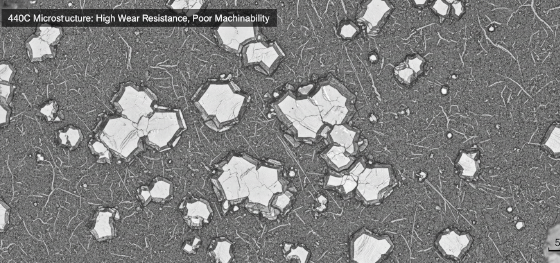
Successfully fabricating components from this high-carbon alloy demands a complete departure from the speeds and feeds used for 304 or 316 stainless. The microstructure of 440C contains massive primary chromium carbides that act like microscopic grinding stones against the cutting edge. Standard carbide inserts wear rapidly, leading to poor dimensional control and frequent machine downtime. The manufacturing workflow typically involves a "soft machining" phase followed by heat treatment and a final "hard finishing" sequence. Jucheng Precision optimizes this specific workflow by integrating hard turning technologies that often eliminate the need for slow, expensive grinding operations, delivering aerospace-grade tolerances at a fraction of the cost.
content:
Annealing State Challenges and Gummy Behavior
Heat Treatment Transformation to Martensite
Hard Turning with PCBN Tools vs Grinding
Grinding Burn and Surface Integrity Risks
Cryogenic Processing for Dimensional Stability
Corrosion Resistance vs Hardness Trade-offs
Coolant Strategies for Thermal Shock Prevention
Jucheng Precision Hard Metal Fabrication Solutions
Annealing State Challenges and Gummy Behavior
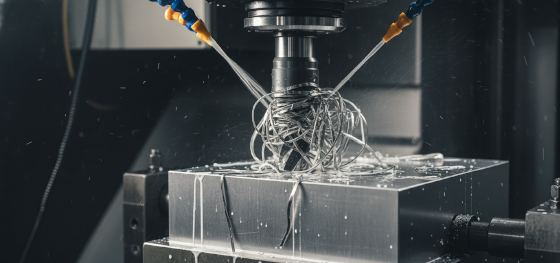
Engineers often assume that machining metal in its soft, annealed state guarantees easy processing. However, 440C proves this assumption wrong. In its spheroidized annealed condition, the matrix is relatively soft (approximately HRC 25), but the material exhibits a "gummy" characteristic similar to pure copper or low-carbon steel. The metal tends to adhere to the cutting tool face, creating a built-up edge (BUE) that destroys surface finish and alters tool geometry. Furthermore, the embedded chromium carbides remain extremely hard even when the matrix is soft, causing rapid abrasive wear on the tool flank.
Overcoming this "gummy-abrasive" paradox requires sharp, positive-rake carbide tools with specialized PVD coatings like TiAlN (Titanium Aluminum Nitride) to reduce friction. Machinists must maintain high feed rates to ensure the cutting edge shears through the material rather than rubbing against it, which would induce work hardening. Chip evacuation becomes critical; the long, stringy chips generated during this phase can easily wrap around the spindle or fixture. High-pressure coolant systems are mandatory to break these chips and flush them away from the cutting zone, preventing re-cutting and catastrophic tool breakage.
Heat Treatment Transformation to Martensite
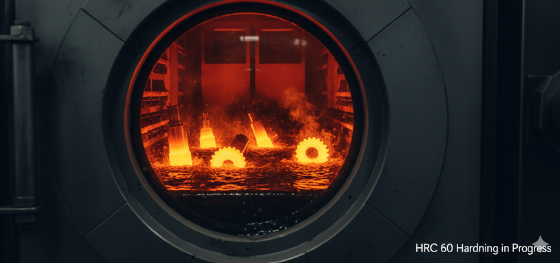
The defining characteristic of 440C is its ability to transform from a soft alloy into a glass-hard ceramic-like material through heat treatment. The process involves heating the component to approximately 1010-1065°C to dissolve the carbon into the austenite matrix, followed by a rapid oil quench. This sudden cooling freezes the carbon atoms in place, distorting the crystal lattice into a highly stressed body-centered tetragonal structure known as martensite. Post-quench tempering is absolutely essential to relieve internal stresses and restore a minimal amount of toughness, preventing the part from shattering like glass under impact.
This phase transformation introduces significant dimensional distortion. The expansion of the crystal lattice causes the part to grow volumetrically. Thin-walled sections or asymmetrical geometries warp unpredictably during the violent oil quench. Manufacturing engineers must leave sufficient "stock allowance"—typically 0.2mm to 0.5mm per side—during the initial soft machining phase to account for this movement. The final dimensions are only achieved through hard machining or grinding operations performed after the material has stabilized at its final hardness.
Hard Turning with PCBN Tools vs Grinding
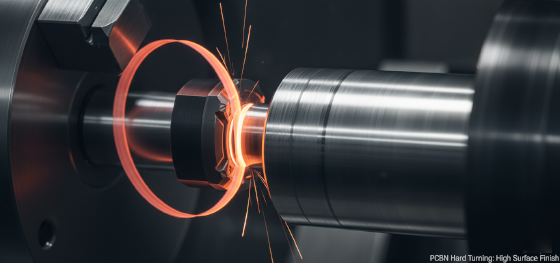
Traditionally, finishing hardened 440C components required slow, expensive cylindrical grinding processes. Modern CNC technology has revolutionized this workflow through "Hard Turning." Using Polycrystalline Cubic Boron Nitride (PCBN) or advanced ceramic inserts, Jucheng Precision can turn HRC 60 steel directly on a lathe. This process is significantly faster than grinding and allows for the creation of complex contours, threads, and chamfers in a single setup, which a grinding wheel simply cannot achieve.
Hard turning generates immense heat at the cutting interface, often turning the chips a bright glowing red. Surprisingly, this heat works to the machinist's advantage by plasticizing the metal immediately ahead of the tool tip, reducing cutting forces. The key to success lies in extreme machine rigidity and zero-vibration workholding. PCBN inserts are brittle; any micro-vibration causes them to chip instantly. When executed correctly, hard turning achieves surface roughness values of Ra 0.2 micrometers and tolerance bands within IT6 standards, effectively rendering grinding obsolete for many concentric parts.
Grinding Burn and Surface Integrity Risks
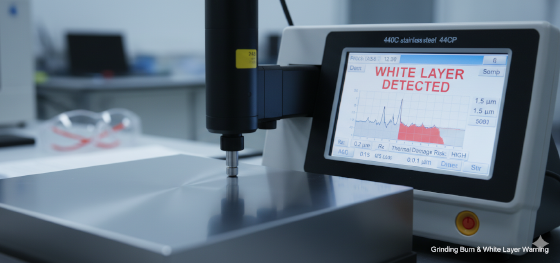
For surfaces requiring extreme flatness or Ra 0.05 surface finishes, abrasive grinding remains necessary. However, grinding 440C carries the high risk of "grinding burn." If the grinding wheel becomes loaded with debris or if the feed rate is too aggressive, the friction generates localized temperatures exceeding the tempering point of the steel. This invisible thermal damage creates a soft layer known as the "White Layer" (untempered martensite) on the surface, beneath which lies a tensile-stressed zone prone to cracking.
Preventing this metallurgical damage requires frequent wheel dressing to expose sharp abrasive grains and the liberal application of coolant. Using Cubic Boron Nitride (CBN) grinding wheels instead of standard aluminum oxide wheels significantly reduces heat generation due to CBN's superior thermal conductivity and hardness. Quality assurance for ground 440C parts often involves Nital Etch inspection, a chemical process that reveals hidden burn marks as dark or light patches on the shiny surface, ensuring the structural integrity of the component is not compromised.
Cryogenic Processing for Dimensional Stability
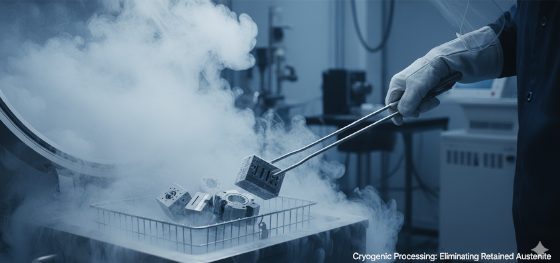
Achieving HRC 60 does not guarantee the microstructure is 100% martensite. A small percentage of soft "retained austenite" often remains after quenching. Over time, or under mechanical stress, this unstable austenite slowly transforms into untempered martensite. This delayed transformation involves a volume expansion, causing precision parts like gauge blocks or aerospace bearings to grow slightly in size months after manufacturing. For micron-level tolerance parts, this instability is unacceptable.
Deep cryogenic treatment solves this problem. By submerging the quenched parts in liquid nitrogen at -196°C, the cooling curve is extended far below room temperature, forcing the stubborn retained austenite to convert fully into martensite. This process not only stabilizes the dimensions permanently but also increases the wear resistance by precipitating fine eta-carbides throughout the matrix. Jucheng Precision incorporates cryogenic cycles for all high-precision 440C components to ensure that the tight tolerances measured in the factory remain true throughout the product's operational lifecycle.
Corrosion Resistance vs Hardness Trade-offs
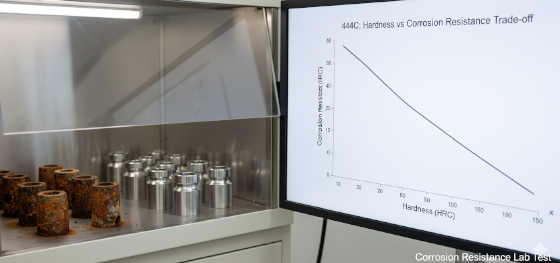
Designers must understand that 440C is not as corrosion-resistant as the 300-series austenitic stainless steels. The high carbon content required for hardness inevitably ties up some of the chromium in the form of chromium carbides. This depletion reduces the amount of "free chromium" available to form the passive oxide layer that protects against rust. While 440C resists fresh water, steam, and mild acids, it will stain and rust in salt water or harsh chemical environments if not properly cared for.
Surface finish plays a massive role in corrosion performance. A highly polished mirror finish offers fewer microscopic crevices for moisture to accumulate, significantly improving rust resistance compared to a rough, sandblasted surface. Passivation—a chemical acid bath that removes surface iron contaminants—is mandatory for all 440C parts. However, standard passivation processes must be adjusted for high-carbon grades to prevent "flash attack," where the acid eats into the material surface. Balancing the need for extreme hardness with the limitations of corrosion resistance is a critical design decision.
Coolant Strategies for Thermal Shock Prevention
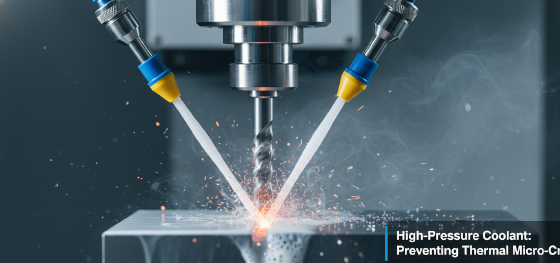
Managing heat during the machining of 440C is a delicate balancing act. While coolant is essential for drilling and sawing, intermittent coolant application during milling can cause thermal shock. The carbide inserts heat up rapidly in the cut and then are blasted by cold coolant upon exiting, leading to thermal cracks at the cutting edge. For carbide milling, running dry with air blast is often preferred to maintain a stable temperature.
Conversely, grinding and PCBN hard turning operations benefit from high-pressure coolant (HPC) delivery. The coolant must be directed exactly at the tool-chip interface to provide lubrication and prevent the workpiece from absorbing the massive heat generated by friction. Oil-based coolants generally offer better lubricity and surface finish for 440C than water-soluble fluids, although they require specialized mist collection systems. Selecting the correct thermal management strategy prevents micro-cracking and ensures the hardened surface retains its compressive strength.
Jucheng Precision Hard Metal Fabrication Solutions
Sourcing reliable 440C components requires a manufacturing partner who understands the complete metallurgical lifecycle of the material. Jucheng Precision eliminates the risks of fragmented supply chains by offering a comprehensive "Turn-Key" solution. Our facility integrates soft machining, vacuum heat treatment, cryogenic stabilization, and final hard finishing under one quality management system. This vertical integration allows us to tightly control the stock allowances and distortion compensation at every step, preventing the common issue of parts coming back from heat treat undersized or warped beyond repair.
Our machine shop utilizes advanced Swiss-type lathes and 5-axis machining centers equipped with high-torque spindles specifically designed for hard metal removal. We regularly produce medical surgical instruments, aerospace bearing races, and precision mold cores from 440C with tolerances as tight as +/- 0.005mm. Whether your project requires a single prototype or high-volume production, Jucheng's "No MOQ" policy and Free DFM review ensure that your high-hardness designs are manufacturable and cost-effective. We turn the industry's toughest material into your competitive advantage.

