


In high-volume manufacturing, efficiency is everything. Every second saved on a part's cycle time translates directly into cost savings and higher output.

When working with stainless steel, this pursuit of efficiency often leads to a critical crossroads. A choice between the industry's reliable workhorse and its thoroughbred racehorse.
This is the strategic battle of 303 stainless steel vs 304. It is a classic trade-off between ultimate machinability and overall integrity. Understanding this choice is key to optimizing your production.
content:
A Game-Changing Ingredient
Round 1: A Race for Speed
Round 2: A Test of Integrity
Making Your Strategic Choice
A Game-Changing Ingredient
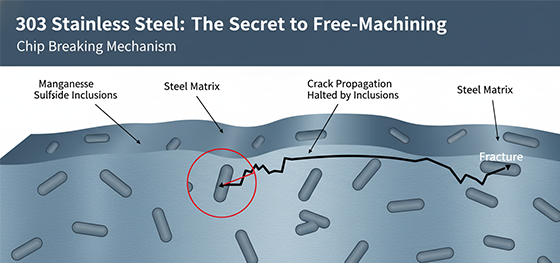
On paper, 303 and 304 stainless steel look very similar. They are both "18-8" austenitic stainless steels with excellent general corrosion resistance. But 303 has a secret ingredient added to its recipe: Sulfur.
This small addition is a game-changer for manufacturing. The sulfur forms tiny, soft inclusions of manganese sulfide within the steel's microstructure.
You cannot see them. But when a cutting tool hits one of these inclusions, it acts as a microscopic "chip breaker."
Instead of forming long, stringy, difficult chips like 304, the chips from 303 break off into small, clean, manageable pieces. This simple change in chip formation completely transforms the stainless steel cnc machining experience.
Round 1: A Race for Speed
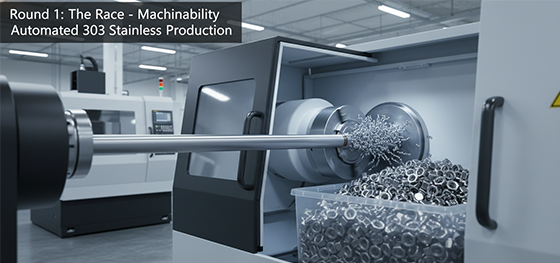
In a head-to-head race on a CNC machine, there is no contest. 303 stainless steel wins, easily.
When machining 304, the material is tough and gummy. It produces long, stringy chips that can tangle around the tool and disrupt an automated process. Machining speeds must be kept relatively low.
The process of 303 stainless steel machining is a different story. The chips break away cleanly. This allows the machinist to dramatically increase the cutting speeds and feed rates. This means a much shorter cycle time per part.
For high-volume production on an automated CNC lathe, this is a massive advantage. A shorter cycle time means a lower cost per part. Less tool wear also contributes to lower costs. In the race for efficiency, 303 is the clear champion.
Round 2: A Test of Integrity
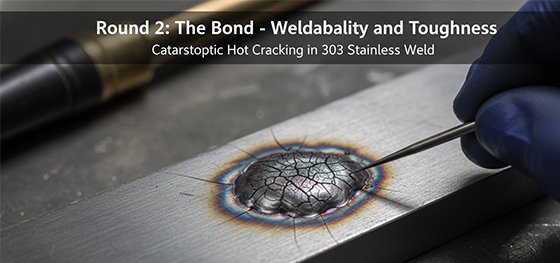
However, the secret ingredient that makes 303 a champion in machining is also its fatal flaw in other areas. It is a double-edged sword.
The first and most critical weakness is its weldability. 303 stainless steel should never be welded. The same sulfur inclusions that break the chips will cause the weld puddle to become brittle and crack as it cools. This is called hot cracking, and it is an unavoidable problem.
304, on the other hand, has excellent weldability. It can be used to create strong, reliable fabricated assemblies.
Secondly, 303 is slightly less tough than 304. It is more brittle and has lower formability. It cannot be bent or cold-formed as easily as 304. And its corrosion resistance, while still good, is slightly reduced by the presence of the sulfur inclusions. In a direct comparison of overall integrity, 304 is the tougher, more reliable material.
Making Your Strategic Choice
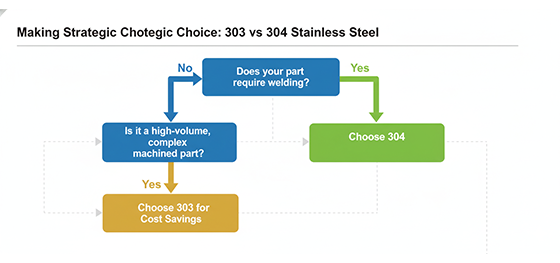
The choice in the 303 stainless steel vs 304 battle is a very clear, strategic decision. It is not about which material is "better." It is about which property is more important for your specific part.
| Factor | 303 Stainless Steel | 304 Stainless Steel |
|---|---|---|
| Machinability (Speed & Cost) | Excellent | Fair |
| Weldability | Do Not Weld | Excellent |
| Toughness & Formability | Good | Excellent |
| Corrosion Resistance | Good | Excellent |
If your design is a high-volume, complex, machined-from-solid part like a shaft, valve component, or a special fastener, and it will not be welded, 303 is the smart, cost-effective choice. Its superior machinability will directly lower your cost per part.
If your part requires any welding, needs to be bent or formed, or requires the best possible corrosion resistance for a general-purpose application, you must choose 304. The slightly higher machining cost is the price you pay for superior integrity.
A good manufacturing partner like JUCHENG can help you make this strategic call. We can analyze your design and production volume and provide a clear cost-benefit analysis.

