


In the world of high-volume manufacturing, speed is king. And for machining stainless steel, there is a special class of alloys known as "free-machining" grades. They are the racehorses of the factory floor.
Within this elite group, two champions dominate the conversation. Both offer incredible machinability. Both can slash your production costs. But they come from two completely different families, with two very different sets of strengths and weaknesses.
This is the ultimate showdown for efficiency: 303 vs 416 stainless steel. Choosing the right champion for your project is a critical strategic decision.
content:
Two Champions, Two Different Families
Round 1: The Race for Speed - Machinability
Round 2: The Test of Strength - Hardness
Round 3: The Shield - Corrosion Resistance
Two Champions, Two Different Families
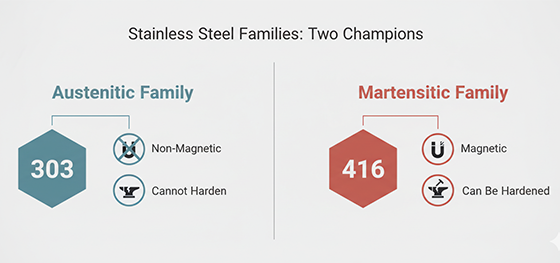
The first thing to understand is that 303 and 416 are not close relatives. They come from two different branches of the stainless steel family tree.
303 belongs to the "Austenitic" family, along with its cousin 304. Austenitic steels are defined by their high chromium and nickel content. They are non-magnetic and cannot be hardened by heat treatment. Their strength comes from their inherent toughness.
416 belongs to the "Martensitic" family, along with cutlery grades like 420. Martensitic steels have high carbon and chromium content, but very little nickel. They are magnetic. And, most importantly, they can be hardened to very high levels through heat treatment.
Both have been given the "free-machining" superpower by adding sulfur, but their core personalities remain completely different.
Round 1: The Race for Speed - Machinability
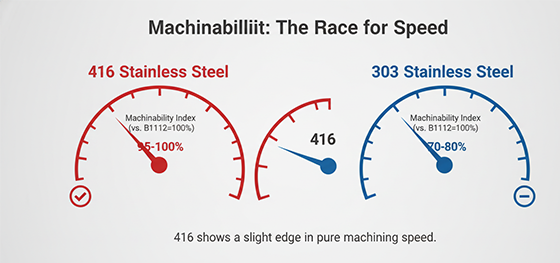
In the race for pure cutting speed, both materials are incredibly fast. The added sulfur in both alloys acts as a chip breaker, allowing for much higher machining speeds and longer tool life compared to their non-free-machining cousins.
However, if we must declare a winner, the crown for the "most machinable of all stainless steels" often goes to 416.
Its martensitic structure, combined with the sulfur, often produces even finer, more brittle chips than 303. This allows for slightly higher speeds and an even better surface finish directly off the machine. But it is a very close race. Both are champions of efficiency in any stainless steel cnc machining operation.
Winner: 416 Stainless Steel (by a nose).
Round 2: The Test of Strength - Hardness
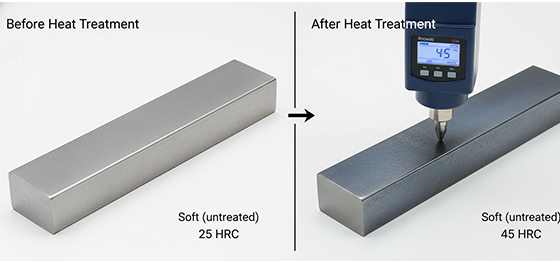
This is where the family difference becomes a massive factor. This round is not a close race.
303 stainless steel, as an austenitic grade, cannot be significantly hardened by heat treatment. Its strength and hardness are fixed.
416 stainless steel, as a martensitic grade, is a completely different story. It can be heat-treated (quenched and tempered) to a wide range of hardness levels. It can achieve a hardness of up to 40 HRC. This is significantly harder than 303.
This makes 416 the clear winner for any free-machining part that also requires high strength, hardness, and wear resistance, such as valve components, gears, or shafts.
Winner: 416 Stainless Steel, by a knockout.
Round 3: The Shield - Corrosion Resistance
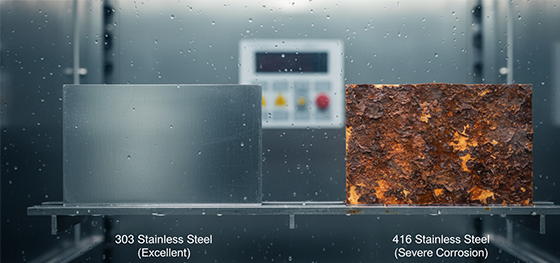
Now, the final and most critical round for many applications. How well do these materials resist the elements?
Here, the tables are completely turned. 303 stainless steel, with its high chromium and nickel content, has good overall corrosion resistance. It is suitable for most atmospheric conditions and can handle many mild chemicals.
416 stainless steel, on the other hand, has significantly lower corrosion resistance. Its lower chromium content and lack of nickel make it much more susceptible to rust, especially in humid or marine environments. While it is "stainless," it is at the very bottom of the ladder in this category. For it to survive, it often needs a protective coating or must be kept well-oiled.
| Factor | 303 Stainless Steel | 416 Stainless Steel |
|---|---|---|
| Family | Austenitic (Non-Magnetic) | Martensitic (Magnetic) |
| Machinability | Excellent | Superior |
| Can be Hardened? | No | Yes (Up to ~40 HRC) |
| Corrosion Resistance | Good | Poor (for a stainless steel) |
Winner: 303 Stainless Steel, by a huge margin.
The choice in the 303 vs 416 stainless steel battle is a choice of priorities. You must ask: "What is more important for my part: hardness or corrosion resistance?" If you need a hard, strong, magnetic part and corrosion is not a major concern, 416 is the clear winner. If you need good corrosion resistance and do not need to harden the part, 303 is the safer, more reliable choice.

