


In the world of high-performance stainless steels, two champions stand apart from the rest. They are not rivals in the same weight class. They are champions of two completely different sports.
One is a heavyweight powerlifter, capable of bearing immense loads. The other is an impenetrable fortress, capable of withstanding the most aggressive chemical attacks.
This is the ultimate showdown: 17-4 ph stainless steel vs 316. Choosing between them is not about finding which is "better." It is about understanding which champion's unique talent your project truly needs to survive.
content:
Meet the Warrior: 17-4 PH Stainless Steel
Meet the Guardian: 316 Stainless Steel
The Head-to-Head Battle: Strength vs. Defense
Your Partner in a High-Stakes World
Meet the Warrior: 17-4 PH Stainless Steel

17-4 PH is the warrior of the stainless world. Its defining characteristic is its incredible strength.
It is a precipitation-hardening (PH) martensitic stainless steel. This complex metallurgy, which involves a special heat treatment process, allows it to achieve a yield strength that is three to four times higher than 316. Its strength is in the same league as some high-strength alloy steels.
This makes it the undisputed champion for high-stress structural applications that also require good corrosion resistance. You will find it in the most demanding places: aircraft landing gear components, high-pressure valve bodies in the oil and gas industry, and shafts for naval vessels. When a part simply cannot be allowed to bend or break under extreme load, 17-4 PH is the answer.
Meet the Guardian: 316 Stainless Steel

If 17-4 PH is the warrior, then 316 is the guardian. Its defining characteristic is its ultimate defense against corrosion.
It is an austenitic stainless steel. Its strength is much lower than 17-4 PH. But its secret weapon is a higher nickel content and the addition of molybdenum. This combination gives its passive protective layer a superior ability to withstand attack from chlorides.
This makes 316 the undisputed champion for applications in the most corrosive environments. It is the gold standard for medical implants, where it must survive for decades inside the human body. It is essential in the pharmaceutical and chemical processing industries, for any component that will be in contact with aggressive chemicals. And it is the "marine grade" standard for any hardware that will be exposed to saltwater. When preventing corrosion is the number one priority, 316 is the ultimate guardian.
The Head-to-Head Battle: Strength vs. Defense
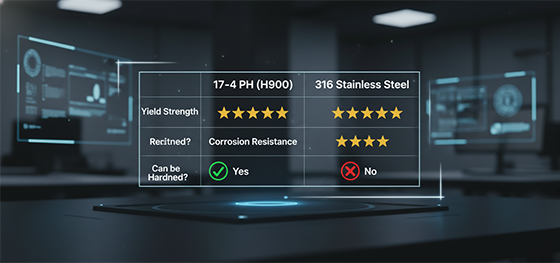
Let's put the two champions side-by-side.
| Factor | 17-4 PH Stainless Steel (H900) | 316 Stainless Steel |
|---|---|---|
| Superpower | Extreme Strength & Hardness | Ultimate Corrosion Resistance |
| Yield Strength | ~1170 MPa (Extreme) | ~241 MPa (Good) |
| Heat Treatable? | Yes | No |
| Magnetic? | Yes | No |
| Best For | Aerospace Structures, High-Load Shafts | Medical Implants, Marine Hardware |
The choice becomes very clear. You are not choosing which is "better." You are choosing which superpower is essential for your part's survival. A highly stressed aircraft part does not need the ultimate corrosion resistance of 316. A medical implant does not need the ultimate strength of 17-4 PH. They are specialists for different battles.
Your Partner in a High-Stakes World
The worlds of aerospace and medical devices are high-stakes environments. They are governed by strict quality standards like IATF 16949 and ISO 13485.
Working with these advanced materials is about more than just having the right CNC machine. It is about having a quality system that can provide the documentation, traceability, and process control that these industries demand.
At JUCHENG, our certifications are your guarantee that we understand these worlds. We have the expertise in stainless steel cnc machining for both of these champion alloys. We can help you analyze the specific demands of your project.
We can guide you in the critical choice of 17-4 ph stainless steel vs 316. And then we can execute the manufacturing of your part with the precision and quality control that your high-stakes application deserves.

