


Touch a high-end consumer electronic device or the dashboard of a modern vehicle, and you are likely touching Acrylonitrile Butadiene Styrene. In the global 3d printing plastic ecosystem, ABS remains the definitive benchmark for what a functional plastic component should feel like. While newer polymers have flooded the market, abs 3d printing remains the strategic choice for engineers who require a material that balances mechanical toughness with a nearly infinite capacity for secondary finishing. It is the bridge between a raw digital idea and a product that looks like it was born in an injection mold. However, the path to a successful ABS component is fraught with thermal traps; it is a material that demands an environment of absolute temperature stability to prevent the catastrophic warping that plagues standard desktop efforts.
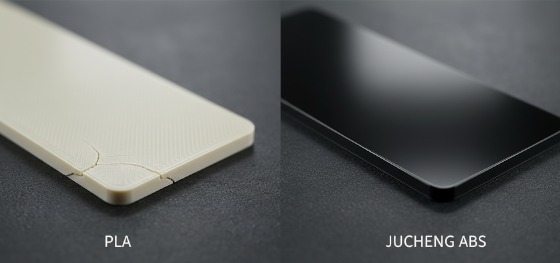
At JUCHENG, we have moved beyond the "hobbyist" limitations of extrusion. We treat ABS as an engineered resin, utilizing industrial-tier FDM platforms that operate within actively heated enclosures. We understand that for a functional prototype, a layer-shift or a weak interlayer bond is more than a cosmetic flaw—it is a structural failure. By controlling the cooling rate of the styrene matrix, we deliver parts that possess the impact resistance needed for real-world drop tests and functional fitment. This guide explores the tri-polymer chemistry of ABS, the tactical advantages of its post-processing flexibility, and why JUCHENG’s expertise in high-performance materials like MJF serves as the essential upgrade path when your designs outgrow the limits of standard filaments.
Efficiency in hardware development is found in the speed of iteration. But speed is useless if the prototype lacks the mechanical fidelity of the final production part. Whether you are building a rugged housing for an industrial sensor or an ergonomic handle for a power tool, the logic of the styrene bond is your greatest asset. Let us examine the technical pillars of industrial ABS and see how JUCHENG transforms filament into functional armor.
Styrene Advantage: Why ABS Feels Like a Product
Thermal Discipline: Preventing the ABS Curl in Industrial Chambers
Post-Processing Potential: Sanding, Painting, and Smoothing
Strategic Pivot: When to Move from ABS to MJF Nylon
JUCHENG’s Functional Standard: Beyond the Desktop Hobbyist
Styrene Advantage: Why ABS Feels Like a Product
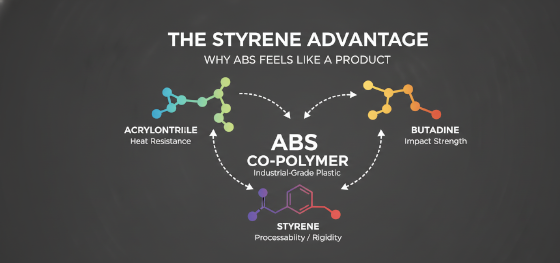
The enduring success of abs 3d printing is rooted in its unique tri-polymer chemistry. Most 3D printing filaments are single-monomer plastics, but ABS is a complex blend of Acrylonitrile, Butadiene, and Styrene. Each component brings a specific mechanical superpower to the build plate. Acrylonitrile provides the chemical and thermal resistance needed to survive industrial environments. Butadiene acts as the "rubber" within the matrix, offering high impact strength and the ability to absorb shocks without cracking. Styrene provides the rigid, glossy finish that makes the part aesthetically viable.
When these three elements work together in an industrial extrusion cycle, the result is a part that feels "real." Unlike the chalky texture of PLA or the waxy feel of Polypropylene, ABS parts have a hard, dense tactile response that consumers associate with high-quality products. At JUCHENG, we leverage this "Styrene Advantage" to produce enclosures and housings that feel like final parts. The material's balanced modulus ensures that internal mounting bosses and screw threads remain structurally stable under torque. By choosing the right ABS grade—ranging from high-impact to high-heat formulations—we ensure that your 3D printing materials choice doesn't just satisfy a visual check, but survives the functional rigor of your assembly line.
Thermal Discipline: Preventing the ABS Curl in Industrial Chambers
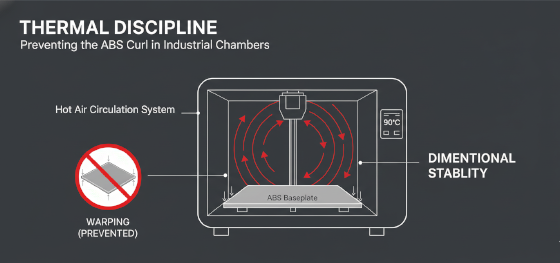
The greatest technical challenge of ABS is its high coefficient of thermal expansion. In a standard office environment, an ABS print is a disaster waiting to happen. As the molten plastic leaves the 240°C nozzle and hits the 25°C air, it shrinks violently. This contraction creates internal leverage that pulls the corners of the part upward—the infamous "ABS curl." If the part doesn't warp off the bed, it will likely develop microscopic delamination between layers, creating hidden weak spots that lead to failure under stress.
Jucheng Precision solves this through "Thermal Sovereignty." Our industrial FDM centers utilize sealed, actively heated build chambers that maintain a constant temperature near 90°C. This keeps the plastic in a relaxed, "annealed" state throughout the entire build process. By minimizing the temperature difference between the nozzle and the atmosphere, we ensure that the layers bond at a molecular level, creating a structural solid rather than a stack of glued strings. This environmental control allows JUCHENG to produce large-scale ABS components—up to 400mm or more—with a flatness and dimensional accuracy that simple heated-bed machines can never duplicate. We don't fight the physics of shrinkage; we engineer a sanctuary where it is neutralized.
Post-Processing Potential: Sanding, Painting, and Smoothing
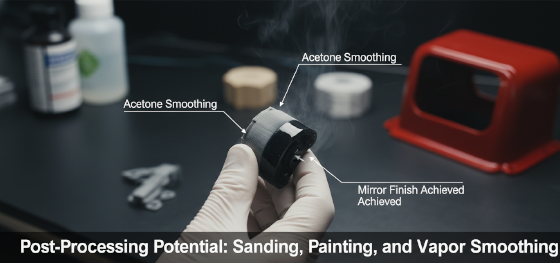
A raw 3D print is rarely the final stop for a consumer-facing prototype. This is where abs 3d printing truly outperforms every other FDM material. Because ABS is soluble in acetone and other common solvents, it offers a level of surface refinement that is unique in the 3d printing plastic world. At Jucheng Precision, we operate a dedicated finishing lab to transform raw extrusions into high-fidelity mockups.
Our finishing workflow includes "Solvent Vapor Smoothing," where the ABS part is exposed to a controlled mist that melts the outer few microns of the skin. This erases the layer lines completely, resulting in a glossy, injection-molded look in minutes. Furthermore, ABS is an exceptionally receptive substrate for paints and primers. We can achieve everything from a soft-touch matte finish to a high-gloss metallic coat that perfectly matches your RAL or Pantone specifications. We also utilize ultrasonic welding and high-strength adhesives to join large ABS sections together, creating monolithic prototypes that are structurally sound. By treating the print as a "preform" rather than a finished object, JUCHENG delivers parts that are ready for the boardroom or the trade show floor, hiding the evidence of additive manufacturing beneath a professional facade.
Strategic Pivot: When to Move from ABS to MJF Nylon
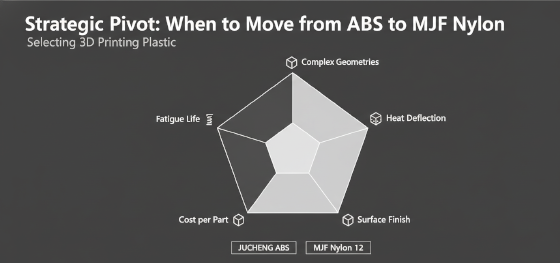
Choosing a manufacturer is a move of technical trust. While abs 3d printing is the king of cost-effective prototyping, it has physical limitations. ABS is an amorphous plastic; it is prone to fatigue failure over millions of cycles and can become brittle when exposed to certain industrial chemicals. At Jucheng Precision, we are honest with our clients: when your design moves past the "visual fitment" stage and into "extreme mechanical endurance," it is time to pivot your technology choice.
| Performance Metric | ABS (FDM) | MJF Nylon 12 |
|---|---|---|
| Tensile Strength | ~30-35 MPa | ~48-50 MPa |
| Isotropic Strength (Z-Axis) | Low (Layer-dependent) | Very High (Isotropic) |
| Heat Deflection (0.45MPa) | ~90°C | ~175°C |
| Feature Resolution | Standard | High / Intricate |
For parts requiring airtight seals, complex internal fluid channels, or living hinges, we frequently recommend upgrading to our MJF 3D Printing line. MJF uses Nylon 12 powder fused with infrared energy, resulting in isotropic parts that are 100% dense and functionally invincible. We help you perform this "Material Audit" during our DFM review, ensuring you don't over-invest in MJF for a simple enclosure, but also don't risk failure by using ABS for a high-torque gear. Our integrated shop provides both paths, managed by engineers who prioritize your part's survival over process convenience.
JUCHENG’s Functional Standard: Beyond the Desktop Hobbyist
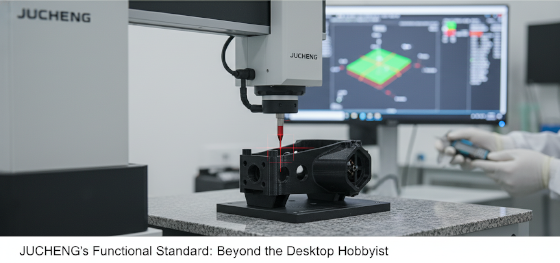
The final hallmark of a professional manufacturing partner is the ability to scale. Most bureaus treat ABS as a "cheap" material and cut corners on inspection. Jucheng Precision operates with a different technical rigor. We treat every abs 3d printing order with the same quality framework as our 5-axis CNC department. We utilize in-process monitoring to ensure extrusion consistency and perform 100% visual inspection on every part.
Our facility is equipped with large-format CMMs and laser scanners to verify that your complex geometries match the digital master. We provide full material traceability and certificates of conformance, giving our medical and automotive clients the documentation needed for strict regulatory audits. When you partner with JUCHENG, you are getting more than just a plastic part; you are getting the benefit of optimized thermodynamics and industrial-scale capacity. Whether you are building the first iteration of a new consumer appliance or a production run of functional jigs for an assembly line, our ABS protocols ensure your vision is delivered with absolute precision. Contact Jucheng Precision today for a comprehensive DFM review and see how our industrial extrusion expertise can clarify and elevate your next manufacturing challenge.

