


Safety in the stratosphere is not a variable; it is a hard-coded technical requirement. When an aircraft interior component or an under-the-hood automotive bracket is designed, the primary fear is not just structural failure, but the danger of fire. In the vast catalog of the 3d printing plastic industry, most materials are essentially fuel. They melt, burn, and emit toxic fumes. There is, however, an elite exception that bridges the gap between plastic versatility and aerospace survival. This is the sophisticated world of ultem 3d printing. Polyetherimide (PEI), known by the brand name Ultem, is a high-performance amorphous thermoplastic that offers an incredible strength-to-weight ratio combined with inherent flame retardancy. It is the only additive material that allows engineers to move from a digital mock-up directly to a flight-certified, end-use component.

At JUCHENG, we recognize that printing with high-heat resins like Ultem is a move into a high-liability manufacturing tier. You cannot achieve the necessary molecular bonding of PEI on a standard desktop machine. If the build chamber is not actively heated to extreme levels, the part will suffer from catastrophic warping and "internal delamination" that isn't visible until the part fails under load. We have engineered our additive facility to satisfy the rigorous demands of the aerospace and defense sectors, utilizing industrial-grade FDM systems that maintain thermal sovereignty over the entire build volume. This guide moves past the basic definitions to explore the chemistry of FST compliance, the mechanical divide between Ultem 9085 and 1010, and why JUCHENG’s integrated approach to high-temperature extrusion is the final step in ensuring your critical designs survive the heat of the real world.
Reliability in extreme environments is found in the management of the thermal shock. You aren't just stacking layers of resin; you are managing a phase-change event at 400°C that must result in a stable, monolithic solid. Whether you are building a lightweight air duct for a satellite or a high-voltage electrical connector, the logic of the melt is your greatest engineering asset. Let us examine the technical pillars of industrial Ultem extrusion and see how JUCHENG locks the integrity of your most ambitious designs into reality.
Thermal Sovereignty: The 180°C Chamber Requirement
Material Selection: Deciphering 9085 vs. 1010 Logic
FST Sovereignty: Why Aerospace Relies on PEI Chemistry
Precision Overhangs: Managing Soluble Support in High Heat
JUCHENG’s Certification Standard: Beyond the Spindle
Technical Data: Ultem Mechanical Property Baseline
Thermal Sovereignty: The 180°C Chamber Requirement

The primary enemy of high-performance extrusion is the temperature gradient. When you melt Ultem filament at 360°C and extrude it into an uncontrolled environment, the material experiences immediate thermal shock. Amorphous resins like PEI have a high glass transition temperature (Tg) of approximately 186°C. If the ambient air around the part is cooler than this threshold, the polymer chains freeze instantly, preventing them from bonding with the next layer. This results in parts that are visually correct but structurally "delaminated"—they will split apart along the layer lines the moment they are subjected to torque or vibration.
At JUCHENG, we eliminate this mechanical vulnerability through absolute thermal sovereignty. Our industrial FDM platforms utilize actively heated build chambers that maintain a constant 180°C environment. This keeps the entire part in a semi-relaxed state during the hours-long build cycle. By maintaining this elevated temperature, we ensure that the interface between layers remains chemically active, allowing for the maximum possible cross-linking across the Z-axis. This thermal discipline is the only way to achieve the +/- 0.15mm tolerances required for aerospace interior components. We don't just "print" Ultem; we manage a slow, controlled cooling event that locks in the dimensional accuracy and structural homogeneity your designs demand. This technical rigor is what separates industrial ultem 3d printing from hobbyist-level failures.
Material Selection: Deciphering 9085 vs. 1010 Logic

Choosing the right grade of Ultem is an exercise in engineering trade-offs. While both materials are built on the PEI molecule, they are optimized for different "theaters of war." Ultem 9085 is the undisputed champion of the aerospace cabin. It is a blended resin that offers high ductility and impact strength. If an aerospace bracket needs to survive a violent vibration or a sudden impact without shattering into dangerous shards, 9085 is the material of choice. Its superpower is its toughness; it bends and deforms slightly before it ever breaks, providing a safety margin that brittle materials cannot offer.
Ultem 1010 is the athlete of pure heat and chemical resistance. It is an unblended, high-purity PEI resin that offers the highest tensile strength and heat deflection temperature in the FDM family. If your part is a food-processing manifold that must endure high-pressure steam cleaning, or an automotive engine housing that sees constant 200°C temperatures, 1010 is the only logical choice. However, 1010 is significantly more brittle than 9085; it behaves more like a glass-filled polymer. At JUCHENG, we help our clients audit their load cases. We don't just look at the melting point; we look at the fatigue cycle. By matching the specific grade of Ultem to the structural destiny of your part, we ensure your 3d printing materials strategy is as precise as your engineering drawings.
FST Sovereignty: Why Aerospace Relies on PEI Chemistry
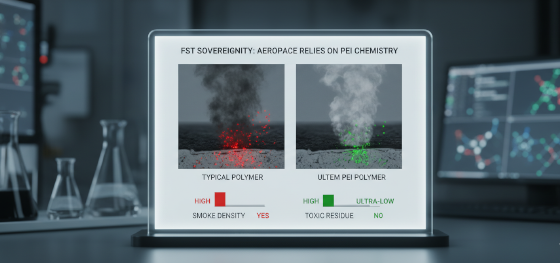
In the aerospace and defense world, "performance" is secondary to "compliance." The ultimate gatekeeper for aircraft interior parts is the FST protocol: Flame, Smoke, and Toxicity. If a component is placed inside a pressurized cabin, it must prove that it will not contribute to a fire and, more importantly, that it won't emit toxic gases that could incapacitate passengers. This is where ultem 3d printing earns its stay. Ultem resins are inherently flame-retardant. They do not require the addition of halogenated additives—which are themselves toxic—to reach a UL94 V-0 rating.
When exposed to direct flame, Ultem forms an insulating "char" layer that prevents the fire from spreading. Its smoke emission is exceptionally low, and its toxicity profile meets the most stringent FAA and EASA standards. At JUCHENG, we treat FST compliance as a manufacturing baseline. We provide full material traceability and certificates of conformance for every aerospace order, ensuring that the 9085 parts we ship are documented survivors. This chemical safety, combined with the lightweight nature of the polymer, allows us to replace heavy aluminum air ducts and junction boxes with topologically optimized Ultem parts, shaving kilograms off an aircraft’s weight while increasing the overall safety of the vehicle.
Precision Overhangs: Managing Soluble Support in High Heat

Complexity in 3D printing is often limited by the ability to remove the scaffolding that holds it up. In the 400°C nozzle environment of an Ultem print, standard breakaway supports are a nightmare. They bond too tightly to the part, leaving behind ugly surface scars that require hours of manual sanding. To solve the riddle of internal channels and complex undercuts, Jucheng Precision utilizes specialized **High-Temperature Soluble Support** materials. These are engineered polymers that can withstand the 180°C chamber temperature without melting, yet dissolve completely in a specialized chemical bath after the print is finished.
This "hands-off" support removal is vital for functional parts like lightweight air manifolds or medical instrument housings with internal electronics bays. It ensures that the internal surfaces are as smooth and precise as the exterior ones. By utilizing dual-extrusion technology, we can print geometries that are physically impossible to de-mold in traditional casting. This freedom allows our clients to design for "Laminar Flow" or "Structural Efficiency" without worrying about tool access. Our mastery of support chemistry ensures that your most intricate internal visions are realized without the manufacturing scars of manual intervention, delivering a level of geometric fidelity that defines world-class 3d printing plastic production.
JUCHENG’s Certification Standard: Beyond the Spindle

Choosing a partner for high-stakes polymers is a decision of technical liability. At Jucheng Precision, we operate a facility that is ISO 9001 and ISO 13485 certified, with IATF 16949-aligned process controls. We understand that for an automotive EV battery enclosure or a medical surgical robot component, "guessing" the material strength is not an option. Our ultem 3d printing protocol includes "Layer-by-Layer Verification." We utilize in-process monitoring to detect any extrusion variations that could indicate an internal void.
We also manage the "Hygroscopic Threat." Ultem resin is extremely sensitive to moisture. If the filament is not dried to a -40°C dew point before it enters the nozzle, the water molecules will turn to steam inside the part, creating microscopic "bubbles" that destroy the part's tensile strength. JUCHENG maintains a closed-loop dry-air system from the material dryer directly to the machine's sealed intake. This ensures that the material we print is as pure as the day it was synthesized. When you receive a shipment from JUCHENG, you aren't just getting 3D prints; you are getting verified engineered solutions. We provide the documentation, the precision, and the material science to ensure your next breakthrough survives the most hostile environments.
Technical Data: Ultem Mechanical Property Baseline
To finalize your design-for-manufacturing review, Jucheng Precision provides the following mechanical baseline for our industrial-grade Ultem components. These values reflect parts produced in our stabilized thermal environments.
| Property | Ultem 9085 (Aerospace) | Ultem 1010 (High Temp) |
|---|---|---|
| Tensile Strength (XY) | ~70-75 MPa | ~80-85 MPa |
| Heat Deflection (HDT) | 153°C | 216°C |
| Elongation at Break | ~6.0% (Ductile) | ~3.0% (Brittle/Stiff) |
| FST Rating | Full Aerospace Compliance | High (UL94 V-0) |
| Ideal Use Case | Cabin Interiors, Brackets | Engine Zones, Molds |
Success in the modern market requires the ability to replace metal with high-performance plastics without sacrificing safety. JUCHENG’s expertise in 3D printing materials ensures that your designs are not just realized, but verified for flight. Contact our engineering team today for a comprehensive technical review and see how our Ultem protocols can armor your next industrial project.

